MUS2026-223 - museum specimen
Broome bullroarer with its cord
Broome, West Kimberley district, Western Australia
Restricted
Source term: bullroarer or tjuringa (churinga)
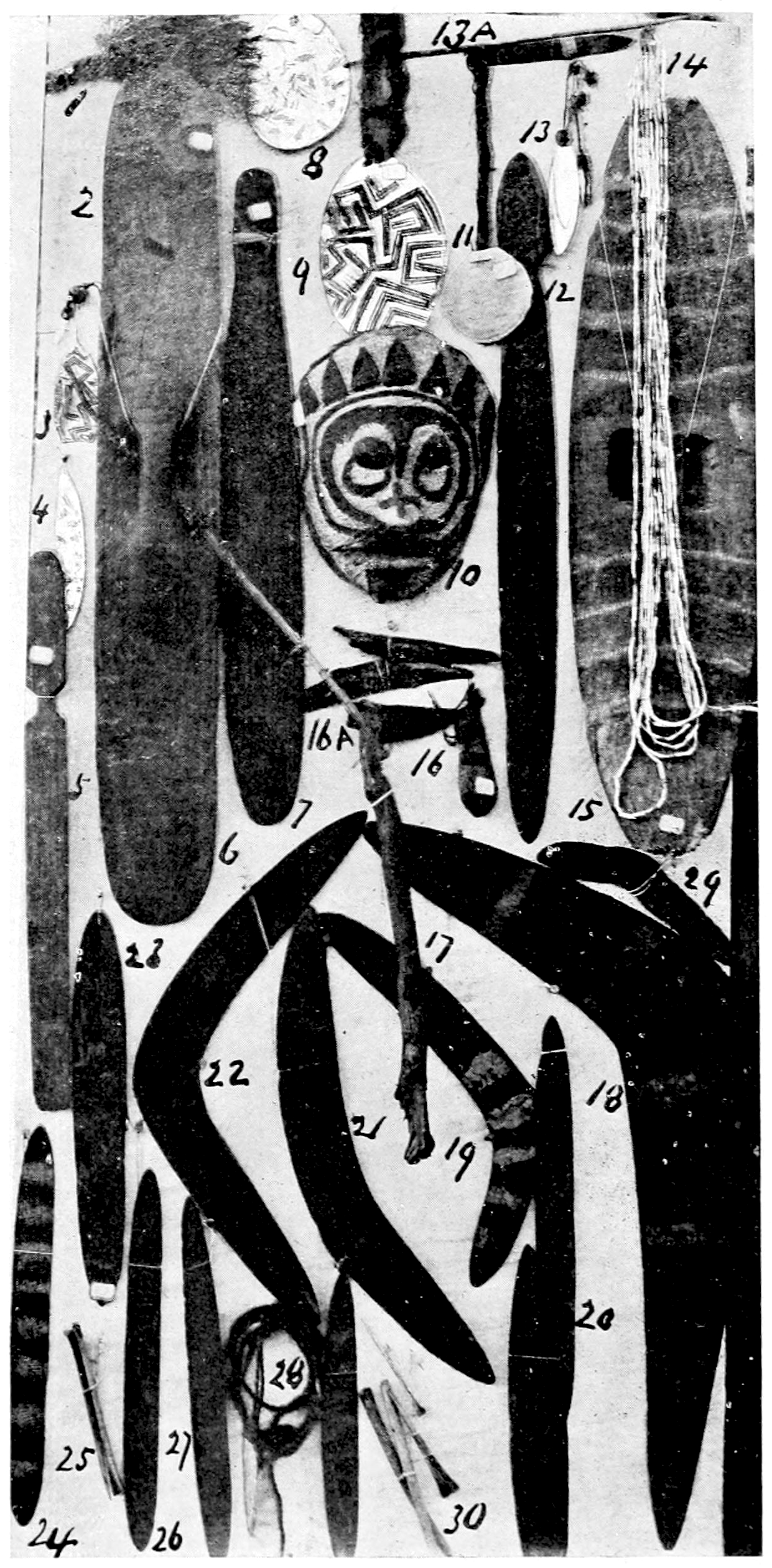
A small wooden blade, carved on both faces with the design of a totemic ancestor, and still strung with its cord. It was gathered at Broome in 1914 and reached Cambridge the following year. The cord is what matters: many blades reach museums stripped of their rigging, leaving the question of how they were used to be argued from shape alone. This one arrived ready to swing.
Small, wooden bullroarer or tjuringa (churinga), with both faces inscribed with sacred designs, which represent a totemic ancestor. A cord is attached.
Museum of Archaeology and Anthropology, University of Cambridge, catalogue description for accession E 1915.20.3
- Object
- A small wooden blade with both faces inscribed with sacred designs representing a totemic ancestor, with a cord attached.
- Function
- The museum records the object as a churinga carrying sacred designs and notes that churinga with a hole bored in one end for a cord are called bullroarers and produce a characteristic sound when whirled; women and uninitiated boys are recorded as forbidden to see churinga.
- Source
- Museum of Archaeology and Anthropology, University of Cambridge, accession E 1915.20.3 (also MAA: AR 1915.290.3). Description: "Small, wooden bullroarer or tjuringa (churinga), with both faces inscribed with sacred designs, which represent a totemic ancestor; A cord is attached." Physical description note: "Small, wooden bullroarer, with both faces carved…
- Source location
Page references
MAA E 1915.20.3 (object 492312)
- Source confidence
- medium Broome district anchor, the narrowest locality the museum records, and deliberately close to the Roebuck Bay anchor already used by AUSIN-029 so the district resolves to one place. Neither a collecting spot nor a place of manufacture is recorded, and the record's wider phrase is "Western Kimberley district".
- Forbidden to women