No. PNG98
Elema: General
Papua New Guinea · Gulf · Oceania · Sahul
Restricted
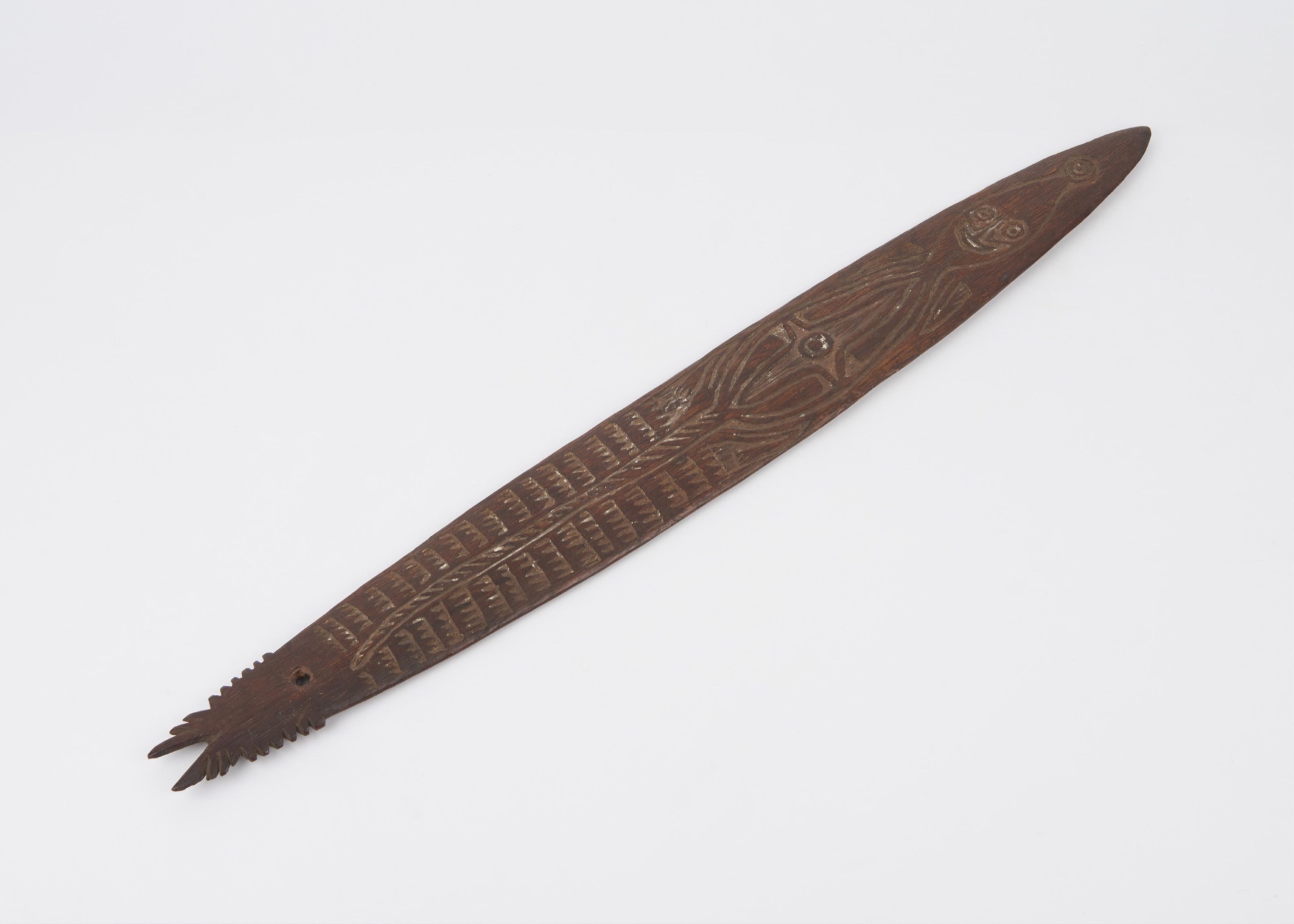
hevehe
hevehe (west) / sevese-semese (east): the Gulf-coast word for the roarer and its whole secret sphere; in Keuru and Opau hevehe is the ordinary word for 'snake', which Williams judges the original sense. The roarer specifically is be'ure hevehe, 'ground-hevehe'. rubu: the central groups' name, 'a word which if repeated rapidly gives a good imitation of the sound'. tiparu: the eastern name (covering bamboo variants too); bukari: 'chief' — the clan owner who controls the instrument, or the instrument itself (Williams 1936b).
Along the Elema coast of the Gulf of Papua, women were told the roaring from the men's houses came from hungry creatures — snakes, lizards, crocodiles — that visited the eravo, howled, and left when fed. At Keuru, where hevehe is the everyday word for snake, the men were said to make them howl by poking their tails with a stick. The great named boards were another matter. Hung in the eravo at initiation, they were never swung, so far as Williams knew; a nervous keeper would speak the names Oro-uravu and Karo-uravu only once, then call them 'two men,' and Williams thought such boards stood for mythical beings still living, whose favour men sought with offerings to prosper their hunting, sago-making and gardens. Authority rode on them too: at the eastern end of the coast each clan's named bull-roarer had its bukari, its 'chief,' who could call up the monster to punish an affront, and it stayed roaring in the village until the offender paid a pig. In the far-east Elema myth the instrument had been the women's first: two women fishing found it in the entrails of the slain crocodile-monster rubu, sounded it, and plotted to frighten the men, until the men captured it and made it their secret. Williams judged the women's ignorance 'fictitious': the Vailala Madness had exposed the roarers outright, yet when Arihava revived the cult in 1930 the women, to whom the instrument 'for the last ten years had been no secret but allegedly a jest,' hid themselves again in their houses or fled into the bush. It was Williams, too, who argued the Papuan administration out of suppressing the cult.
His greatest coup, perhaps, was to prevent the suppression of the 'bull-roarer cult' in the Gulf of Papua.
Michael W. Young, 'Williams, Francis Edgar (1893–1943)', Australian Dictionary of Biography, vol. 12, 1990
Particulars
- Object
- Six Elema blades reached the Penn Museum in Philadelphia in 1912 and 1913. Three differ exactly at the end below the string hole — one ribbed, one notched, one with the rib deliberately left off — and three more carry paint or pigment.
- Function
- Male secret-cult bullroarer of the whole Elema coast: represented to women and the uninitiated as snakes, lizards or crocodiles; sounded at initiation; and at the eastern end each clan's named major roarer is controlled by its bukari (bull-roarer chief), who calls it up to punish affronts until placated with a pig (Williams 1936b).
Source
F. E. Williams, Bull-roarers in the Papuan Gulf, Territory of Papua Anthropology Report 17 (Port Moresby, 1936), repr. in Erik Schwimmer (ed.), Francis Edgar Williams: 'The Vailala Madness' and Other Essays (Honolulu, 1977), pp. 76–115; K. A. Gourlay, Sound-Producing Instruments in Traditional Society: A Study of Esoteric Instruments and Their Role in Male-Female Relations, New Guinea Research Bulletin 60 (Canberra, 1975), Table 1, entry 98, and p. 67; Michael W. Young, 'Williams, Francis Edgar (1893–1943),' Australian Dictionary of Biography, vol. 12 (1990); Penn Museum, Philadelphia, Elema bullroarers P4110 and P4112–P4116