No. AUSIN-016
Murinbata Karwadi Punj ngawuru
Australia · Port Keats · Daly region · Top End
Restricted
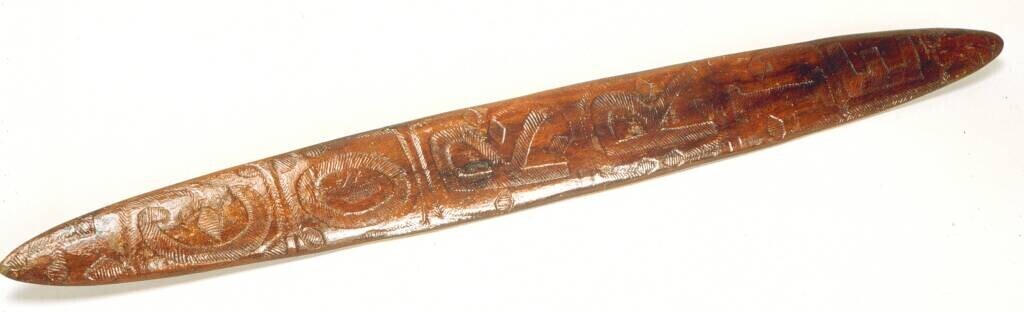
ngawuru / Punj
Source term: ngawuru
ngawuru — the Murinbata bullroarer, emblem of Karwadi (The Mother of All / The Old Woman); Punj is the public name of the ceremony in which it is revealed.
Etymology. Stanner states explicitly that Punj is the public name of the Murinbata bullroarer ceremony, paired with Karwadi as its secret name; and in glossing the title of the initiated men, kadu punj, he translates the element punj as the domain of 'secret, forbidden, dangerous affairs' (with kadu = 'human beings/persons'), so the rite's public name names the secret/forbidden sacred quality itself. The same sense is independently corroborated where Stanner writes that circumcision 'is not Punj, in other words is not a secret, obscure and dangerous thing,' and in the class-compounds mi-Punj ('vegetable food forbidden to initiates'), ku-Punj ('flesh food forbidden to initiates'), and kura-Punj ('ritually dangerous waters').
Among the Murinbata of the Port Keats region, the bullroarer (ngawuru) is the emblem of Karwadi, the secret name of a spirit also called The Mother of All or The Old Woman, and the roaring sound it makes when swung is held to be the sign of her real presence. The anthropologist W. E. H. Stanner, who worked in the Daly River and Port Keats country in the 1930s, described the secret ceremony publicly called Punj as turning on the showing of bullroarers to young men circumcised some years before. The candidates are stripped, made nameless, called ku were ("wild dog," no longer of human flesh), smeared head to foot with blood, and told they will be swallowed alive by Karwadi and then vomited up — the same fate met in myth by Mutjingga, the Old Woman who swallowed ten children before two men speared her, broke her neck, and cut the children living from her belly. At the climax men hidden nearby begin to sound the bullroarers, and as the roar comes nearer the older men cry with well-simulated fear, "Karwadi! Karwadi! The Old Woman is calling." The secret of the supposed voice is then revealed when the swingers spring into view; each youth's prospective brother-in-law rubs a new bullroarer across his bloodied breast and loins and thrusts it between his thighs so that it stands up like an erect penis. Women and children were rigidly excluded from the secret phases on pain of the most severe sanctions.
One man told me that during the blooding he used to feel weak with fear of the unknown, and that his emotional stress was nearly unbearable when the bullroarers began to sound.
Stanner, On Aboriginal Religion (1963; Sydney University Press ed. 2014), p. 8, n. 2
Particulars
- Object
- The Murinbata bullroarer, emblem of the spirit Karwadi.
- Function
- Swung unseen as the voice of Karwadi, then revealed to young men at the Punj rite; the Djamindjung to the south had taught the Murinbata to swing it in place of a humming spear-thrower.
Source
W. E. H. Stanner, On Aboriginal Religion (1963; Sydney University Press ed., 2014), pp. 2-8, 159