No. TORRES-001
Mer rain-making bullroarer (bigo)
Australia · Mer (Murray Island), Eastern Islands, Torres Strait, Queensland · Oceania
Weather / fertility magic
bigo
Meriam Mir name recorded for the bullroarer on Mer (Murray Island); given on the Australian Museum catalogue cards as "bigo (DRM)", the indigenous term supplied by curator David R. Moore. The cognate Western-island (Mabuiag) form is bigu.
Etymology. Bigo is the Meriam Mir word for the bullroarer, glossed in the Cambridge expedition vocabularies as a small bull-roarer and equated with Mabuiag bigu, the deep-noted instrument of the Western Islands. On Mer, Haddon knew it chiefly from the doiom rain-makers' kit and from turtle ceremonies, and by 1898 it survived mainly as a child's toy; nothing further is recorded about the word itself.
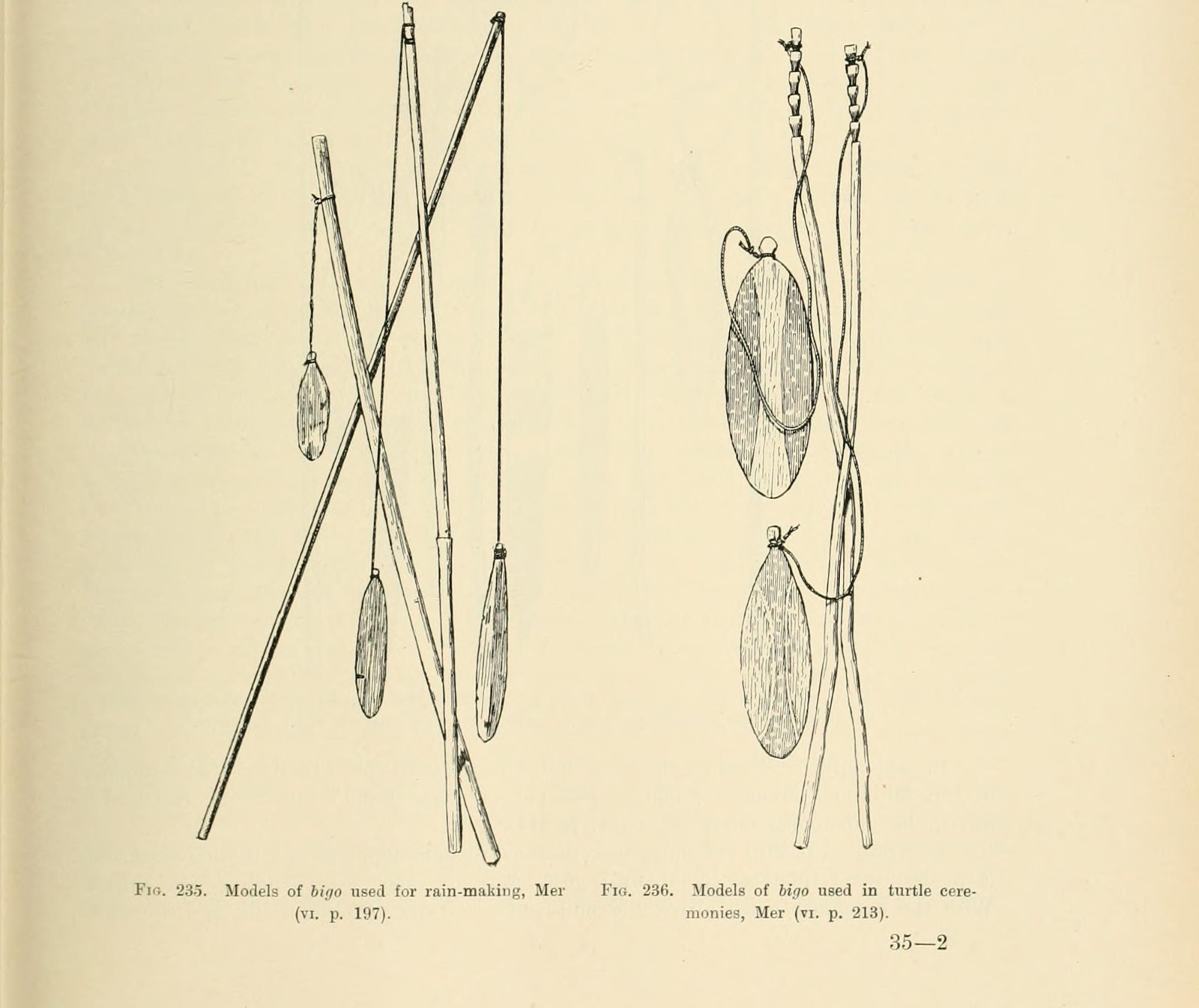
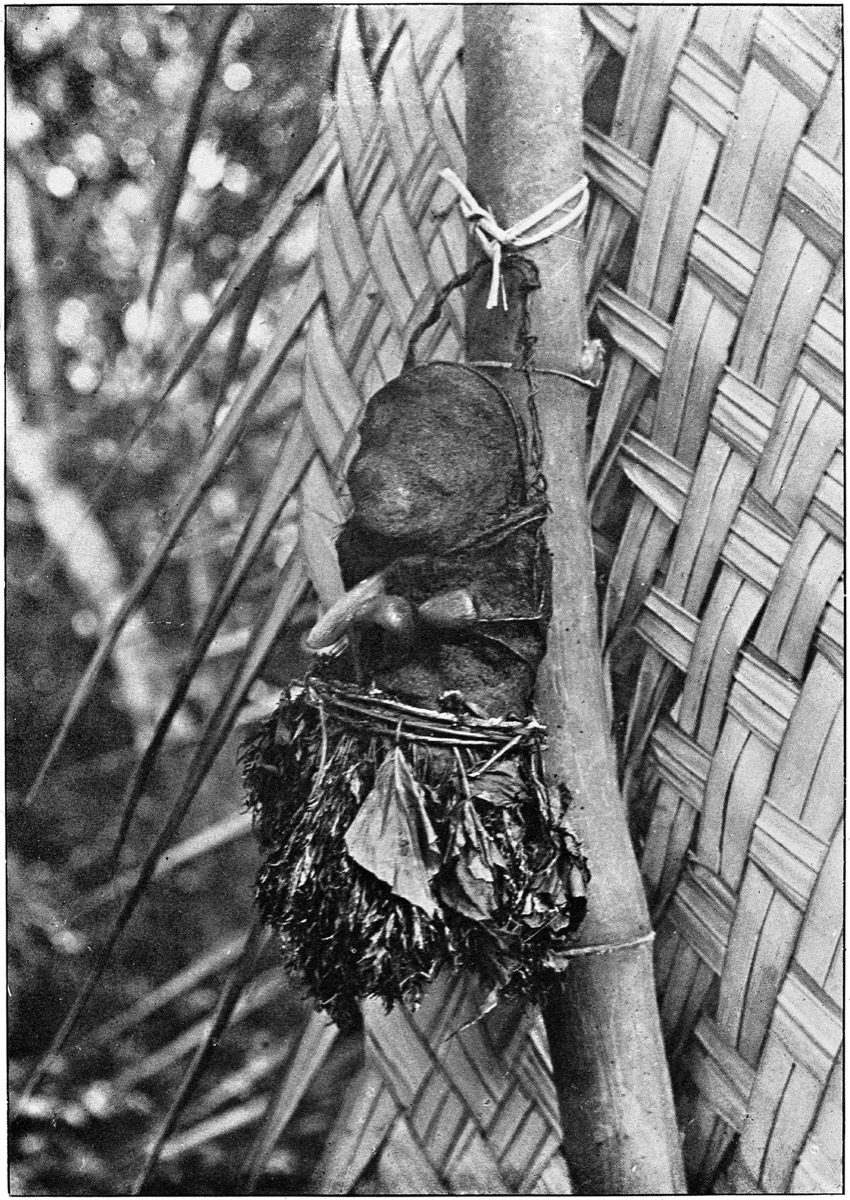
In the Eastern Torres Strait the bullroarer was an instrument of the weather. Every Mer rain-maker owned a doiom — a rudely carved stone man — and each was dressed for work with a small bigo, a bullroarer, hung at its neck on coconut-fibre line. The mightiest had names. Dugena, owned by Gasu, was the strongest of them; its head had snapped off the day Gasu, furious that it brought no rain, dashed it to the ground — he wired it back on, and after selling it to Haddon he 'never ceased regretting its loss.' Working bigo were lanceolate hardwood blades whirled on some two feet of cord knotted to a metre-long stick. The Australian Museum holds two small wooden examples from Mer, collected by Hedley and McCulloch in 1907 — display models mounted to show how cord and handle worked. Where Haddon's western islanders whirled the bigu and wanes for turtle and wind, on Mer the whirled blade was turned to calling the rain.
"Dugena," owned by Gasu … which made very heavy rain with a little thunder
Haddon, Reports of the Cambridge Anthropological Expedition to Torres Straits, vol. VI (1908), p. 195
Particulars
- Object
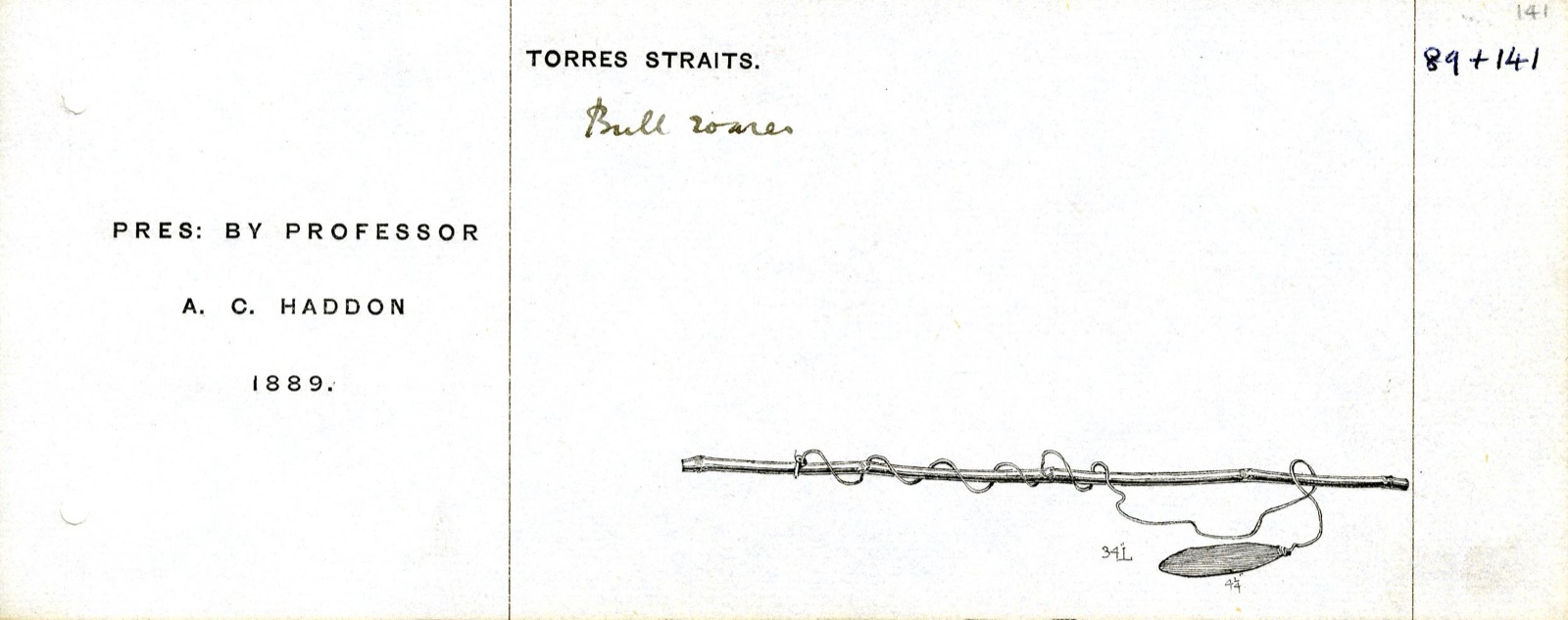
- Two small wooden bullroarers in the Australian Museum. E.17230 is a mounted model carved from softwood with a black band; one end carries a braided palm-fibre cord, the other is fixed to a notched bamboo stick (L 25 cm, W 6 cm). E.17231 is a mounted model carved as a small oval, one end with a knob and plant-fibre cord, the other fixed to a bamboo stick (L 22.5 cm, W 5.7 cm). Both are flat slats whirled on a cord. The British Museum has a complete rig Haddon brought home from his first visit of 1888–89, Oc,89+.141: a flat oval wooden blade the size of a thumbnail, 2.8 centimetres, lashed by cord to a cane stick eighty-five centimetres long. Cambridge holds Haddon's own Mer rig, MAA Z 9702 A: a small pear-shaped blade of brown wood bound to its stick with fine strings of coconut fibre — blade, line and handle together.
- Function
- Whirled in rain-making rituals (weather magic).
Sources
- Florek, Stan. 2005. The Torres Strait Islands Collection at the Australian Museum. Technical Reports of the Australian Museum No. 19, p. 89, catalogue entries 160 (E.17230) and 161 (E.17231). View · archived
- A. C. Haddon (ed.), Reports of the Cambridge Anthropological Expedition to Torres Straits, vol. VI (1908), pp. 194-198 and Pl. VIII fig. 1 View