No. EXH2026-054
Borli/Boli (Waria watershed)
Papua New Guinea · Borli · Boli (Waria watershed) · Oceania
Restricted
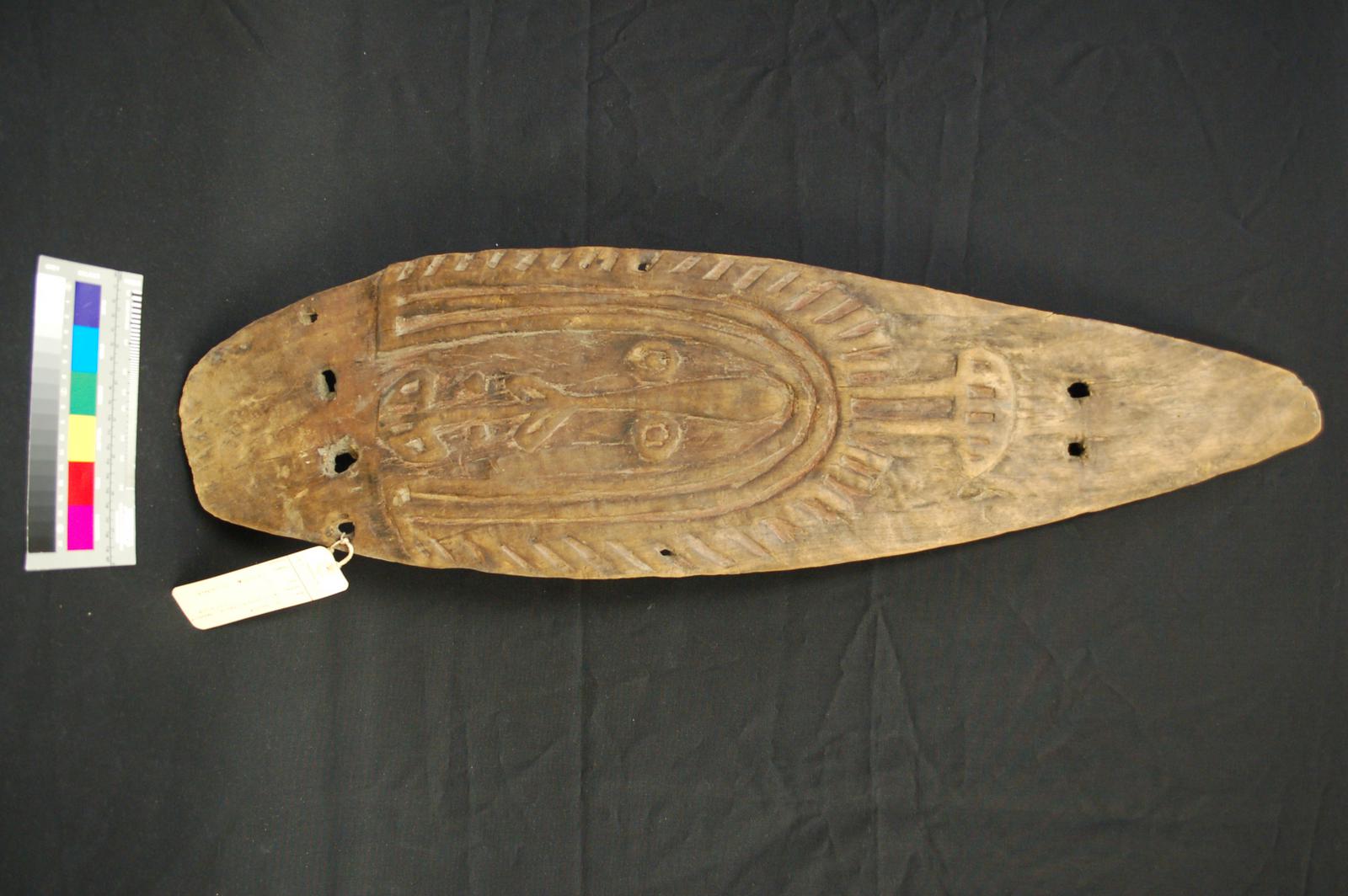
bora
Source term: bullroarer
bora: the bull-roarer; guhu-bora: the initiation house itself, named for the bull-roarer sounded within it.
Etymology. Bora is the Borli name of the bullroarer, and the word runs through the whole initiation vocabulary Haddon reports from Chinnery: the bush seclusion house is the guhu-bora and the initiated men who terrorise the novices are the bora keda. The uninitiated took its sound for the voice of evil spirits in human form; no literal meaning of the word is recorded.
Boys were shut inside the initiation house the Borli called guhu-bora — bora being their own name for the bull-roarer, believed by women and the uninitiated to be the voice of evil spirits appearing in human form. A candidate could not leave except in an elder's company; he could not laugh, for fear a death would follow in his family; and he could not lie down while the bull-roarer sounded, lest his growth be stunted — a rule some got around by slipping to a running stream, where the water's noise covered the drone long enough to eat or drink in peace. Any lapse brought punishment: the elders shut the doors and beat the candidates with sticks and water-filled bamboos that broke and soaked them, and if fear drove a boy to break through the walls into the bush, it was the sound of the bull-roarer itself, they said, that forced him back inside. E. W. P. Chinnery, the patrol officer who had traced the Waria River to its source, set the whole regime down in his report on the Waria, Williams and Bialolo watersheds, published in 1928 as Anthropological Report No. 4 of the Territory of New Guinea; A. C. Haddon had already drawn on the same fieldwork in 1920, eight years before the report itself reached print.
They are forbidden to lie down while the bull-roarer is in action, and even if it commences while they are asleep they must sit upright with head bent lest their growth should be retarded.
E. W. P. Chinnery, Territory of New Guinea Anthropological Report No. 4, Natives of the Waria, Williams and Bialolo Watersheds (1928), pp. 59-61
Particulars
- Object
- Bora bull-roarer of the Borli/Boli initiation-house rites.
- Function
- Voice of evil spirits appearing in human form, sounded at the guhu-bora initiation house; candidates were bound by taboos while it sounded — no leaving without an elder, no laughing, no lying down (lest growth be stunted, evaded by retreating to a running stream), no eating while it roared — with beating for any lapse.
Source
E. W. P. Chinnery, Natives of the Waria, Williams and Bialolo Watersheds, Territory of New Guinea Anthropological Report No. 4 (1928), pp. 59-61; A. C. Haddon, 'Migrations of Cultures in British New Guinea,' Journal of the Royal Anthropological Institute 50 (1920), pp. 249-250 and 268-269