No. EXH2026-024
Boven-Bian Marind (Ezam cult)
Indonesia (Papua) · Upper Bian River, kampong Mandoem, Merauke · Oceania · New Guinea
Restricted
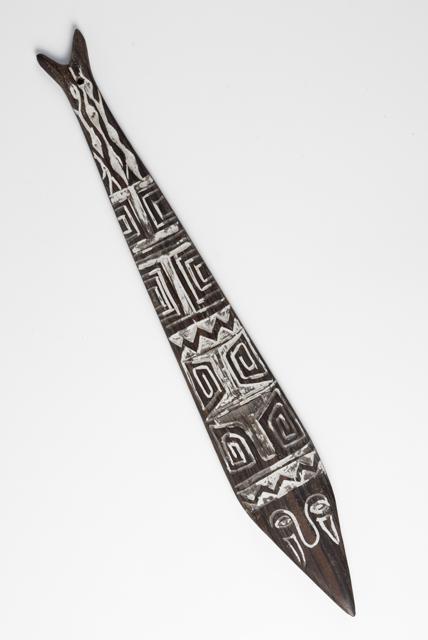
Ezam (the bromhout embodies it)
Source term: bromhout
ezam: among the upper Bian Marind, both the chief spirit ('husband') and the bullroarer that is his voice; the narrower companion bullroarer is the uzum ('wife').
Etymology. Ezam means 'husband': it names both the chief spirit of the cult and the bullroarer that is his voice. It is paired throughout with uzum ('wife') and a third, smaller 'child' bullroarer that has no ritual function.
Among the Marind of the upper Bian River, inland from Merauke, the bullroarer was the voice of Ezam, a dwarfish spirit who emerges from underground once a year at the end of the dry season, when his cult must be celebrated. The instrument bears his very name: ezam means husband, and the fish-shaped wooden blade swung until it growls is the husband — a second, narrower bullroarer is the uzum, his wife. Ndiwa, who made the earth and the sky and the first man and set up the clans, was cutting firewood one day when three chips flew off with a buzzing sound; he took one up, fastened a cord to it, and said, "This is my ezam." Another account adds that the rites belonged first to the women, until one day, with Ndiwa and most of the women away, the men forced their way in, performed the rites themselves, and stole the secret. The bullroarer itself remained a male secret: women were told that to see it was to die on the spot, and youths met it only at initiation, in a silent rite in which an old man simply showed them the instrument. After the rite the collected semen was carried home, drunk or applied to houses, plants and bodies to spread fertility and health through the community. Van Baal and Wirz placed this upper-Bian rite at the western edge of the Sosom complex, which had spread from the east.
The bullroarer, among the eastern coastal Marind the voice of Sosom, the man, among the Boadzi that of the atu, the old woman, is the voice of both Ezam and Uzum among the upper Bian Marind.
J. van Baal, Dema. Description and Analysis of Marind-anim Culture (1966), p. 597
Particulars
- Object
- Fish-shaped wooden blade, painted face at the head, cord through a round hole at the tail fins, whirled in ever-faster rotation. Stichting Papua Erfgoed EA/1001/13 is a Bian Marind ezam of dark wood, 37 × 5 × 1 cm: a fish-tailed blade with a single cord hole at the tail and white-filled carving — scrolls, zigzags, and a pair of eyes at the point — down its face.
- Function
- Voice of Ezam and Uzum in male initiation; ritual semen was taken home for drinking or application to houses, plants, and bodies, and the rites were held to bring fertility and health to the community.
Source
J. van Baal (with J. Verschueren), Dema: Description and Analysis of Marind-anim Culture (South New Guinea) (KITLV Translation Series 9; The Hague: Martinus Nijhoff, 1966), pp. 568-597, esp. pp. 584 and 588; Paul Wirz, Die Marind-anim von Holländisch-Süd-Neu-Guinea (Hamburg, 1922-25); Stichting Papua Erfgoed, object EA/1001/13