No. NGUINEA-005
Sirorata sova, the hooded initiates
Papua New Guinea · Oro Province · Sirorata · Oceania · Sahul
Restricted
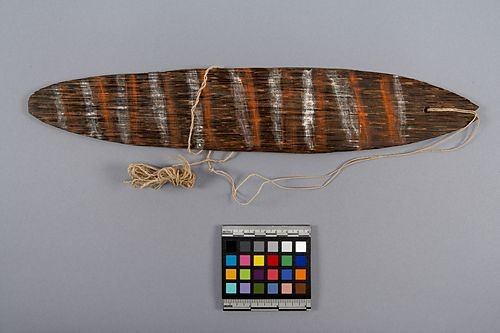
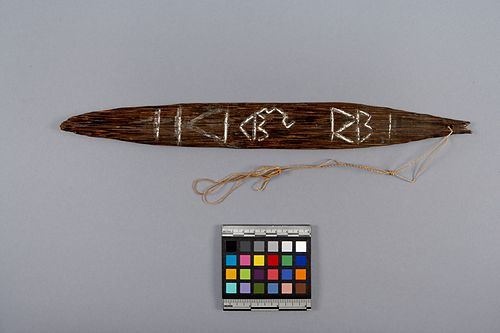
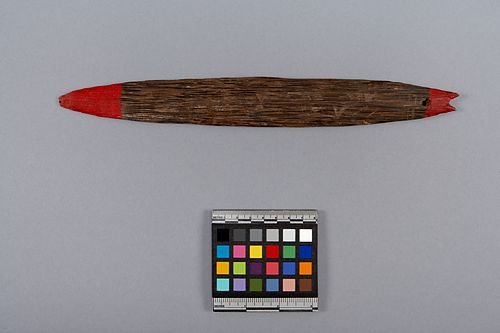
sova
Source term: sova (Bullroarer)
At Sirorata, a Hunjara village in Papua New Guinea’s Oro Province, the bullroarer is called sova: three survive, slim blades of black palm, one still tied to its bark-fibre cord, another painted red at both ends. The general Orokaiva term for the instrument is umbubu, "a thin slat of palm-wood with a hole drilled through one end." F. E. Williams, the government anthropologist of the Orokaiva, recorded an initiation account from the Hunjara’s Koko people: boys and girls sat hooded in bark-cloth while men pulled trees down on long lianas and sounded the bull-roarers, notes running from the deepest bass to a piercing siren-like shriek — to the hooded children the voices of the embahi, spirits of the dead, who gabbled "Kambo, kambo, kambo!" — "Bite, bite, bite!" In the morning the initiates were shown the bull-roarers and flutes that had terrified them overnight. The name sova sits close to sovai, the Orokaiva word for those spirits of the dead — a nearness that goes unexplained.
The bull-roarer and the flute are esoteric objects in that they are never seen but only heard by the uninitiated.
F. E. Williams, Orokaiva Society (1930), p. 277.
Particulars
- Object
- UBC Museum of Anthropology sova, object type Bullroarer; object number 2623/2; place made Papua New Guinea: Oro, Sirorata. Two companion sova from the same donation, 2623/11 and 2623/12, are black-palm blades 38.2 and 31.1 cm long carved with zigzag and X designs; 2623/11 keeps its bark-fibre cord, and both ends of 2623/12 are painted red.
- Function
- An esoteric initiation instrument among the Orokaiva: never seen but only heard by the uninitiated, its booming passed off as the voice of the embahi, spirits of the dead; candidates, boys and girls alike, were brought into its secret.
Sources
- UBC Museum of Anthropology, 2623/2, 2623/11 and 2623/12, sova, Sirorata, Oro Province View · archived
- Tom Dutton, A Checklist of Villages in the Central and South-East of Mainland Papua, Pacific Linguistics B-24 (1973), p. 65 View · archived
- Tom Dutton, Pacific Linguistics B-9 (1969), p. 91 View · archived
- F. E. Williams, Orokaiva Society (1930), pp. 89, 99, 180, 183, 195–196, 266–267, 277 View