No. MUS2026-023
Rirangode, the Masingara Sosom
Papua New Guinea · Western Province (near Daru) · Oceania · Sahul
Restricted
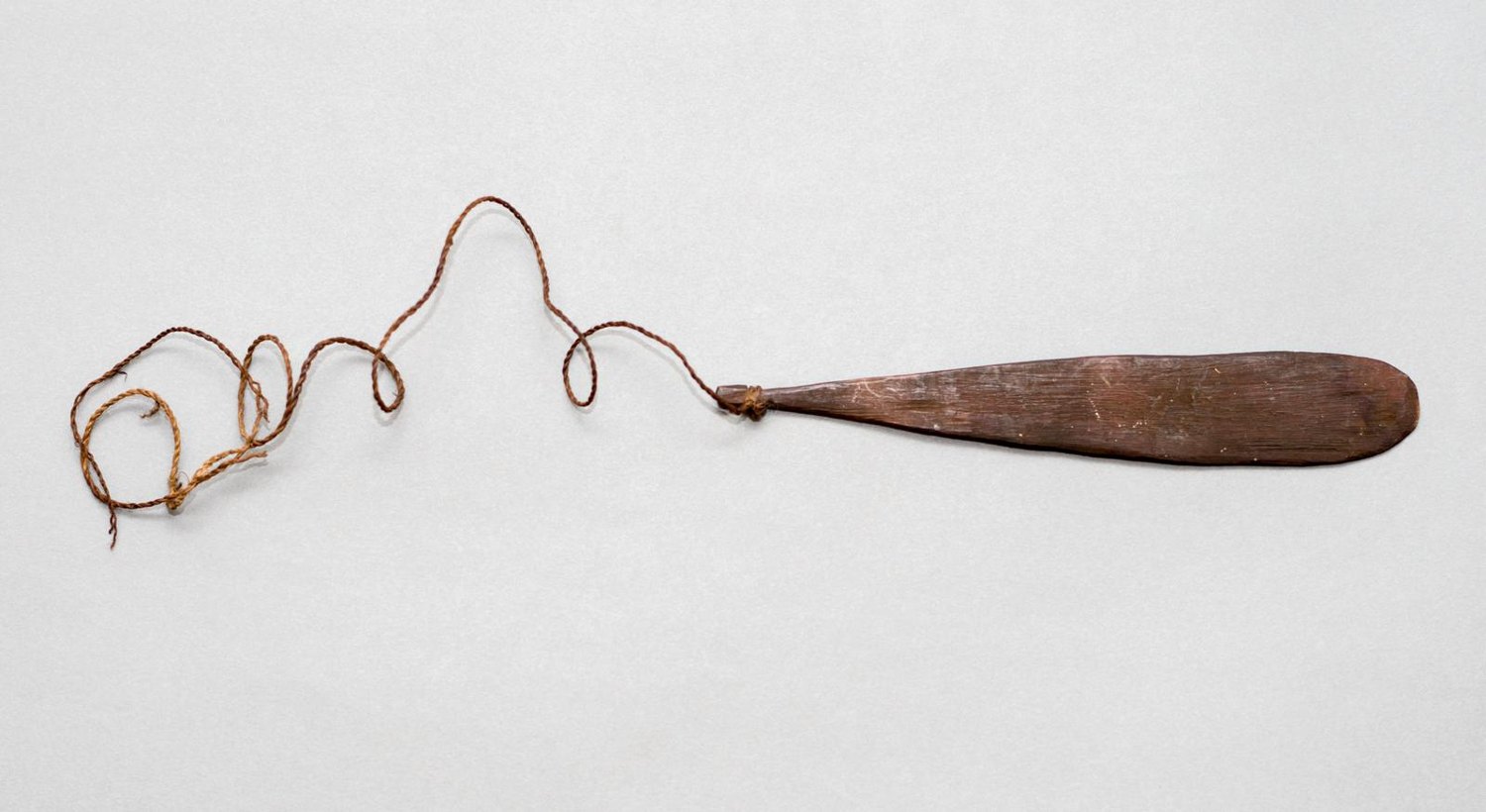
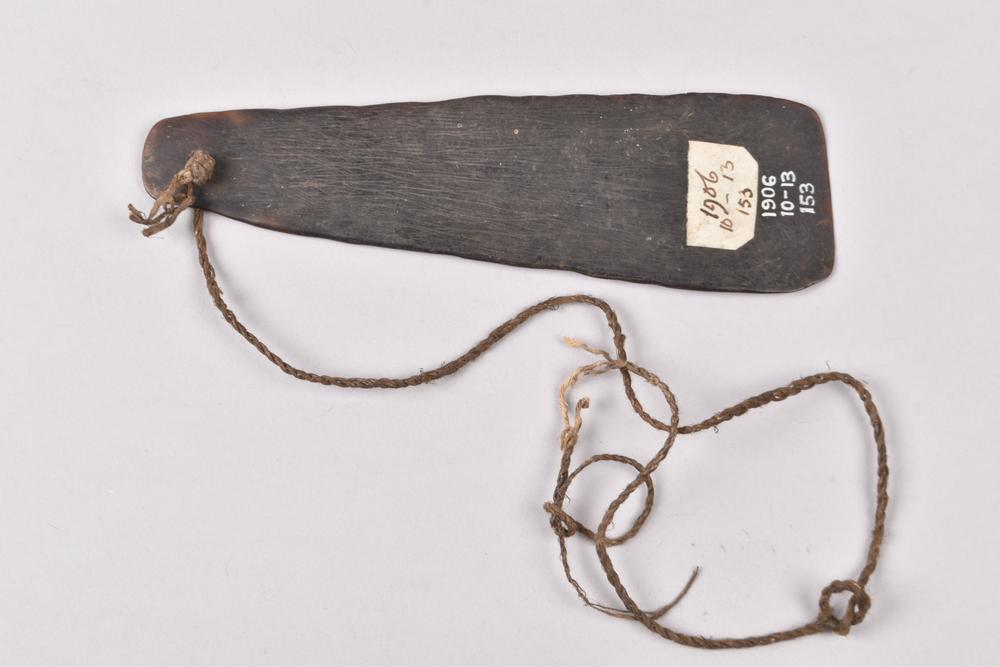
rirangode / erapisa-pisa
Source term: bull-roarer
rirangode / erapisa-pisa: Masingara names for the bullroarer itself, also clan totems; Sosom: its myth-name, shared with a child-eating bush monster of the Masingara initiation festival and with the Marind-anim bullroarer-god to the west; wagra: the general Bine word for the bullroarer; buebue: a children's toy bullroarer made from a coconut leaf.
At Masingara, a bush village behind Mawata in the Bine country of the Trans-Fly, the bullroarer had two working names, rirangode and erapisa-pisa, both also clan totems, and a myth-name, Sosom, shared with a monster of the forest said to eat children at the annual initiation festival. Its coming belongs to the story of Ua-ogrere, a woman who had always existed, never born, who taught the Masingara their houses, their weapons and their ceremonies; in her story the instrument's arrival carries a sodomy-and-growth motif, echoed almost word for word in a neighbouring telling of Kambel and his son Gufa, a wretched, undersized boy who grew to full stature by the same practice. Elsewhere among the Bine the men's roarer is wagra, and children cut a roarer of their own, the buebue, from a coconut leaf and swing it for play.
the bullroarer has the same name (sosom) as that of a mythical monster in the bush... there seems to be a reminiscence of a monster who eats children
A. C. Haddon and C. G. Seligman, reviewing Gunnar Landtman's Masingara fieldwork, Journal of the Royal Anthropological Institute 50 (1920)
Particulars
- Object
- Bull-roarer of the Masingara (Bine), British Museum Oc1906,1013.152.a; its sibling Oc1906,1013.153 is a tapering plate of ground turtleshell, 30 x 4.5 x 1 cm, pierced at the narrow end and strung with twisted plant-fibre cord, with an incised line below the hole. The Bine dictionary of Irukupi village names the bullroarer wagra and a children's coconut-leaf roarer buebue.
Sources
- British Museum, Oc1906,1013.152.a View
- British Museum, Oc1906,1013.153
- Gunnar Landtman, The Folk-Tales of the Kiwai Papuans (1917), p. 77
- Gunnar Landtman, The Kiwai Papuans of British New Guinea (1927)
- A. C. Haddon and C. G. Seligman, review of Landtman, Journal of the Royal Anthropological Institute 50 (1920)
- Nature 108 (1921), account of Landtman’s Masingara material
- Alexander Riesenfeld, The Megalithic Culture of Melanesia (1950)
- F. E. Williams, Papuans of the Trans-Fly (1936)
- Reports of the Cambridge Anthropological Expedition to Torres Straits, vol. I: General Ethnography (1935)
- Christian Döhler, A dictionary of Bine (draft, 2020), Endangered Languages Archive deposit bine-doehler-0471, PDF pp. 20, 52, s.v. buebue and wagra