No. CAPELL1950-001Australia
Djäbulju's galiguru from the south
Australia · Roebuck Bay · Roebuck Plains, south of Broome, West Kimberley, Western Australia
Sacred / spirit
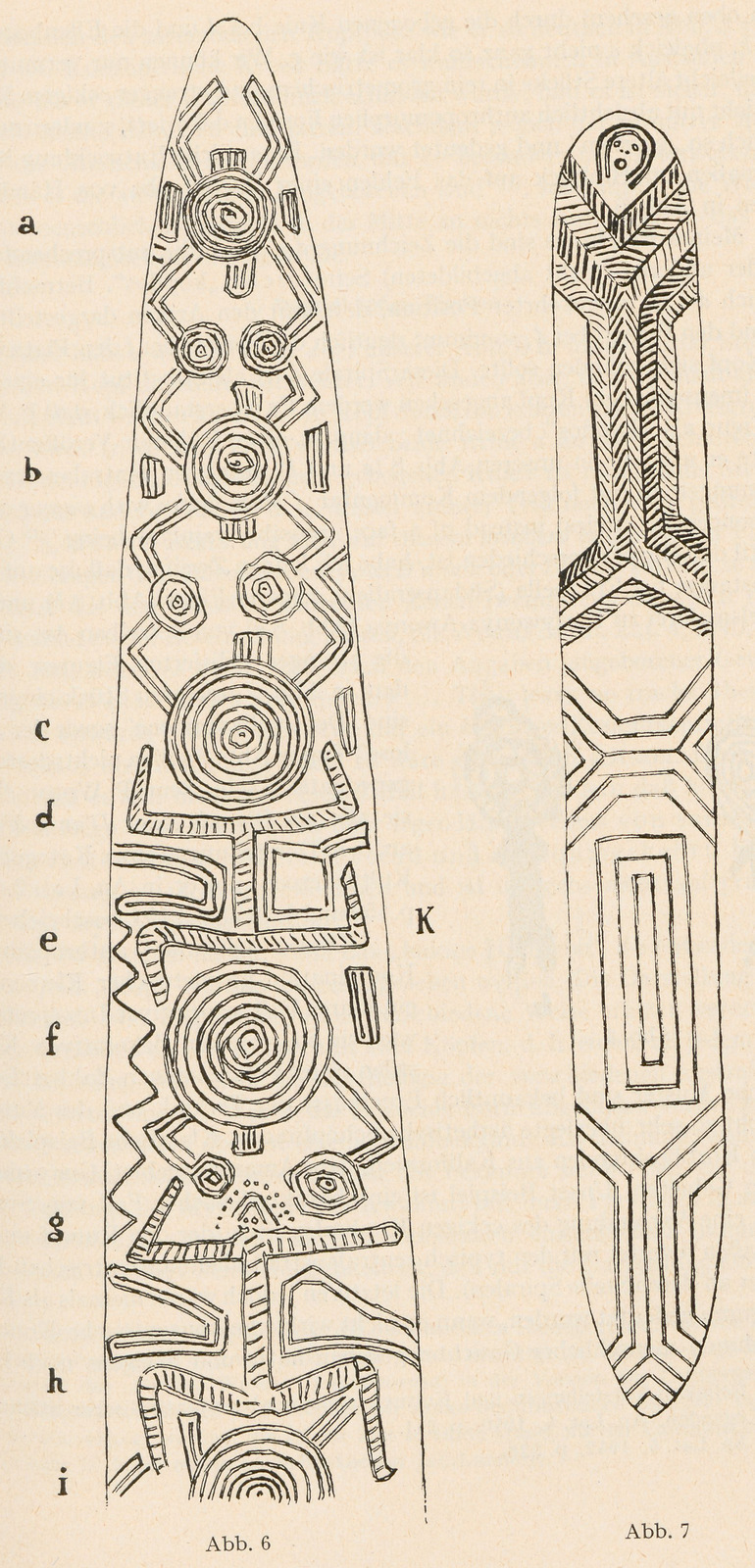
galiguru
Source term: bull-roarer
galiguru: the bullroarer, the same word as Karadjeri; Nyul-Nyul and Bardi galigur. Djäbulju: "grey-haired", the old man of the Dreaming.
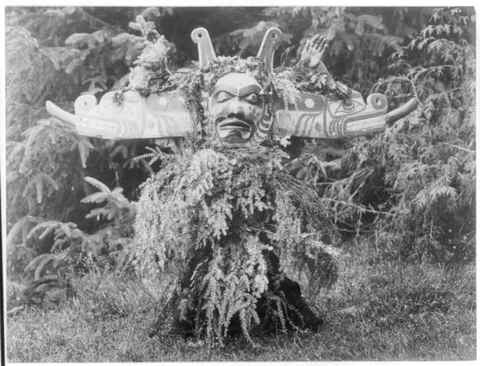
In the dream time an old man made the bull-roarer, and he came from the south. The Yawuru called him Djäbulju, Grey-hair. He made the larar, the small pointed stick of the corroboree, and the shield and the boomerang of old. Another old man, Naldja, made a boomerang and the club and gave them to men; an old man set out the four sections, Garimba, Baldjeri, Banaga and Burong, complete for all time; and it was Djäbulju who gave the people their increase sites, the totem centres. The Yawuru tongue stood apart from that of the Karadjeri to their south, but in custom they took much from their southern neighbours, and the roarer's name came north with it: galiguru, as in Karadjeri, while up the coast the Nyul-Nyul and the Bardi say galigur. Yawuru boards carried people too. On the long minbero, angular figures with bent arms and spread knees rise among spirals: the squatting figure carved and painted on ritual objects from Australia and New Guinea around the Pacific rim, as on the Kwakwaka’wakw house painting where a frontal, bent-limbed figure squats above a whale. Another Yawuru board ends in a tiny face whose mouth is the cord hole.
D'äbul'u galiguru inamagoran bugarigara. Jälmban-gab indiṛan.
Djäbulju bullroarer made in-dream-time. South-from he-came.
A. Capell, "Some Myths of the Garadjeri Tribe," Mankind 4(4) (1950), p. 159
Particulars
- Object
- The Yawuru galiguru, known from a Dreaming text. Two illustrated Yawuru boards accompany it: a 72 × 9 cm minbero with angular human figures, and a 61.7 × 8.8 cm blade with a face at its pierced end (Adam 1958, figs. 6–7).
- Function
- Made in the Dreaming by the culture hero Djäbulju, who also gave the people their increase sites; its ritual use is not recorded.
Discussed in 3 essays
 The Bullroarer in the Coalsack
 The Right to Roar
Sources
- A. Capell, “Some Myths of the Garadjeri Tribe, Western Australia,” Mankind 4(4) (1950): 148–162, pp. 158–161. View
- Leonhard Adam, “Anthropomorphe Darstellungen auf australischen Ritualgeräten,” Anthropos 53 (1958), pp. 1–50, pp. 20–23, figs. 6–7. View
- Adam 1958, p. 49: Yaro/Yaoro attributions, dimensions and collection. View
- Andrew Cutler, “Andreas Lommel and the squatters,” Vectors of Mind (14 May 2024), section “The squatting figure”: the Hocker comparison across Australia, New Guinea and the Pacific rim. View · archived
- Cutler, “Andreas Lommel and the squatters,” footnote 3: further squatting figures, Gorgons and ritual masks. View · archived
- “The Right to Roar,” section “The warrior who could not stop,” Plate VII: Kwakwaka’wakw wall painting with a squatting figure above a whale (Boas 1897, plate XL). View
Nearby in the atlas
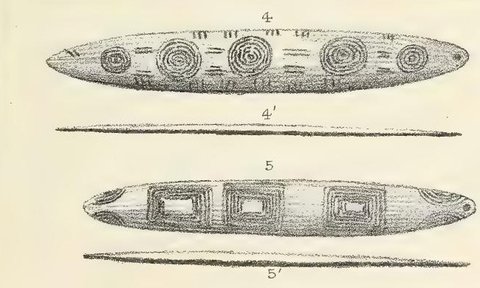 Sunday Island bullroarer (Mjöberg expedition)Australia · Western Australia / Kimberley / Sunday Islands · Sacred / spirit
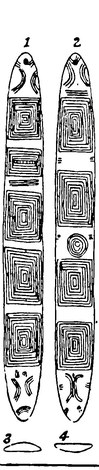 Bunuba novice's ancestral-voice roarerAustralia · Fitzroy River and the Napier, Oscar and Leopold ranges, south-west Kimberley, Western Australia · Restricted
 Drysdale River Kimberley Peabody bullroarerAustralia · Western Australia / Kimberley / Drysdale River · Restricted
 Lombadina mondegi draws a loverAustralia · Lombadina, Dampier Peninsula, West Kimberley, Western Australia · Restricted
 Two-headed Mayala mondegiAustralia · Djigallie (Mr Secombe’s station), about 80 miles south-south-east of Broome, Western Australia · Function not recorded
 Mount Barnett bullroarer (SMVK)Australia · Western Australia / Kimberley / Mount Barnett · Restricted