No. PNG97
Orokolo
Papua New Guinea · Gulf · Oceania · Sahul
Restricted


hevehe / hurava
Source term: hevehe
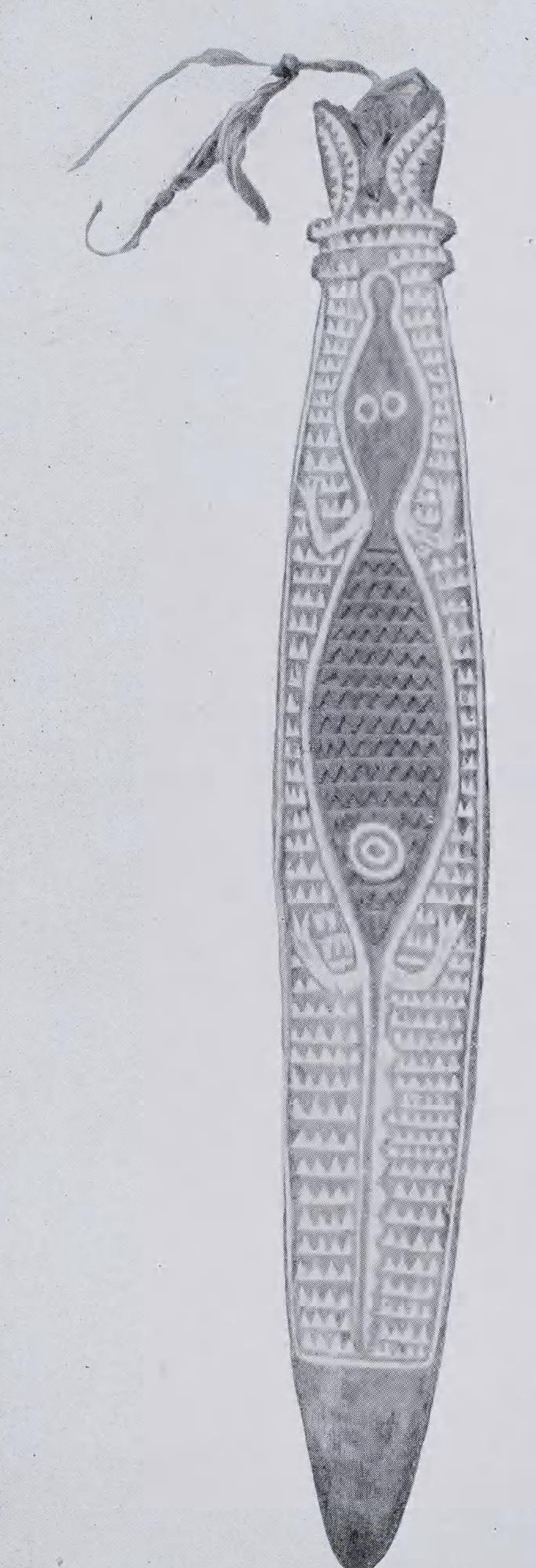
hevehe names the whole secret cycle, masks and roarers alike; the roarer itself is tiparu (Holmes 1902), the common Papuan Gulf name — Holmes's Plate XLI figures the most valued tiparu of the Moreaipi at Orokolo, carved with the ancestor pair Iva and Ukaipu. For Williams (1936), the roarer specifically is be'ure hevehe, 'ground-hevehe' (bea-ure: under the ground); in Keuru and Opau hevehe is the ordinary word for 'snake', and Williams judges snake 'probably an original' meaning of the whole word-family (Orokolo's own snake word being ekaroa). kaiavuru: a common generic name for the bull-roarer in the Orokolo group, which Williams took for the local rendering of the Purari kaiemunu, the wicker monster of the men's house; hevehe is the Orokolo type-name, hurava a second Orokolo name (Marcuse 1964), and Marcuse's 'Hevoa' is likely a hevehe variant.
Etymology. Hevehe is the western Elema name for the bull-roarer and for the whole cycle it belongs to. The term also names the cult's sea-monsters (ma-hevehe, "water hevehe"), the masks built to impersonate them (apa-hevehe, "drum hevehe"), and, among the Keuru and Opau, "snake."
Among the Elema of Orokolo, on the Papuan Gulf, the swung bull-roarer was the voice of unseen creatures and warned women and the uninitiated to hide from the sacred procession; it was kept inside the great men's ceremonial houses, the eravo, some thirty metres long. The missionary J. H. Holmes, writing in 1902, spelled out the stakes: to let the women know that the whining of the bull-roarers was "not the cry of a god but the work of a man" brought down the curse of tiparu, "equivalent to death." At the last stage of initiation, semese, youths were led to a lonely place in the bush, shown how the tiparu was made to sound, and bound to absolute secrecy. Twenty years on, in In Primitive New Guinea, Holmes finally set down the origin legend the Ipi elders told him. The first tiparu lay inside the body of Oalea, a cannibal god of Yule Island who had devoured his own daughter's child; when the sorceress Oripeu came to demand her slain sons, Oalea surrendered his own stomach and died, and inside it were found the eaten child, a bag, an arm-shell and the first bull-roarer — the secret of his power. His daughter Aviaru claimed it for the women, who masked themselves and whirled it at a feast to drive the men off; but the chief Jeai knew them — "only women swing their buttocks in that fashion when they dance" — and the men rushed them and took it, and Oripeu laid the taboo under which no woman has seen it since. Oalea's stolen flesh melted away in the creeks and became the first oaia fish. Williams heard the same monster-slaying story as Arihava and Orokolo's own. In his fullest telling the monster is Oa Birukapu, a swallower of children; when he was killed and the women cleaned his entrails, they "found inside them the bull-roarer," and Williams read the swallowing of the children as their initiation. It was one of seven bull-roarer origin myths the two villages told him, women first in most: in one a woman bears the first bull-roarer outright, 'a thing of mere bones' that cried with a roarer's voice instead of a baby's; in another the old woman Orohahape fetches it up from her underground village; in a Koraguba story the old woman Uravu made it. To the women listening outside, the unseen roarers were creatures — at Orokolo snakes and lizards 'from obo, the great carpet snake, downwards' — and the men liked to pretend they made the snakes howl by tickling their tails with a stick. Williams thought the word hevehe itself originally meant nothing more than 'snake,' and the two oldest relic bull-roarers, kept wrapped and polished at Muru, were said to have travelled there crookedly along the ground like snakes, carving the bed of Kiravi Creek as they went. In 1919 an old man named Evara, in a village near the Vailala River, fell into trances and prophesied that a steamer would bring back the ancestors and a cargo of European goods, setting off what became known as the Vailala Madness: the ancestors, he said, demanded that the old ceremonies be abandoned. In the eastern Orokolo villages bull-roarers and masks were dragged out of the men's houses and burned in front of the women and uninitiated boys from whom they had always been hidden. The government anthropologist F.E. Williams, who chronicled the movement and later wrote Drama of Orokolo, argued for the old ceremonies' preservation and worked to keep officialdom from completing their suppression.
Attached to a long string on the end of a stick and swung round the head, giving forth a loud humming sound, sounded to warn the women and children to 'clear' before a dance.
R. Hamlyn-Harris, "Sacred Sticks or Bull-roarers," Memoirs of the Queensland Museum 2 (1913), p. 38
Particulars
- Object
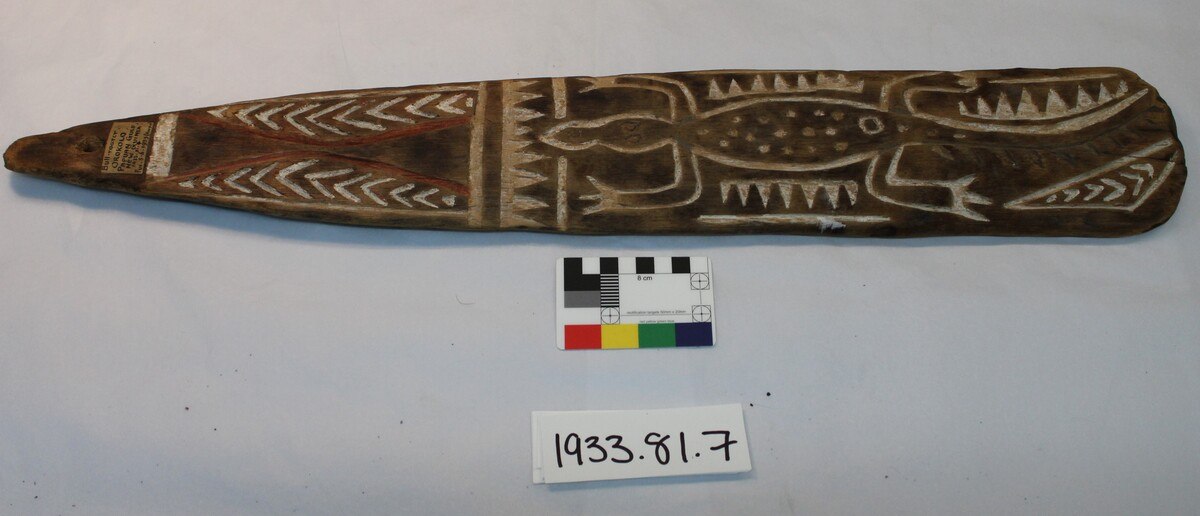
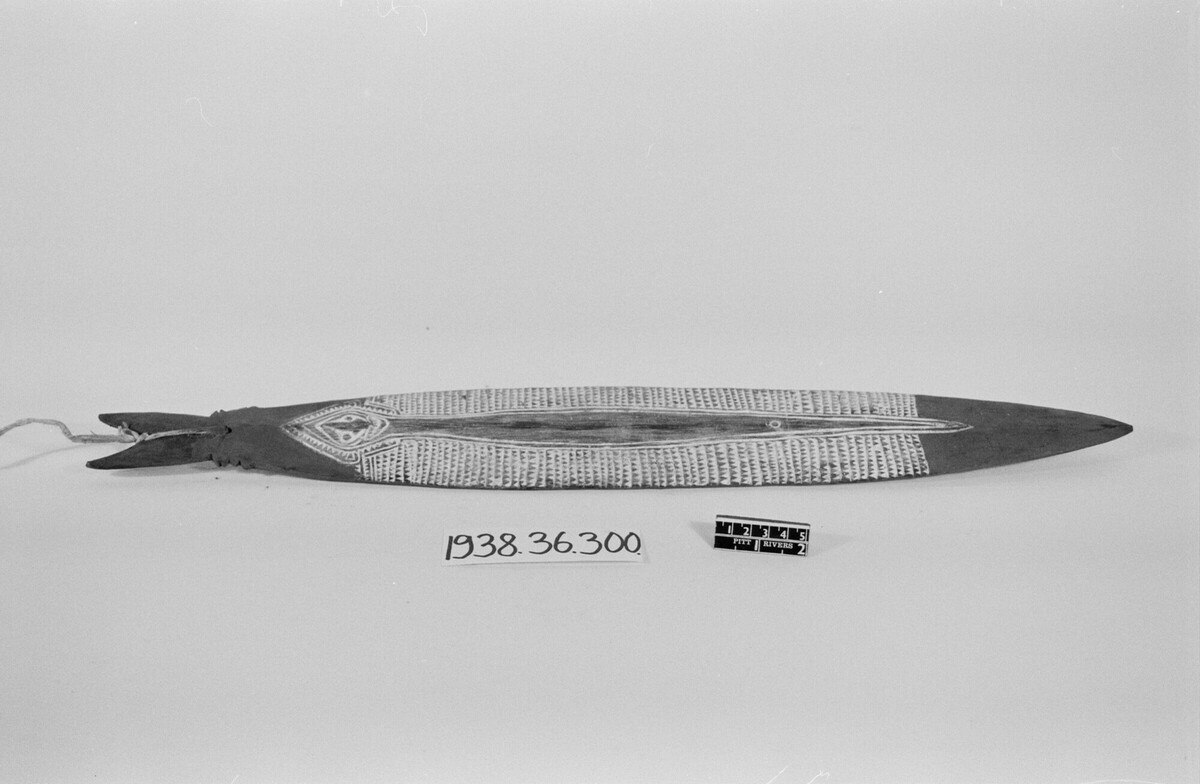
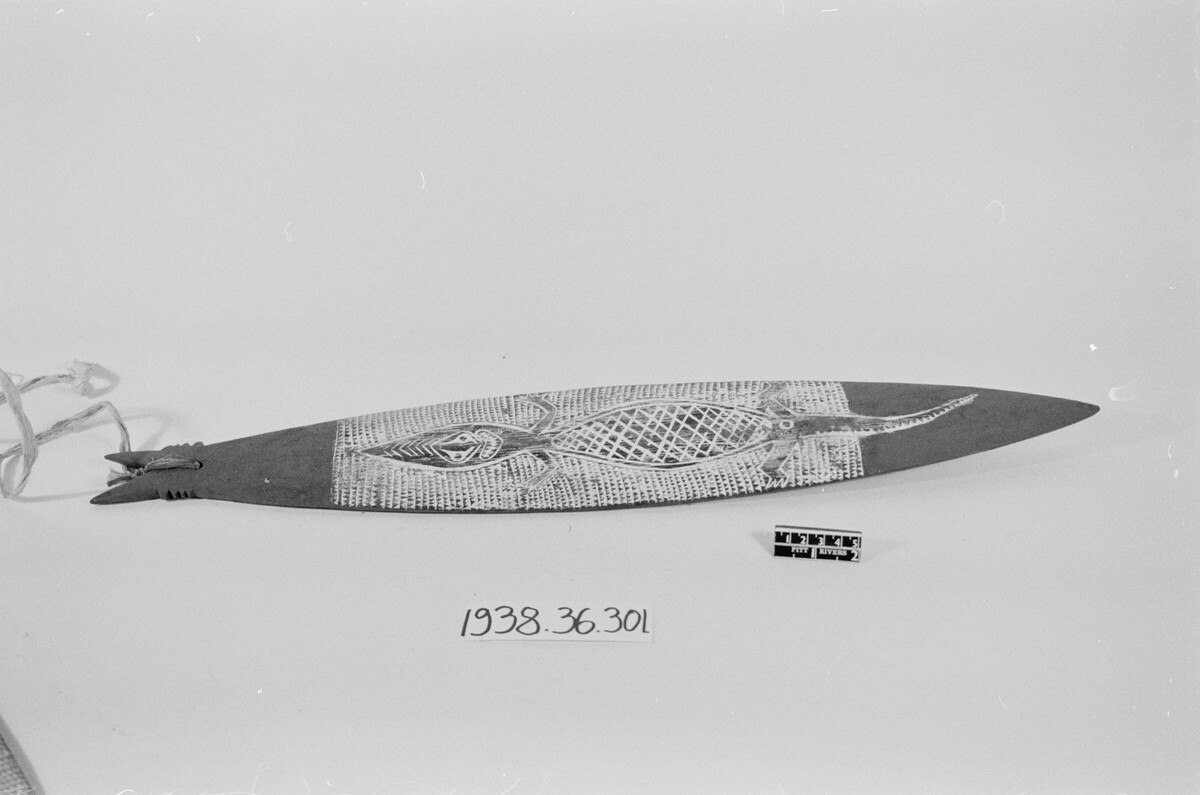
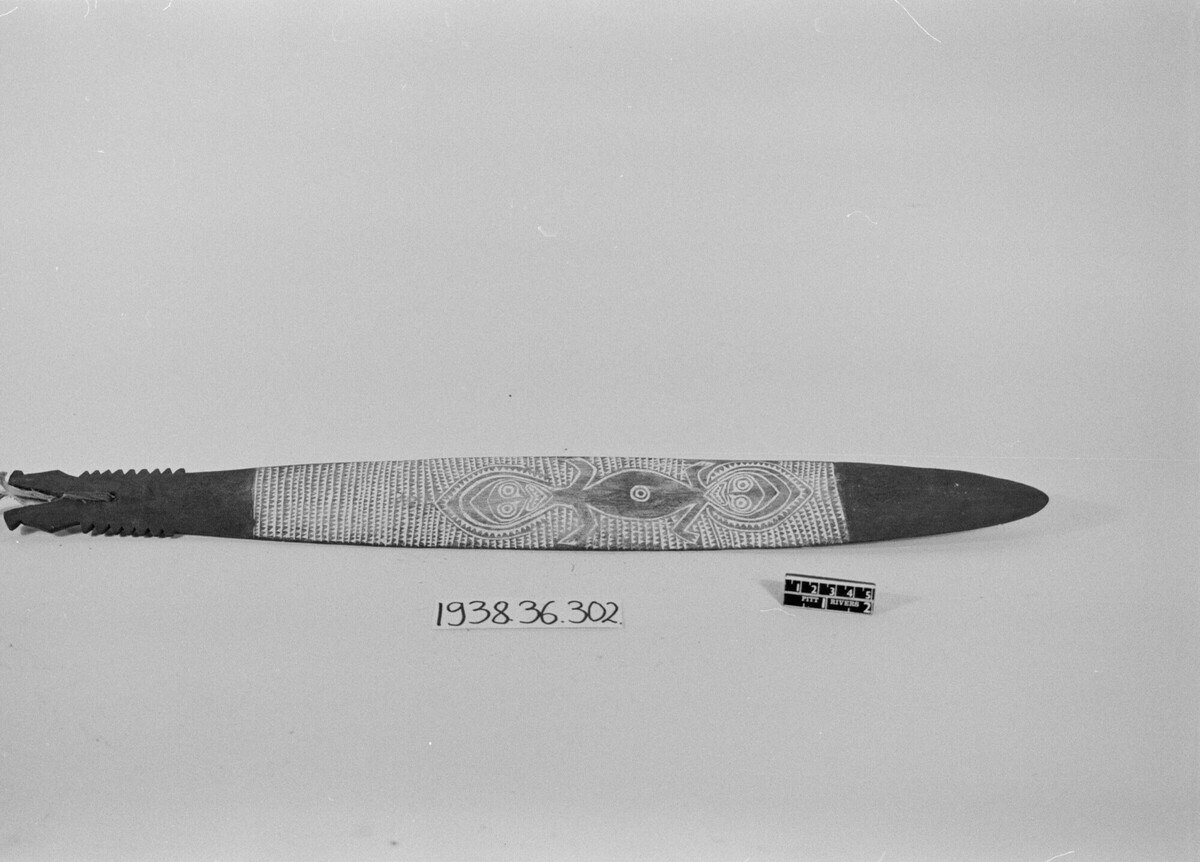
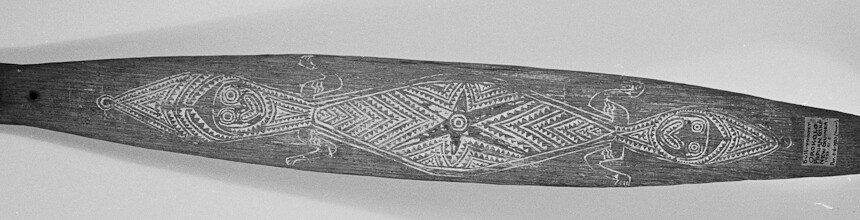
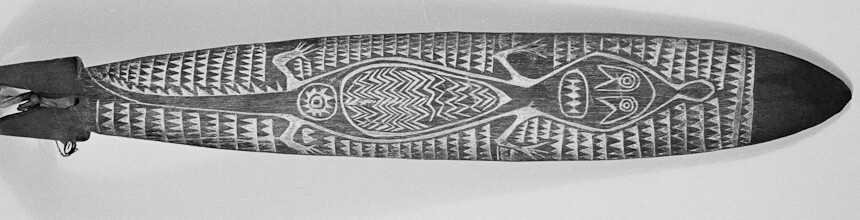
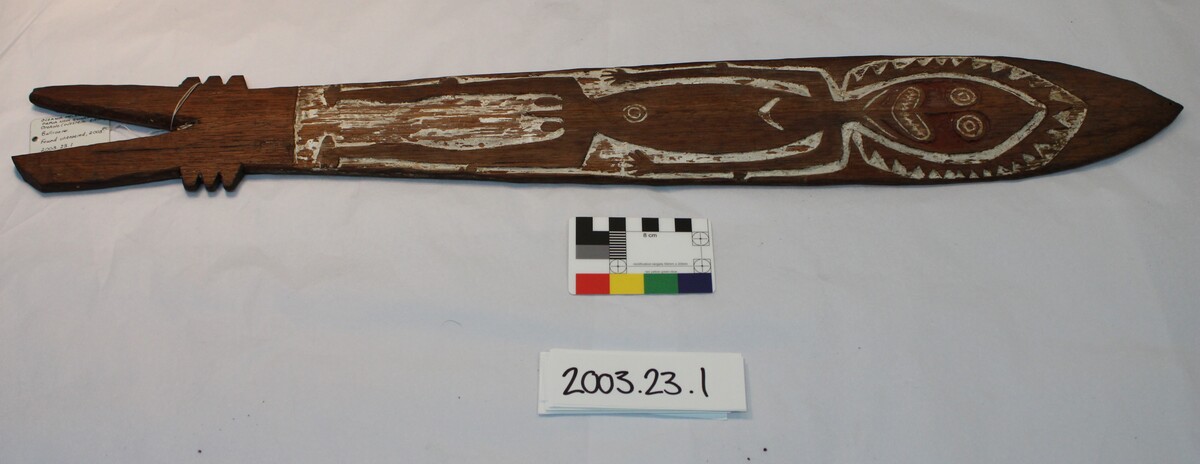
- Orokolo bullroarers include a plain RMCA wooden specimen and British Museum Oc1951,07.10, a Moreaipi/Elema board carved in relief with the ancestor pair Iva and Ukaipu. Pitt Rivers holds exact Orokolo specimens: Hooper's 1933.81.7 (69 x 11 cm, crocodile relief) and Blackwood's 1937 trio 1938.36.300-302 (62-66 cm, ipura imunu), collected wrapped together in palm spathe. Pitt Rivers 2003.23.1, found unentered in 2003 and probably from Blackwood's 1937 collecting, is a 75.5 cm blade carved with a full human figure, its face stained with red ochre and its body outlined in white, the lower end forked.
- Function
- Voice of unseen creatures, sounded to clear women and children before processions and dances; revealed under absolute secrecy to youths at semese, the last stage of initiation; women in several origin myths made or found the first one.
Source
F. E. Williams, Drama of Orokolo (Oxford, 1940), pp. 158–159, 172–180, 204; F. E. Williams, Bull-roarers in the Papuan Gulf, Anthropology Report 17 (1936), repr. in Erik Schwimmer (ed.), Francis Edgar Williams: 'The Vailala Madness' and Other Essays (Honolulu, 1977), pp. 76–115; J. H. Holmes, "Initiation Ceremonies of Natives of the Papuan Gulf," Journal of the Anthropological Institute 32 (1902), pp. 418–425, pl. XLI; J. H. Holmes, In Primitive New Guinea (London, 1924), pp. 82, 188–191; R. Hamlyn-Harris, "Sacred Sticks or Bull-roarers," Memoirs of the Queensland Museum 2 (1913), p. 38, pl. XVII fig. 1; K. A. Gourlay, Sound-Producing Instruments in Traditional Society: A Study of Esoteric Instruments and Their Role in Male-Female Relations, New Guinea Research Bulletin 60 (Canberra, 1975), Table 1, entry 97; British Museum Oc1951,07.10; Pitt Rivers Museum, Oxford, 1933.81.7, 1938.36.300–302, 2003.23.1; Royal Museum for Central Africa, Tervuren, MO.1965.64.12; Queensland Museum E.13/219