No. AUSMAIN-027
Pindupi (Pintupi)
Western Desert, between Lake Mackay and Lake Macdonald along the WA · NT border (Kintore Range · Walungurru); Roheim's Pindupi data gathered from his 1929 base at Hermannsburg in Central Australia
Restricted
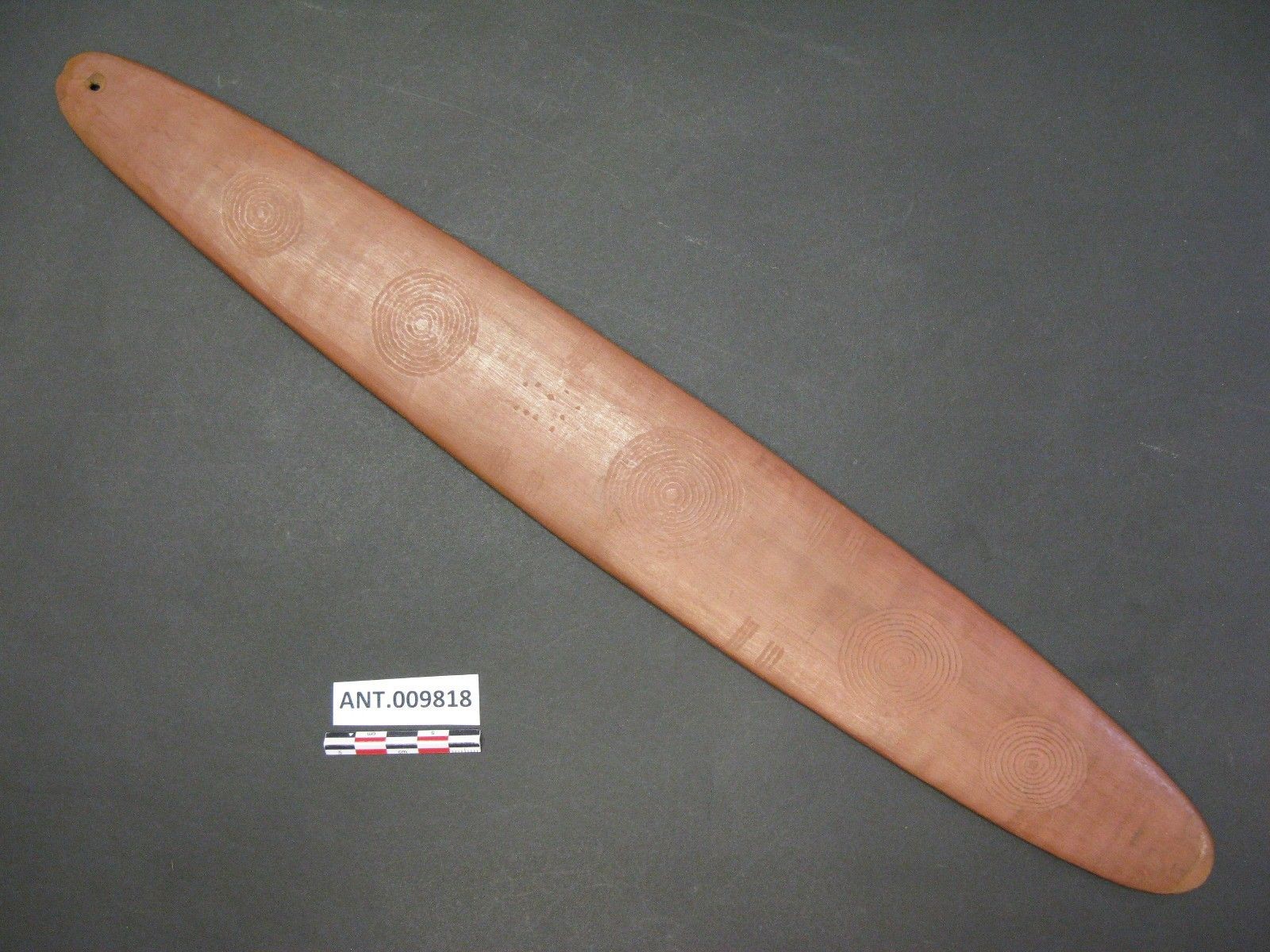
mandagi (Luritja group); namatuna
Source term: mandagi
mandagi: the Luritja-group (hence Pindupi) name Roheim records for the whirled bull-roarer; namatuna is his Aranda form for the same instrument.
Etymology. mandagi is the bull-roarer word of the Luritja-speaking tribes Roheim worked with, including the Pindupi; he sets it beside Murngin mandelprindi and Nyulnyul mandeken as one of the striking word-parallels running across Australia, but records no literal meaning. In the Luritja love-magic songs the instrument is also called kalinka, which Roheim derives from kalu, 'penis.'
Among the Pindupi (Pintupi) of the Western Desert, the bull-roarer was a secret of initiated men. Geza Roheim, working from Hermannsburg in 1929 among the Luritja-speaking western tribes, recorded it as a small whirled slat handed to boys before they were brought back into camp, with strict instructions on where it could be sounded: keep to the thick scrub, away from the women's road. Whirled, it gave the roaring voice of the bull-roarer demon, the apuju, which novices learn at initiation is in fact made by the men. Its power, Roheim was told, came from blood drawn at the subincision wound, and the same instrument served in love magic. Roheim names it mandagi in the Luritja-speaking group to which the Pindupi belong (namatuna in the neighbouring Aranda); it is a true cord-whirled bull-roarer, and it belongs to a uniform initiation complex shared across the desert peoples he studied, the Pindupi among them.
Knatata remembers how, before being brought back into the camp, the boys are handed the bull-roarer (namatuna) and told "For the woman's road don't take it." "When you whirl it, you keep to the thick scrub only." This namatuna, which is used for love magic, receives its magical power from blood taken from the subincision opening.
Geza Roheim, The Eternal Ones of the Dream (New York: International Universities Press, 1945), pp. 13-14.
Particulars
- Object
- A small perforated wooden tjurunga whirled on a cord to roar. Roheim describes these as the little sacred objects 'with holes in them to be used as bull-roarers and to be whirled,' as distinct from the large unperforated tjurunga.
Source
Geza Roheim, The Eternal Ones of the Dream: A Psychoanalytic Interpretation of Australian Myth and Ritual (New York: International Universities Press, 1945), pp. 13-14 (and p. iv intro for the term mandagi; p. 222 for the witnessed-initiation bull-roarer/apuju); from 1929 Hermannsburg fieldwork among the Luritja-speaking western Central Australian tribes (Aranda neighbours plus Pitjentara, Pindupi, Yumu/Jumu, Nambutji, Ngatatara). Cf. Roheim, Children of the Desert: The Western Tribes of Central Australia, ed. W. Muensterberger (New York: Basic Books, 1974)