No. MUS2026-204
Table-land cora, place unwritten
Pilbara · Western Australia
Sacred / spirit
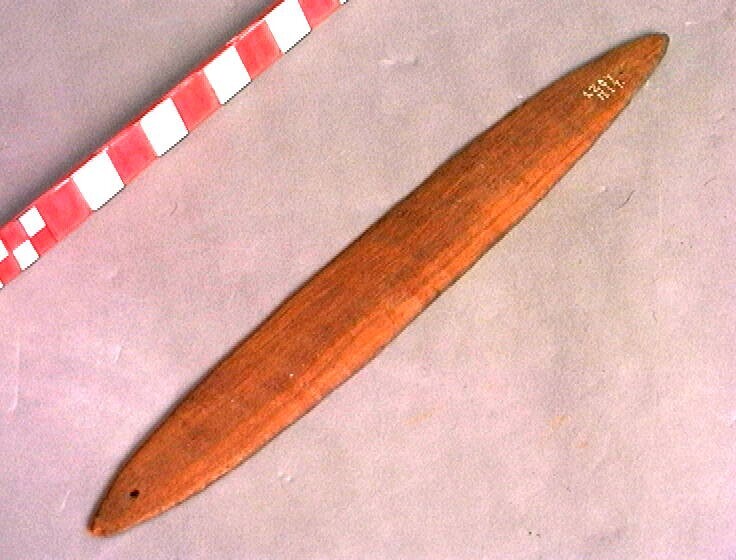
cora / bonangharry
Source term: devil scarer or bullroarer
cora / bonangharry (Clement's own spelling boonangharry; banangari in Radcliffe-Brown 1913): the Pilbara bullroarer, glossed 'devil-scarer' because it is swung to drive off the djuno, the evil spirit blamed for every illness and every death. A shared Ngayarta term; cora is recorded only in the Leiden catalogue headings and is never glossed.
A short zigzag-cut blade, thirty-five centimetres long and pierced at one end for its cord, labelled only "Table-land" — somewhere up on the Pilbara plateau, and Clement never wrote down where. What it was for he did write down. The cora was the devil-scarer: the djuno caused every illness and every death, and the answer was to make a noise at it. Blades like this one were set going over a sick man while the doctor circled him and finally pounced, rubbing the sore place, then putting his mouth to it and drawing out one or two semi-transparent pebbles the size of a hen's egg, which he carried off and buried in the sand. They were swung again over the dead. And at the circumcision camp, when the boys were seized and their arms bound to their bodies with human-hair string, the blades were swung violently in the camp to keep the djuno out of it.
the "boonangharries" or "Devil-scarers" are violently swung in the camp, to keep the "djuno", or Evil-spirit away.
Emile Clement, "Ethnographical Notes on the Western-Australian Aborigines," Internationales Archiv fuer Ethnographie 16 (1904), p. 10
Particulars
- Object
- Item 144 (inv. 1207/17), 35.5 x 4.5 cm. An elliptic slat of hard brown wood like item 143, one side convex and one flat, but with the ornament pattern less visible and most of the grooves zigzag-shaped. Pierced at one end. Three more of Clement's cora sit in the Pitt Rivers Museum, Oxford: 1898.75.47, a 495 mm blade with braided human hair strung through the pierced end and white pigment blocking the other; 1898.75.48, 480 mm, carved all over with one white-tipped end; and 1898.75.51, a notched and incised blade of 618 mm.
- Function
- Swung over the sick while the taketa circled the patient; swung at a death to drive off the djuno, held to be the cause of every death; and swung violently in the camp through the buckli circumcision gathering, roaring incessantly beside the nightly una and hibageh dances.
Source
J. D. E. Schmeltz, Ethnographica II: Sammlung Clement aus Nordwest-Australien, Internationales Archiv fuer Ethnographie 16 (1904), Group XI, item 144; Wereldmuseum (Rijksmuseum voor Volkenkunde) Leiden, inv. 1207/17. Function from Emile Clement, Ethnographical Notes on the Western-Australian Aborigines, same volume, pp. 8-11