No. SCHOORL1997-001
Muyu mulin bullroarer, Upper Kao-Digul
Indonesia · Muyu · Upper Kao-Digul · historic Netherlands New Guinea · Oceania · Sahul
Restricted
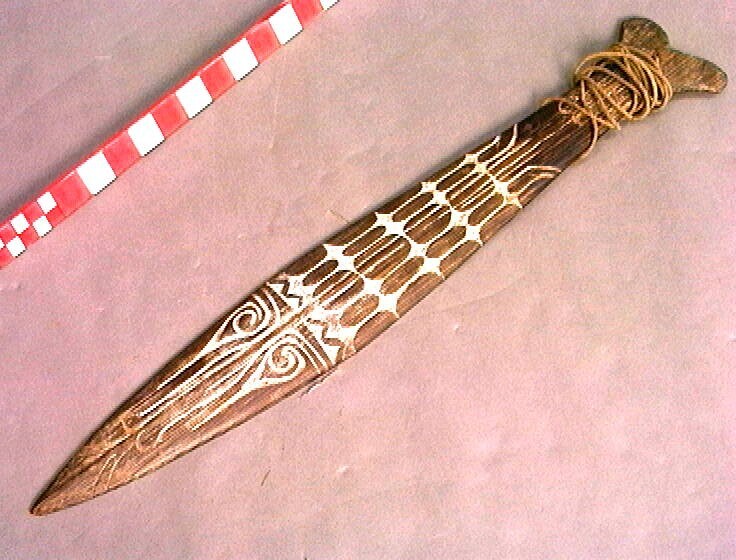
mulin / áyerèt / áyeèt
Source term: bilah-geram
bilah-geram = bullroarer (Indonesian); mulin and áyerèt/áyeèt are the Muyu names recorded by Schoorl.
In the Muyu's primordial age — which they set no more than five or six generations back, when the line between people and animals was not yet drawn — Kamberap turned himself into a pig, had himself trapped and shot, and ordered his body divided: the upper half became the sacred pig, men's meat eaten secretly in the forest, forbidden to the very women who raise the pigs. It was Kamberap who prescribed the mulin, the corded blade whirled until it growls, hidden from women and children. Its first sounding was cosmogonic: when the flood burst from the sacred plain of Mòtkòm, the people whirled the bullroarer against the rising water — and failed, and the escaping flood cut every river of the Kao country. To that same plain the Muyu dead return; and the mulin's growl is their voice, the grandfather and grandmother spirits come back to eat the sacred pork — or, at Kawangtet, the voice of Konki, the mud-covered spirit who ambushes boys at initiation. When the mulin is at last shown to the initiates, the men sit in a circle, talking and joking, until one gropes among the leaves and shouts that he has seen a snake. Everyone leaps up; he takes the mulin and whirls it, and then the flutes are shown.
bilah-geram (mulin atau áyerèt = sebilah kayu yang diberi lubang dan diberi tali; untuk diayunkan berputar-putar sehingga mengeluarkan suara)
bullroarer (mulin or áyerèt = a piece of wood with a hole and cord, swung round and round so that it makes sound)
Schoorl 1997, p. 169.
Particulars
- Object
- Wooden blade perforated at one end, tied to a cord, and whirled in circles to make a grumbling sound.
- Function
- Hidden from women and children; whirled in the yawarawon pig-sacrifice and initiation. Its growl is the voice of the ancestral dead (Yibi) or of the spirit Konki (Kawangtet); in myth it was first whirled against the flood that formed the rivers.
Source
J. W. Schoorl, Kebudayaan dan Perubahan Suku Muyu dalam Arus Modernisasi Irian Jaya (1997), pp. 169-84 (Kamberap myth after Den Haan 1955; initiation and the yawarawon pig-sacrifice) and glossary, pp. 473, 479, 482