No. HH1913-001
Mekeo tabu-proclamation bull-roarer
Papua New Guinea · Central Province · Mekeo District · Oceania · Sahul
Sacred / spirit
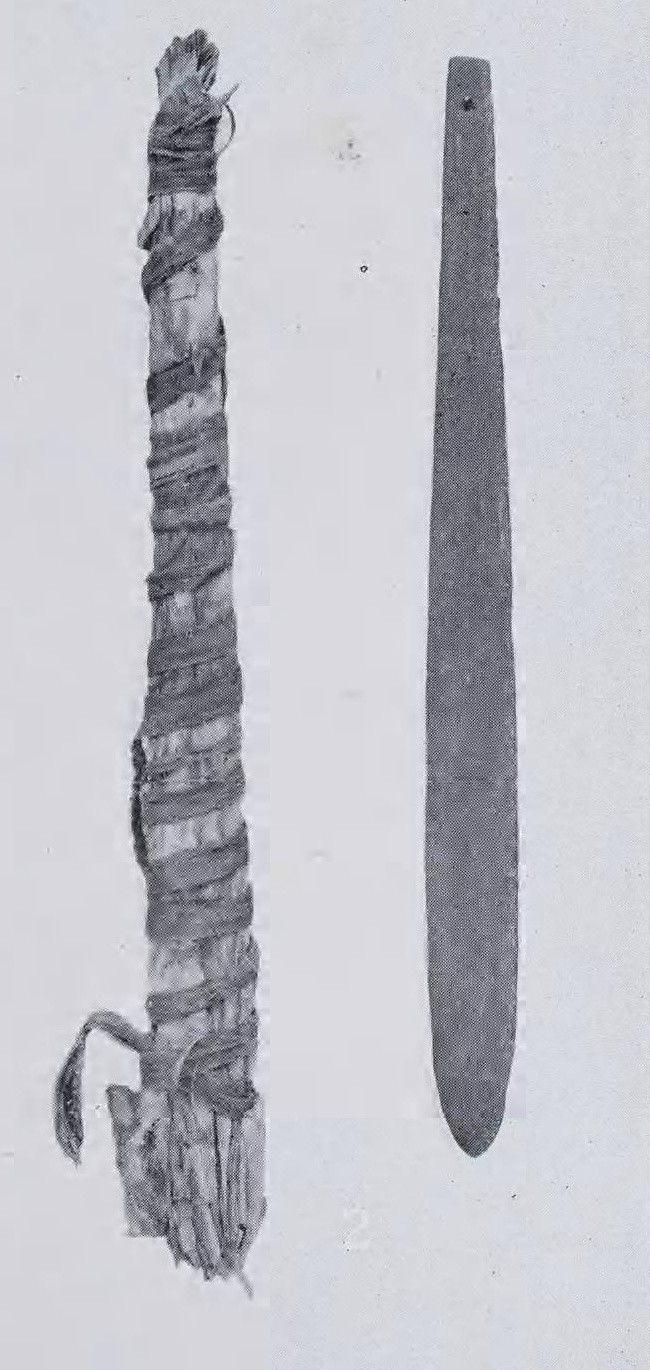
Source term: bull-roarer
kaivakuku: the masked taboo-men who proclaimed bans on garden food; among the Mekeo found chiefly at Inawi, which took the custom from the Papuan Gulf.
A masked Mekeo man swung this bullroarer when a tabu was laid on the coconut palms, and the roar told the whole village the crop was closed. The masked taboo-makers were the kaivakuku, men who alone could lay the most dreaded and most strictly kept of all bans on garden food. They were not an old Mekeo institution: Inawi and a few other Mekeo villages had taken them over from the peoples of the Papuan Gulf, along with the Gulf style of decorating their clubhouses, and the people of Inawi said so themselves. Sir William MacGregor collected the slim hardwood blade still in the plaited bark sheath that hid it.
Used by masked men... when proclaiming a 'tabu' on cocoanuts.
Hamlyn-Harris, Memoirs of the Queensland Museum II (1913), p. 38
Particulars
- Object
- Slim spatulate hardwood blade, 38 cm long, pierced at the squared end and kept in a plaited bark sheath; Queensland Museum N.G. 18639.
- Function
- Swung by masked men to proclaim and enforce a tabu on coconuts.
Sources
- R. Hamlyn-Harris, "Sacred Sticks or Bull-Roarers, as exemplified by specimens in Queensland Museum Collections," Memoirs of the Queensland Museum II (1913), pp. 25-38, plate XVII fig. 2. View
- J. Edge-Partington, An Album of the Weapons... of the Natives of the Pacific Islands, 3rd series (1898), p. 73. View
- C. G. Seligmann, The Melanesians of British New Guinea (Cambridge, 1910), pp. 299, 314. View