No. MUS2026-093
Iari slats that could not roar
Papua New Guinea · Purari Delta, Gulf · Oceania · Sahul
Restricted
imunu viki
Source term: bull-roarer
imunu viki: 'weeping spirit' (imunu 'spirit / vital force'), the Namau/Purari-Delta name for the bull-roarer, whose whir is heard as a spirit lamenting a dead man; its sound is also the voice of the kaiaimunu wickerwork monster of the men's house. F. E. Williams, JRAI 53 (1923): 363 (upura imunu / imunu-viki, 'the weeping imunu'); Smidt 1975: 10.
Etymology. In the Purari (Namau) delta the bull-roarer is called imunu viki, 'weeping spirit' — imunu being the Purari word for a spirit or vital force — because its whir is heard as a spirit's cry lamenting a dead man; the I'ai (Iari) are one of the Namau tribes. Its sound is also taken to be the voice of the kaiaimunu, the wickerwork monster kept in the men's house.
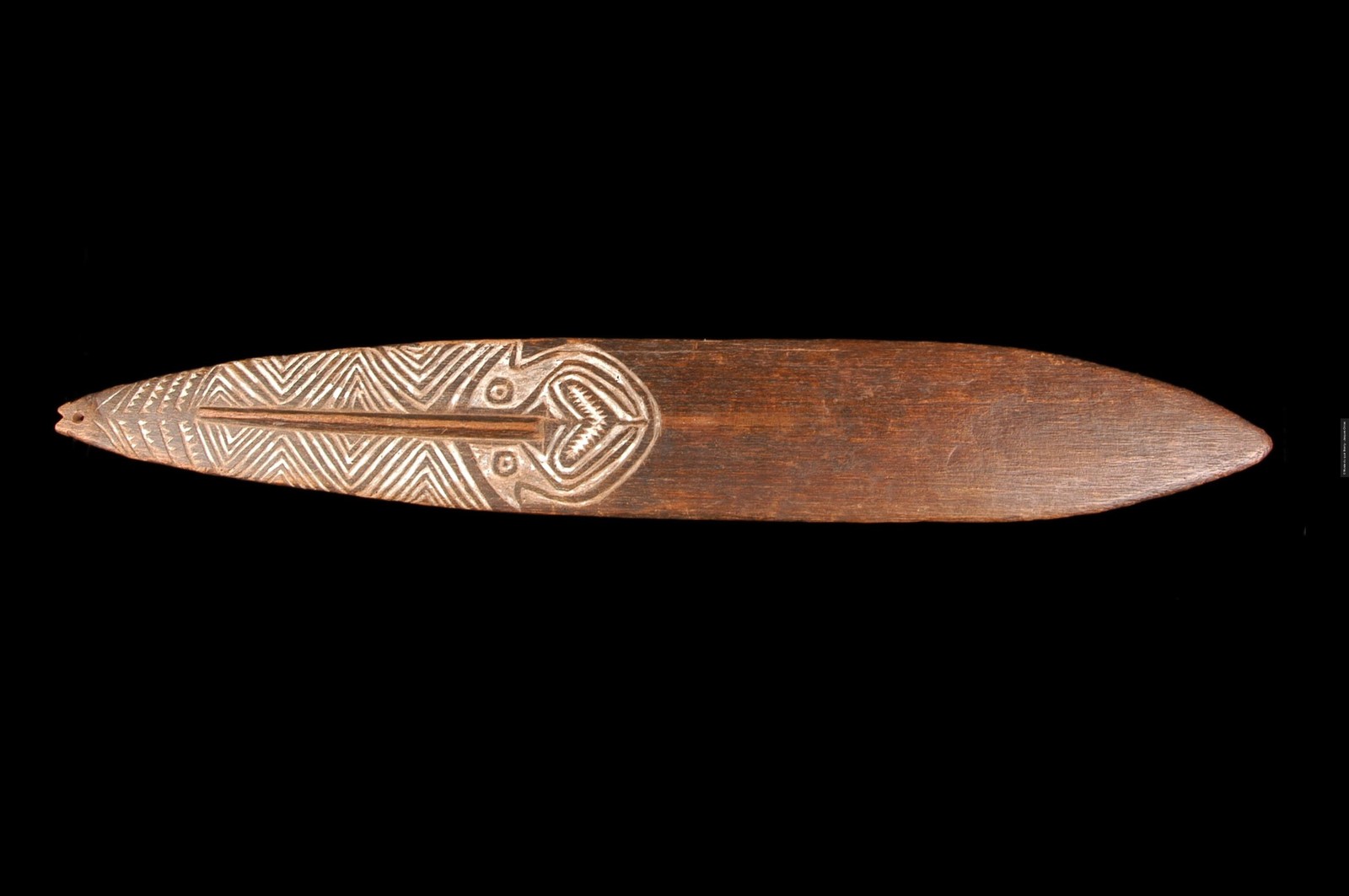
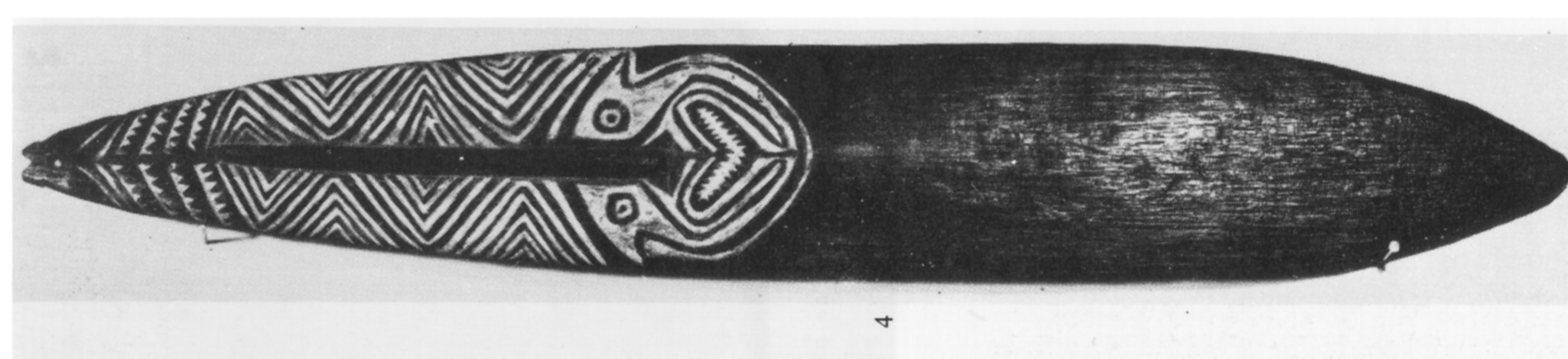
Swung elsewhere in the Purari Delta, these blades roared with the voice of the kaiaimunu, the wicker monsters of the men's house. The Iari cut theirs without a string-hole, some with only a button or mark near the tip of the nose where the hole should be: bullroarers that could not roar, kept by the sheaf in plaited sago-leaf bags in the men's houses. Silence did not make them safe. Upura held the imunu quality, the sacred charge, in the highest degree; entry into their secret cost a pig, and many grown men stayed outside it. Where the blades did sound, they were imunu viki, 'the weeping imunu,' swung after the burial of an amua to mourn him.
Whenever the name is even mentioned, there follows an immediate and hurried retreat of a large number of the listeners. The younger boys will fairly run out of ear-shot.
F. E. Williams, The Natives of the Purari Delta (1924), p. 167
Particulars
- Object
- Carved wooden slat, 72 × 11 × 2.5 cm; chevron zigzags and a face with ringed eyes and a toothed mouth fill its narrow half, the broad half left plain.
- Function
- Secret-cult boards associated with initiation; sounding Purari variants represented kaiaimunu voices and lamented an amua after burial.
Source
Musée du quai Branly – Jacques Chirac, Paris, 71.1930.29.206; Pitt Rivers Museum, Oxford, 1976.23.8; F. E. Williams, The Natives of the Purari Delta, Territory of Papua Anthropology Report 5 (Port Moresby, 1924), pp. 131, 165–171; Metropolitan Museum of Art, New York, 1979.206.1545