No. AUSIN-022
Wyndham pair pierced at both ends
East Kimberley · Western Australia
Restricted
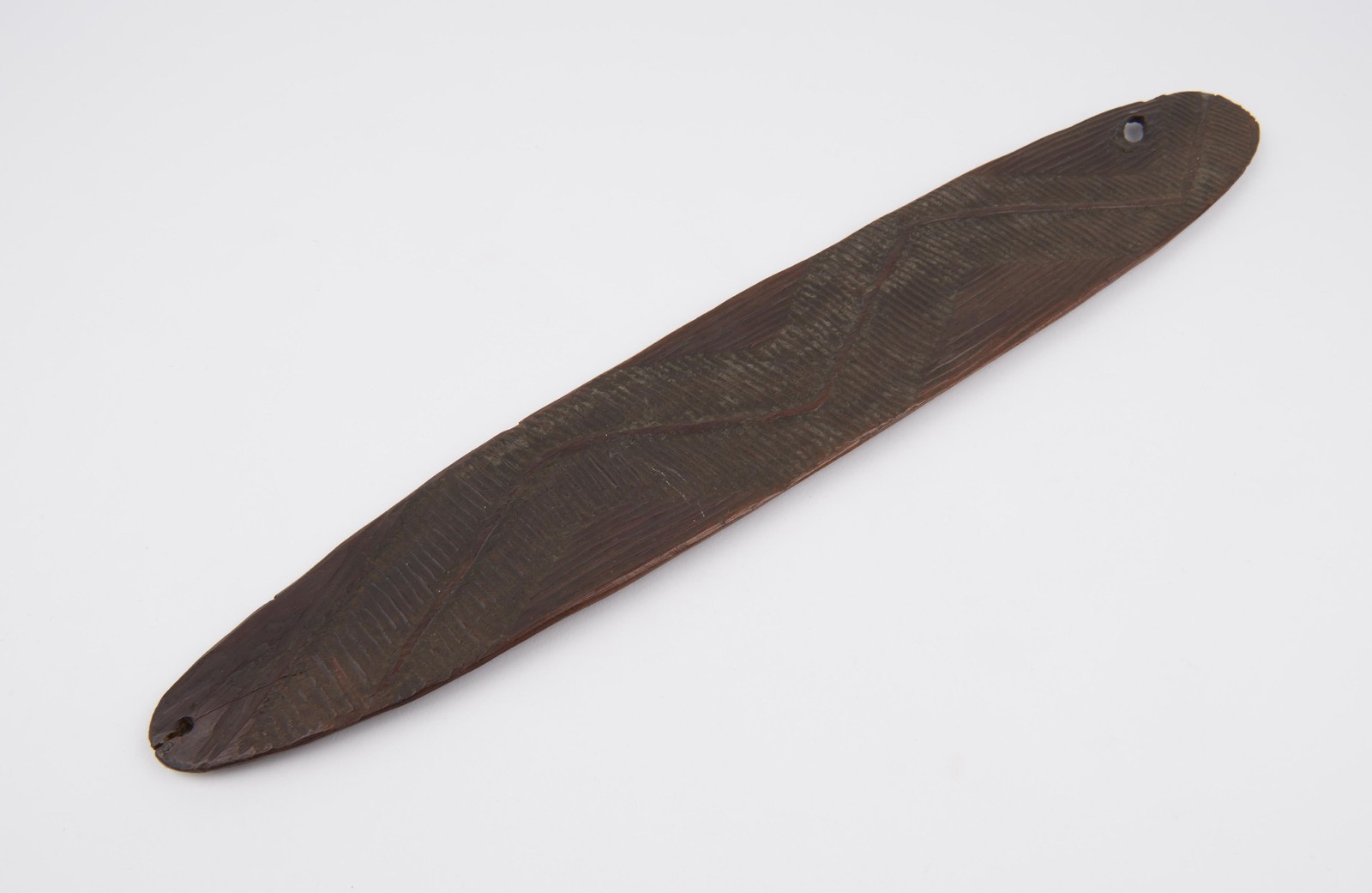
Source term: bull-roarer
Two wooden bullroarers from Wyndham, in the East Kimberley of Western Australia, each perforated at both ends and cut with carved rectilinear designs. Collected c. 1870-1925, they passed into Sir Henry Wellcome's museum and are now held by the Science Museum Group in London. Phyllis Kaberry, working in this district in 1934-36, heard what they were: the men held them as something sacred never to be seen by women, and a Miriwoong woman told her they were gugbu, forbidden. Kaberry set down what women knew of them: that they were of wood, that they carried markings, that they went with corroborees, that they promoted growth and gave strength. In the neighbouring Lunga country the bullroarer itself hangs in the sky: it is the dark patch in the Milky Way, the Coalsack, and Orion's belt is the stick the bird Banaga threw after it when it broke from its string.
both perforated at either ends and decorated with carved rectilinear designs. When attached to a cord and swung through the air, bull roarers emit a deep, vibrant, roaring sound and are important in rituals in Australian Aboriginal society.
Science Museum Group Collection, object A140596 (co104687), "Two wood Bull Roarers, Western Australia, c. 1870-1925"
Particulars
- Object
- One of two wood bullroarers from Wyndham in Science Museum Group collection
- Function
- In the East Kimberley the boards are sacred and never to be seen by women; Miriwoong women called them gugbu, forbidden, and at initiation men stood round whirling them.
Sources
- Science Museum Group, object A140596 / co104687, “Two wood Bull Roarers, Western Australia, c. 1870-1925” View · archived
- Phyllis M. Kaberry, Aboriginal Woman: Sacred and Profane (1939), pp. 229-230
- Froggatt, in R. Etheridge, Jr., 'On circular and spiral incised ornament on Australian Aboriginal implements and weapons,' Records of the Australian Museum 3(1) (1897), p. 5 View · archived