No. SCHMELTZ1896-002
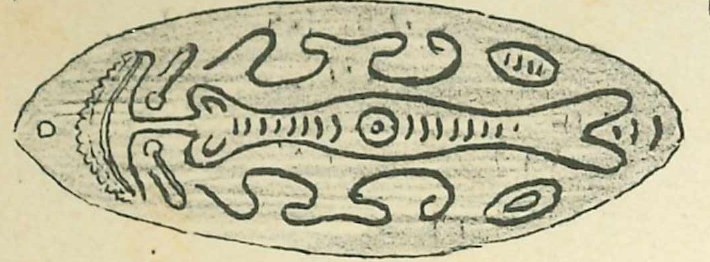
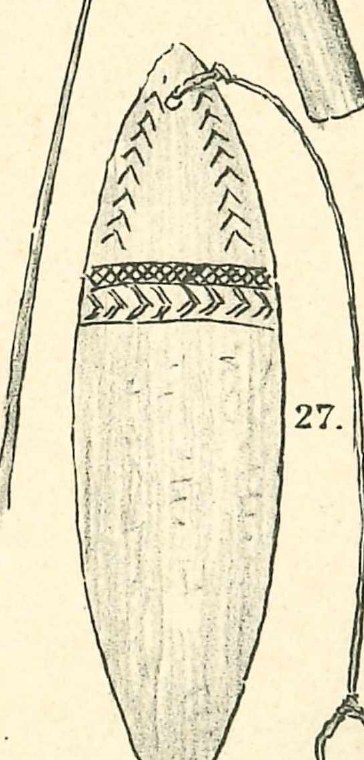
Port Moresby Papan house emblem and child's bullroarer
Papua New Guinea · Port Moresby, British New Guinea · Oceania
Sacred / spirit
Papan
Papan — the name recorded with the object; no gloss given.
Not every bullroarer was made to fly. The Papan of Port Moresby — an oval blade drawn over with curving lines that gather into a stylized animal, partly reddened — hung in the Eramo, the great house, as a luck symbol: the missionary James Chalmers, who knew the town well, sent it to Europe with that account. Whose hands carved it, the record never says. A second Port Moresby bullroarer is a child's: an elongated oval marked with two cross-bands and little fern-leaf figures, on a cord that ends not at a stick but in a loop for the finger. House emblem and plaything, from the same town, side by side.
Particulars
- Object
- Two Port Moresby bullroarers: the oval Papan with a terminal cord hole, ornamented with curved parallel lines forming a stylized animal, partly red-painted; and an elongated oval child's bullroarer with two cross-bands and fern-leaf figures, its cord ending in a finger loop.
Source
J. D. E. Schmeltz, 'Das Schwirrholz,' Internationales Archiv für Ethnographie IX (1896), p. 108 with plate figs 20 and 27