No. POMPIDOU2026-001
Breton's six-spiral rhombe
Northern Australia (museum: Océanie, Australie, Région du Nord)
Function not recorded
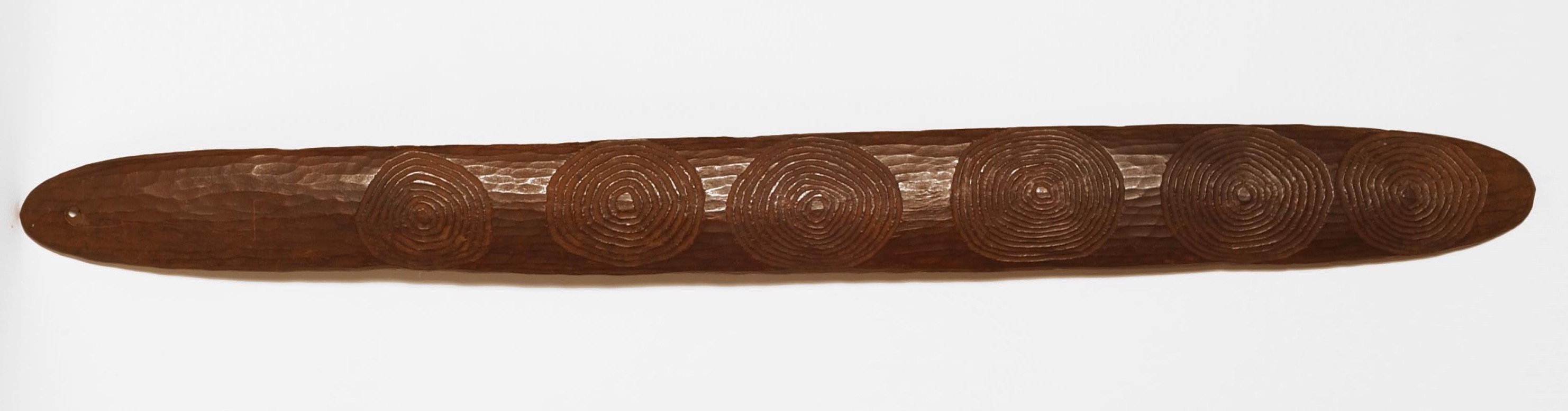
Source term: Rhombe
Rhombe: French museum term for the bullroarer. Churinga: the object's former title, a collectors' spelling of Arrernte tjurunga, the sacred objects of Central Australia.
André Breton never stopped adding to his collection, driven, he said, by an irresistible need to possess and a wish to take on the powers of objects that had surprised him. In the studio of his flat in the rue Fontaine, Paris, where he lived from 1922 until his death in 1966, paintings by Picasso and Miró hung among masks, Oceanic carvings, stones, roots and boxes of butterflies: 212 works and objects on one wall. This long wooden blade from northern Australia hung among them, six spiral roundels cut down its length and a hole at one end for the cord. For years it carried the title 'Churinga'. The whole wall entered the Centre Pompidou in 2003.
Il n’a cessé de l’enrichir, guidé par « un irrésistible besoin de possession », qu’il attribuait au désir de « s’approprier les pouvoirs des objets » ayant suscité en lui surprise et interrogation.
He never stopped adding to it, guided by “an irresistible need for possession”, which he attributed to the desire “to appropriate the powers of objects” that had surprised and puzzled him.
Brigitte Leal, Collection art moderne (Centre Pompidou, 2007), on the Breton studio wall
Particulars
- Object
- Long, straight wooden blade, 75 × 7.2 × 2 cm, carved and incised down its length with six spiral roundels and pierced at one end; part of the studio wall of André Breton's Paris apartment.
- Function
- Not recorded.
Source
Centre Pompidou, Musée national d'art moderne, 'Rhombe', AM 2003-3 (190), from the Mur de l'atelier André Breton; with Brigitte Leal's analysis from Collection art moderne (2007)