No. MUS2026-038
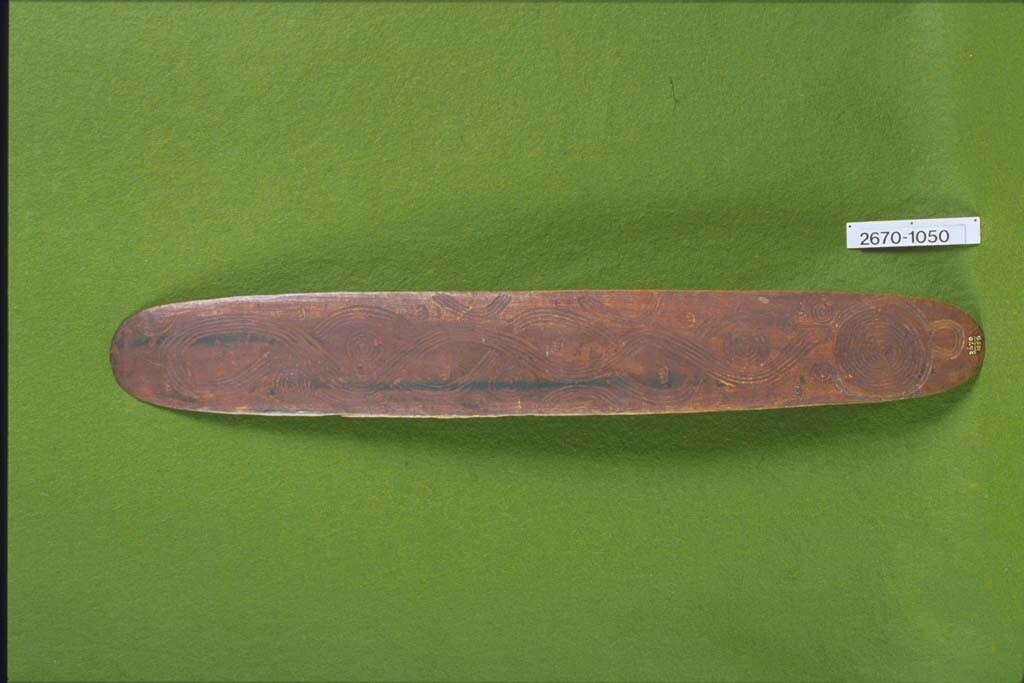
Nyamal cora with a carved figure
Pilbara · Western Australia
Restricted
bonangharry / cora
Source term: bull-roarer
bonangharry (also cora; boonangharry in Clement's own prose): 'devil-scarer', the Pilbara name for the bullroarer.
Etymology. Clement (1903) records the north-west Australian bullroarer as 'cora' or 'bonangharry' and glosses it 'devil-scarer'; Radcliffe-Brown (1913) gives the same word, banangari, for the neighbouring Kariera, so the name is shared across the Pilbara rather than uniquely Nyamal.
Well carved, with a human figure worked into the wood, this whizzing-stick was collected on the Oakover River in Nyamal country, in the Pilbara, and bought by the Pitt Rivers Museum in Oxford in 1901. Its collector, Émile Clement, heard the bonangharries roar over the dead to drive away the djuno, the evil spirit behind every death, and through every night of dancing at the circumcision camp. In 2019 the Manchester Museum unconditionally returned forty-three such secret sacred and ceremonial objects to their communities — the Aranda, Gangalidda Garawa, Yawuru, and the Nyamal of the Pilbara among them.
When a member of the tribe falls ill, the boonangharries … are set in motion, and the taketa [native doctor], dressed up in feather ornaments … and painted with white and red stripes, walks and struts round the sick person in huge circles, which get smaller and smaller until he is close to the prostrate patient, when he suddenly pounces upon him.
Émile Clement, "Ethnographical Notes on the Western-Australian Aborigines," Internationales Archiv für Ethnographie 16 (1903), p. 8
Particulars
- Object
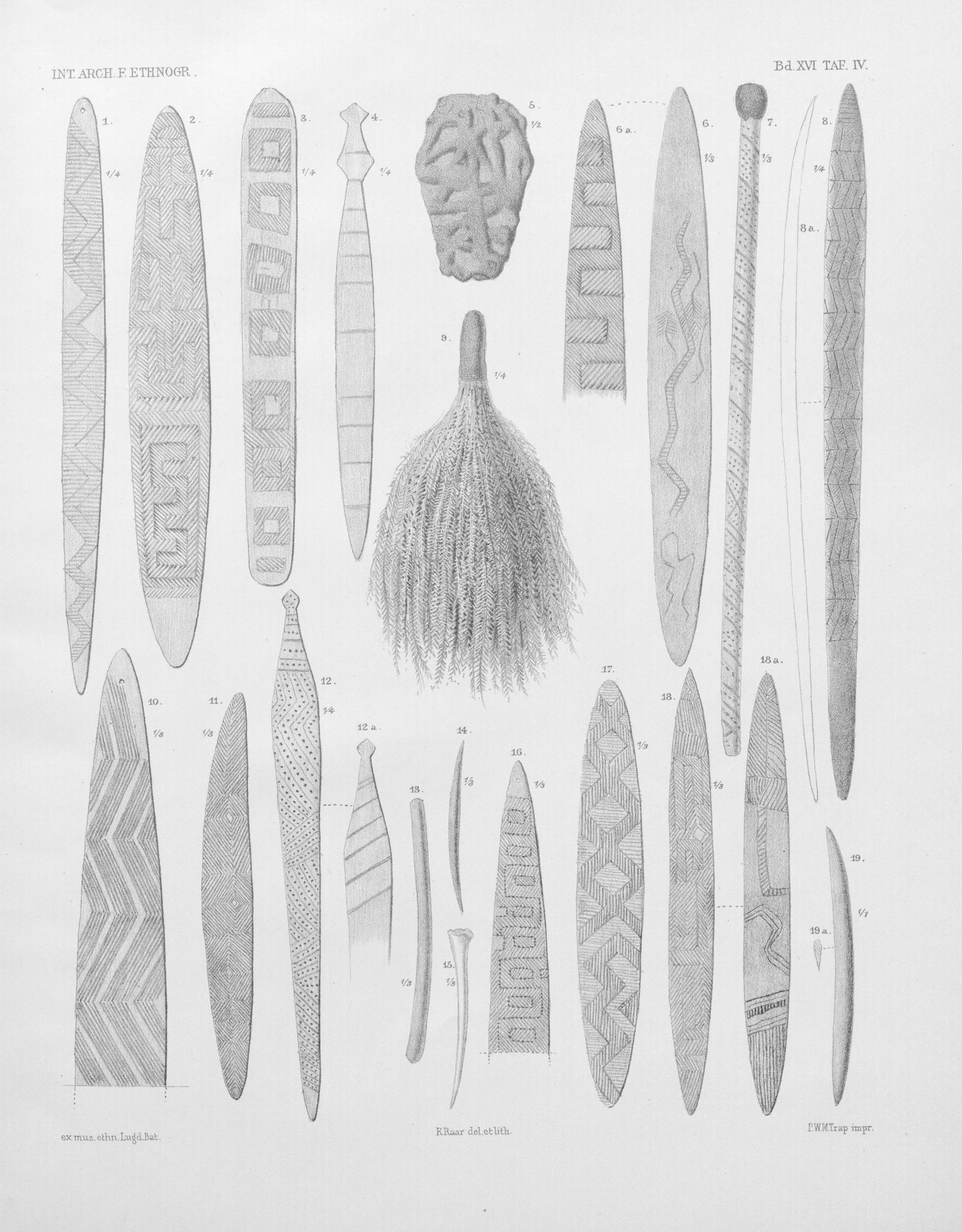
- Bull-roarer of the Nyamal, Pitt Rivers Museum, Oxford (acc. 1901.58.23). Clement no. 151, a 57 x 4 cm dark wooden blade with a terminal hole, is shown on Plate IV fig. 1.
- Function
- Set roaring over the sick while the doctor circled the patient, swung at a death against the djuno, and sounded through the circumcision gathering.