No. PNG9
Arapesh (incl. Kaboibus)
Papua New Guinea · East Sepik · Oceania · Sahul
Restricted
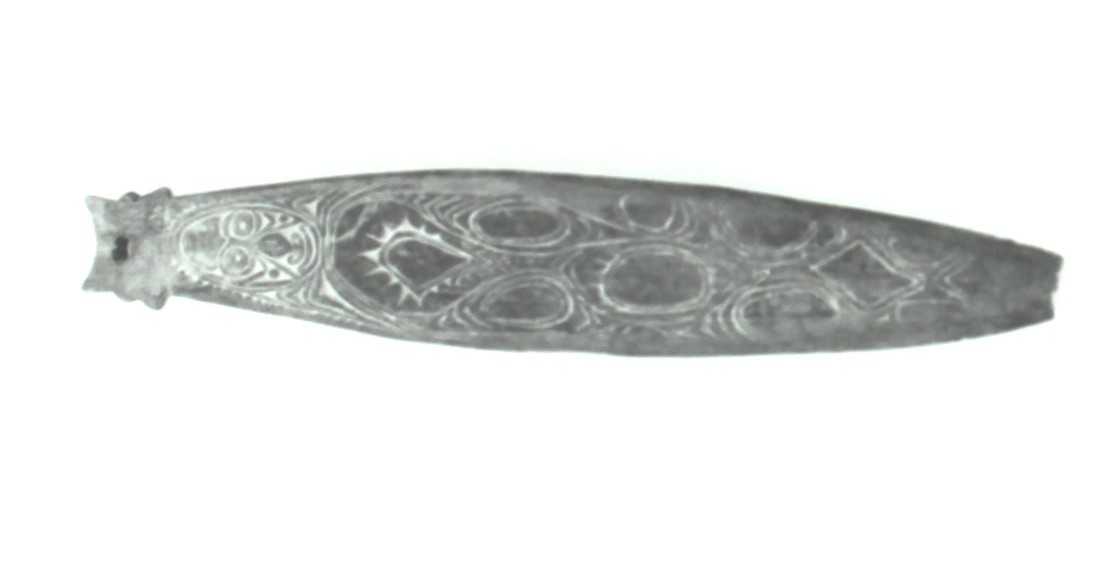
Among the Mountain Arapesh of the East Sepik hills, the voice of the tambaran — the men's cult patron — was the sound of bamboo flutes and booming garamut slit-gongs, told to women and uninitiated children as the cry of a being who lived in the sea and stood tall as a coconut tree. Margaret Mead, who studied them from the hamlet of Alitoa in 1931-32, recorded that women were not permitted to see the tambaran, and that young girls learned to push all thought of it from their minds lest they "endanger the order of the universe"; at initiation the boys learned the secret — the voice was only men with flutes and gongs. The cult could also punish: a man publicly shamed could have the tambaran summoned against his own house, its voice driving the couple out into the night while the men wrecked the wife's pots, net-bag and rings. To the southwest, in the huge lowland village of Ilahita, Donald Tuzin found the same cult grown monumental: at the great yam-harvest ceremonies, initiated men sounded bullroarers and giant voice-amplifying pipes behind the screens as the voices of the spirits — the bullroarer's drone belonging to Lefin, a red-bearded dwarf whose gigantic voice it was said to be. The cult's end came on a Sunday in 1984, when men of Ilahita stood up in church, by prearrangement, and confessed to the women in the congregation that the tambaran was a lie — 'the secret was that there was no secret.' The revelation, Tuzin found, was not the shocker generations of male foreboding had promised: the women were 'yawningly indifferent' to the particulars, at liberty at last to admit they had always assumed the men were lying about the people-eating monsters — 'We always figured it had to be something like that' — though they were also impatiently skeptical of the excuses that had excluded them, and 'wrathful at having been duped.'
The 'voice' of this tambaran is a bull-roarer, its eerie sound represented to the uninitiated as the gigantic voice of a dwarf with red hair and beard and a huge mouth with great teeth.
Donald Tuzin, 'Ritual Violence Among the Ilahita Arapesh,' in Herdt (ed.), Rituals of Manhood (1982)
Source
K. A. Gourlay, Sound-Producing Instruments in Traditional Society (1975), Table 1, entry 9; Margaret Mead, Sex and Temperament in Three Primitive Societies (1935), pp. 24, 64–73, 117; Donald Tuzin, 'Ritual Violence Among the Ilahita Arapesh' (1982) and The Cassowary's Revenge (1997); David Howes, 'Sensation and Transmission' (2015), pp. 155–56