No. SG1899-005Australia
Loritja apuju and mantiki bullroarers
Western MacDonnell · Hermannsburg-Finke region · Central Australia
Restricted
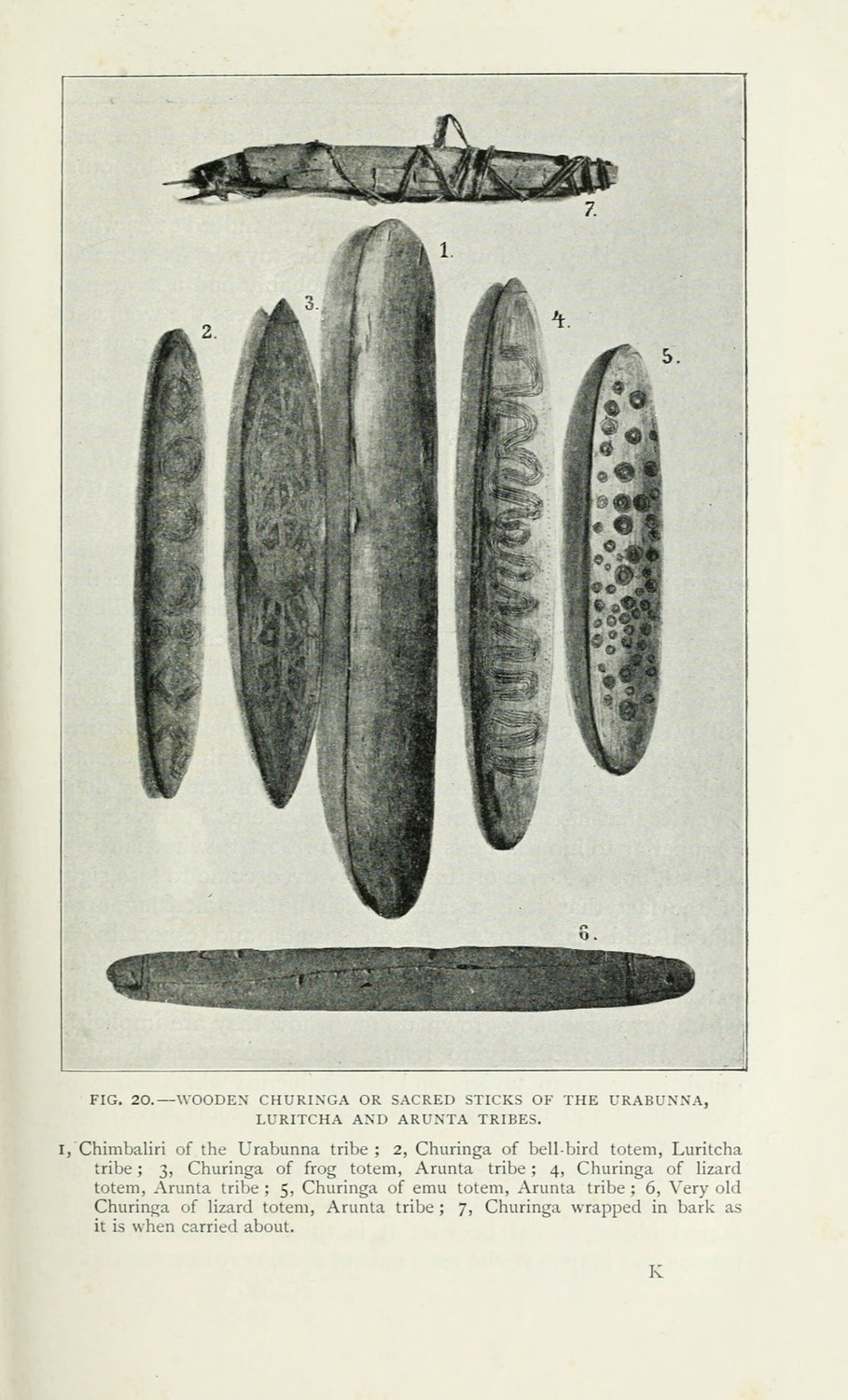
apuju (large bullroarer); mantiki (small bullroarer); kuntanka (sacred board, general)
Source term: Churinga; Schwirrholz
apuju: 'the whirring ones', the large bullroarer and the name the children give the newly circumcised; mantiki: the small bullroarer, which Leonhardi held to be related to Niol-Niol mandaka; Maiutu: the Loritja counterpart of the Aranda Tuanjiraka.
Etymology. Spencer and Gillen explicitly gloss the Arunta/Luritcha word churinga as meaning 'sacred or secret': used as a substantive it denotes a sacred emblem (the stone or wooden slab, some of which serve as bull-roarers), and used as a qualifying/adjectival term it means sacred or secret.
Loritja women and children believed in the Maiutu, little men of the far west who wound live snakes round their necks and bodies. A Maiutu struck off a boy's head with a lizard's tail and set it back on, and the roaring that sent them running was his voice. After circumcision the boy was handed the large bullroarer, apuju, cut with his mother's totem, and told: this is Maiutu. Keep telling the children he exists, the men warned, or the people will vanish. Later came the small mantiki, swung so that a promised girl would want him.
Siehst du diese tjurunga? Dies ist Maiutu.
Do you see this tjurunga? This is Maiutu.
Carl Strehlow, Die Aranda- und Loritja-Stämme in Zentral-Australien, IV.1 (1913), p. 50
Particulars
- Object
- Two Loritja bullroarers of wood: the large apuju, cut with the marks of the owner's mother's totem and given after circumcision, and the small mantiki, given later when the beard grows or at the closing tingari pole rite. Spencer and Gillen add that Luritcha churinga use and meaning are like the Arunta pattern.
- Function
- Initiation and love magic. The newly circumcised youth swings his apuju to drive women and children off; they take the roar for the voice of Maiutu. The small mantiki, given later, is swung so that the promised girl will consent.
Sources
- Carl Strehlow, Die Aranda- und Loritja-Stämme in Zentral-Australien, part II (Frankfurt, 1908), pp. 48-49, 81-82 View
- Carl Strehlow, Die Aranda- und Loritja-Stämme in Zentral-Australien, part IV, section 1 (Frankfurt, 1913), pp. 50-51, 56, 60 View
- Baldwin Spencer and F. J. Gillen, The Native Tribes of Central Australia (London, 1899), pp. 157-158 View