No. MUS2026-028
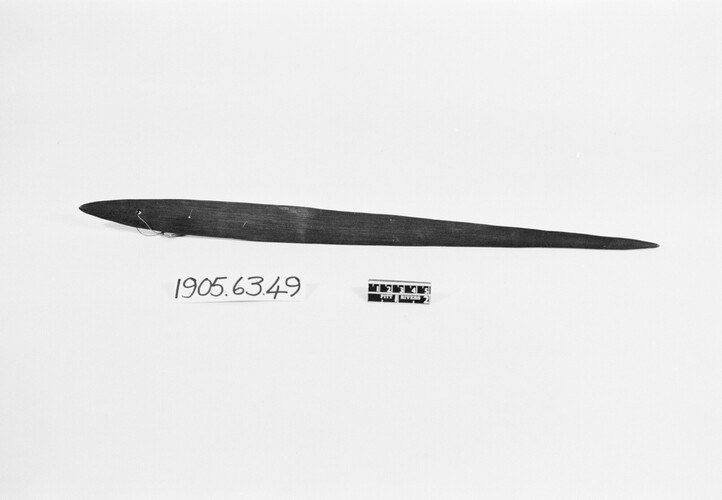
Half-metre Bensbach blade, two fingers wide
Papua New Guinea · Western Province (Morehead) · Oceania · Sahul
Function not recorded
Source term: bull-roarer
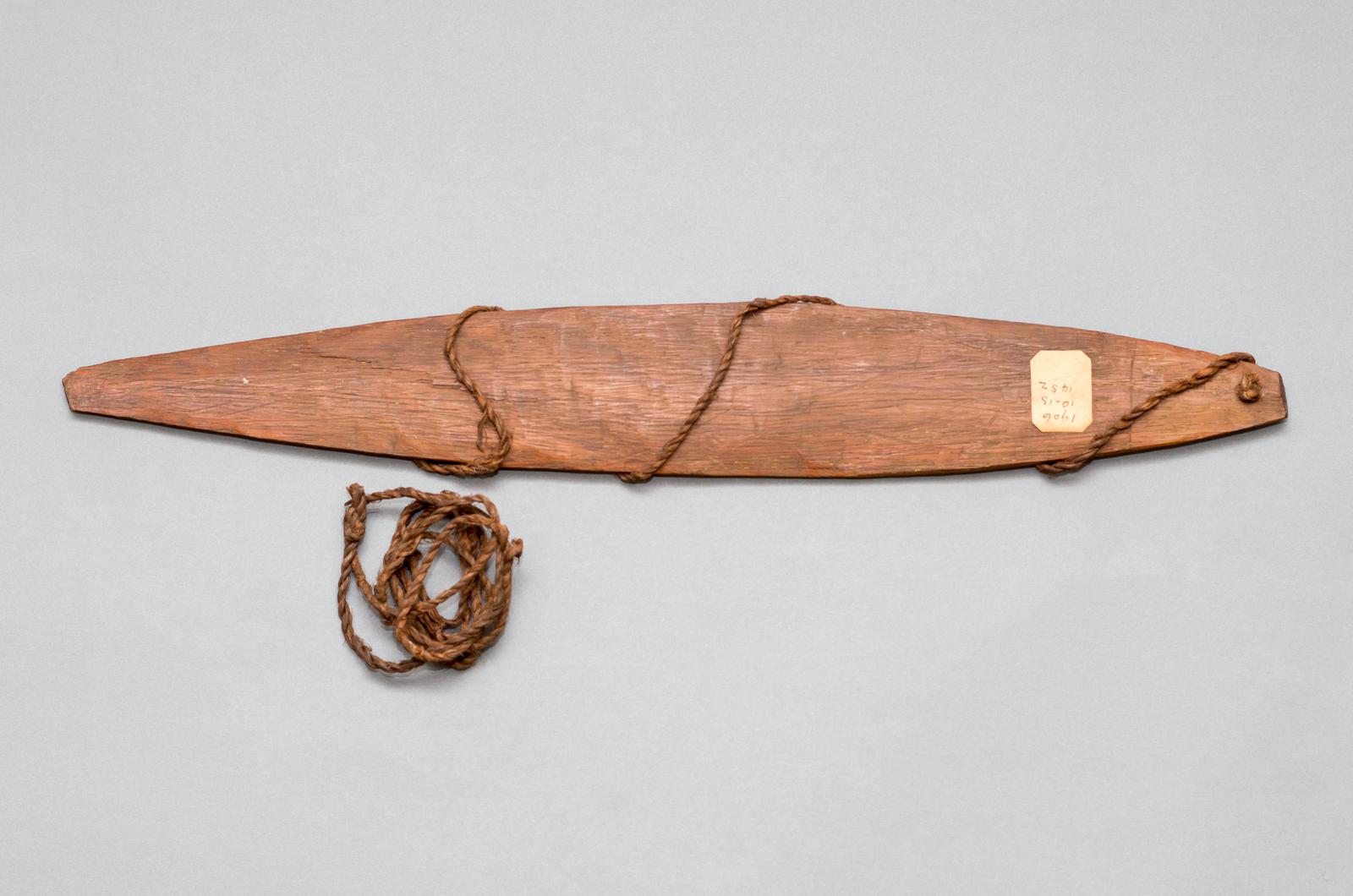
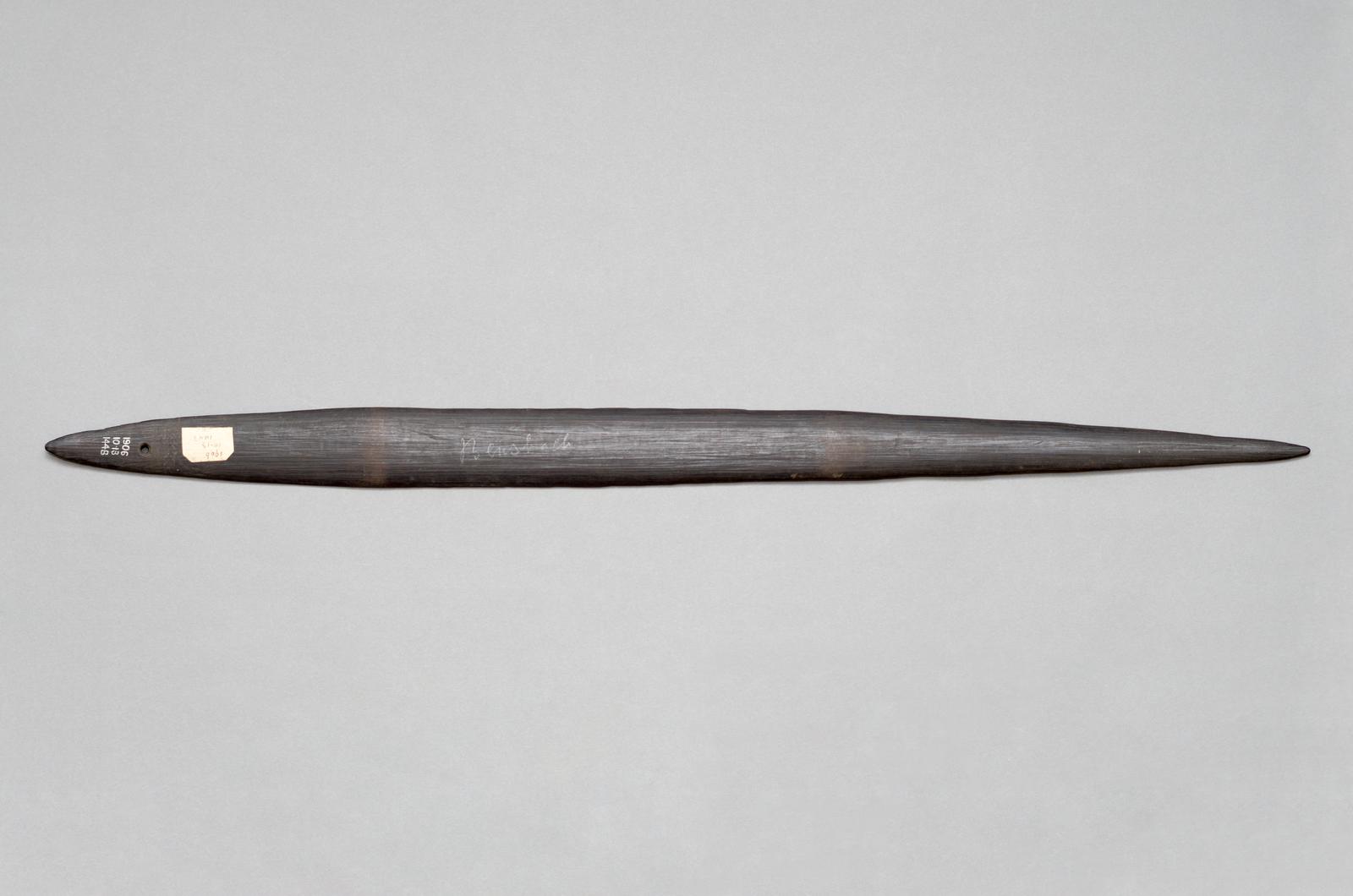
A dark wooden blade half a metre long and scarcely two fingers wide, a scrap of cord still threaded through the hole at its wider end. The Cooke Daniels expedition carried it out of the Bensbach River country of the far southwest in 1904-05 — one of three bull-roarers it brought home from separate corners of British New Guinea — and Henry Balfour entered it at the Pitt Rivers Museum as simply 'bull-roarer, Bensbach River.' A sister blade at the British Museum, 'Bensbach' handwritten across the wood, was later second-guessed as work from Waima, a Roro-speaking town on the distant coast; this one kept its river. Another Daniels blade at the British Museum kept both its river and its cord: red-stained palmwood, a K-shaped scratch on its back, the twisted coconut fibre still run through the hole. What the roarer meant to the people of the trans-Fly went unwritten.
bull-roarer, Bensbach River
Henry Balfour, "Report of the Curator of the Pitt-Rivers Museum, 1905," Cooke Daniels Expedition accessions list
Particulars
- Object
- Long, thin, undecorated bull-roarer of dark wood, 515 x 33 mm, a single hole at the wider end retaining a short cord remnant; collected by the Cooke Daniels expedition 1904-05 (Cooke Daniels number 49) and donated to the Pitt Rivers Museum in 1905 (PRM 1905.63.49). A second blade from the same expedition, in the British Museum (Oc1906,1013.1452; given by C. G. Seligman in 1906), is an ovoid palmwood blade 40.3 cm long and stained red, with an incised line and a small perforation near one end, scratched marks on the reverse including one shaped like the letter K, and its twisted coconut-fibre cord still threaded through the hole.
- Function
- Not recorded.
Source
Pitt Rivers Museum, Oxford, 1905.63.49 (Cooke Daniels expedition no. 49); Henry Balfour, 'Report of the Curator of the Pitt-Rivers Museum, 1905'; British Museum Oc1906,1013.1448 (comparison); British Museum Oc1906,1013.1452 (Daniels Ethnographical Expedition, Bensbach River, 1903-04; Seligman donation 1906)