No. MAT1898-002
Port Lincoln witarna and pullakalli
Port Lincoln · South Australia
Restricted
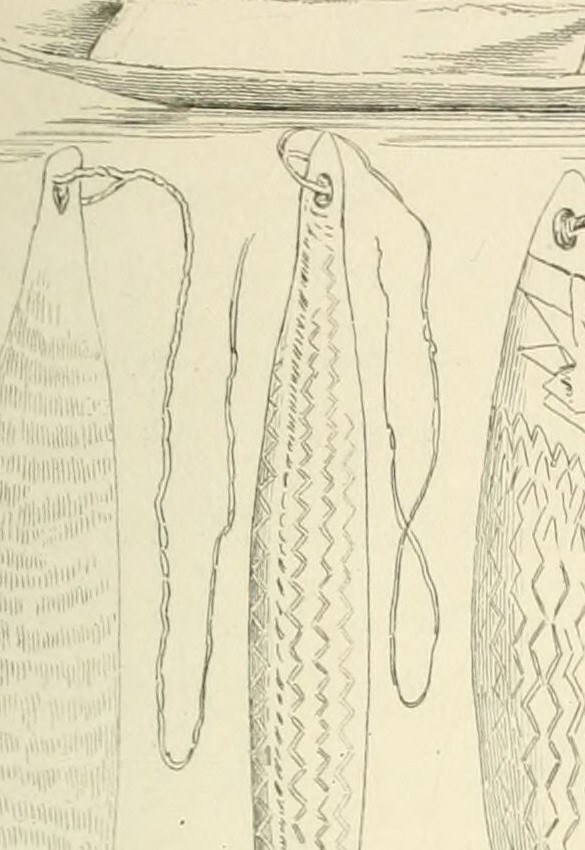
witarna / pullakalli
Source term: bull-roarer
witarna: the larger Port Lincoln (Parnkalla/Barngarla) bull-roarer, an oval wooden board swung on a string to make a deep humming sound; pullakalli is the smaller instrument.
Etymology. witarna: the larger Port Lincoln bull-roarer, an oval wooden board swung on a string to make a deep humming sound.
At the initiation ceremonies of the Port Lincoln tribes on South Australia's Eyre Peninsula, the missionary Clamor Schurmann recorded two bull-roarers: a larger one, the witarna, and a smaller, the pullakalli. In his Parnkalla vocabulary the witarna is an oval wooden object fastened to a string and swung rapidly to make a deep humming sound, used chiefly at native ceremonies. R. H. Mathews, drawing on Schurmann's 1846 report, paired the two with the Kamilaroi murrawan and mooniburribean and set down the threat held over the young men.
The novitiates were told not to betray what they had seen and heard on such occasions, or they would be speared, thrown in the fire, or have other dreadful things done to them.
R. H. Mathews, "Notes on the Aborigines of New South Wales" (1907 reprint, sec. 8, "Bull-roarers used by the Aborigines"), drawing on Schurmann's 1846 report
Particulars
- Function
- Schurmann reported larger and smaller bullroarers at Port Lincoln initiation ceremonies, with severe penalties for betrayal.
Sources
- R. H. Mathews, 'Bullroarers used by the Australian Aborigines,' Journal of the Anthropological Institute 27 (1898), pp. 52-60
- R. H. Mathews, Notes on the Aborigines of New South Wales (1907), sec. 8, “Bull-roarers used by the Aborigines” View · archived
- Schurmann, report (1846), via Mathews 1907, sec. 8 View · archived