No. MUS2026-069Oceania
Kaluli bachelors' bullroarer chase
Papua New Guinea · Mount Bosavi, Great Papuan Plateau · Oceania · Sahul
Restricted
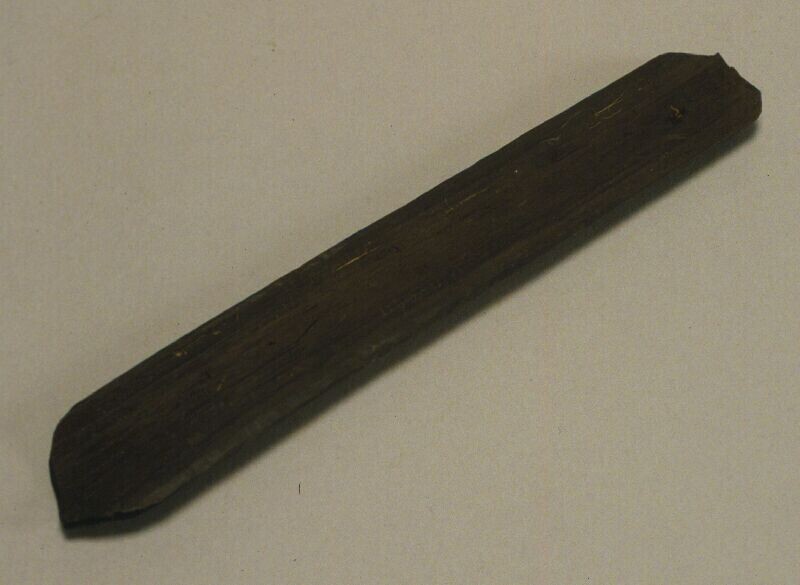
Source term: bull-roarer
"Zoemhout" is Dutch museum cataloguing for "bull-roarer" (literally "humming wood").
Four bachelors burst from the forest edge, spinning round and round and whirling tiny bullroarers, and the married men fled the clearing in mock terror. This was sibulu, the day the young hunters of a Kaluli bau a took possession of their lodge. For some fifteen months boys of eight and bachelors near thirty, none of whom had ever been with a woman, lived apart and hunted under the eye of the memul spirits, who had given the lodge to humankind and sent the game. Women were told their sons had gone off to become "like wild pigs," and must not go near. When the hunting ended the bachelors carried their smoked game home and chased the married men off once more. Decades later, men who had hunted at Wogole in the early 1940s still lit up remembering it.
Particulars
- Object
- Small wooden bull-roarer, 16.5 x 3 cm, of the Kaluli, Mount Bosavi; Wereldmuseum WM-74192 ('Zoemhout - gaso chi').
- Function
- Swung by young members of the bau a hunting lodge at its sibulu and sogono celebrations to chase the married men from the lodge clearing; the older men feigned fear.
Source
Wereldmuseum (NMVW), WM-74192, 'Zoemhout - gaso chi' (Kaluli, Mount Bosavi; wood, 16.5 x 3 cm; purchased 1968; documentation Th. G. Schultze-Westrum; record flagged by the museum as possibly non-validated),; Steven Feld, Sound and Sentiment: Birds, Weeping, Poetics, and Song in Kaluli Expression (University of Pennsylvania Press, 1982); Edward L. Schieffelin, "The Bau A Ceremonial Hunting Lodge: An Alternative to Initiation," in Gilbert H. Herdt (ed.), Rituals of Manhood: Male Initiation in Papua New Guinea (Berkeley: University of California Press, 1982), ch. 4, pp. 155–200 (sibulu and sogono celebrations)