No. SG1899-003
Roth north-west-central Queensland whirler complex
Australia · North-west-central Queensland
Restricted
pril-ling-a; mer-pul-li-mung-i; un-mun-ja; pi-ri pi-ri; wilmurra
Source term: whirler / whirring-stick / roarer
Local terms for the whirler/roarer: pril-ling-a (Pitta-Pitta), mer-pul-li-mung-i (Roxburgh), un-mun-ja (Yaroinga), pi-ri pi-ri (Kalkadoon and Mitakoodi). Hamlyn-Harris (1913) records wilmurra as the Kalkadoon name of the Queensland Museum whirler from Leichhardt (Selwyn District).
Etymology. mer-pul-li-mung-i is Roth's Roxburgh-district name for the whirler/bull-roarer; his Pitta-Pitta vocabulary glosses it 'a whirler, roarer' and flags it as a Roxburgh word. No deeper meaning or shared name is recorded.
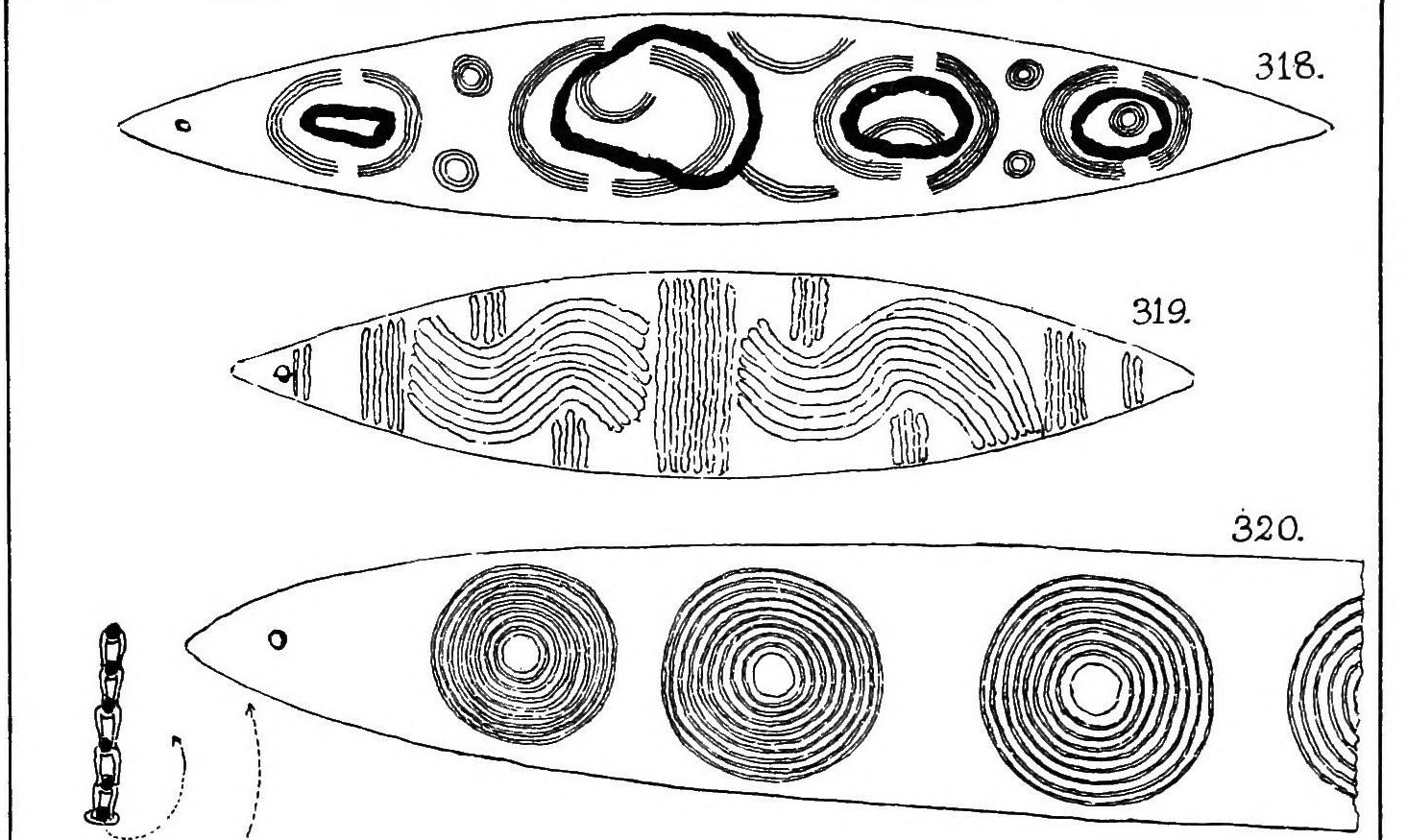
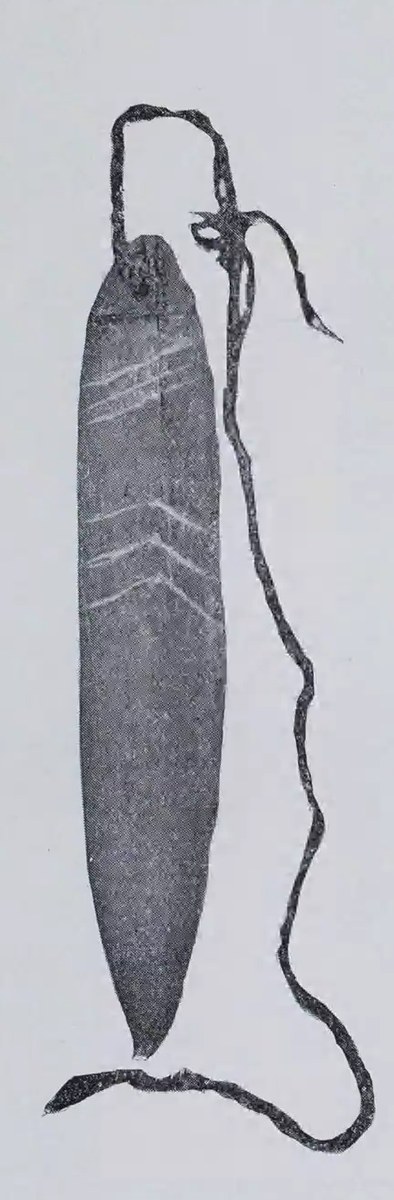
In north-west-central Queensland Walter Roth found the same flat, spindle-shaped board of gidgee wood serving three lives. A hole was drilled at one end with a sharpened emu-bone, a string fixed through it to a small stick, and the board whirled until its flat face caught the wind and roared. The plain boards, about four inches long, were toys swung by either sex at any age. The larger graved ones, seven or eight inches, belonged to the circumcision rites: when the women came too close, men sounded the whirlers as a signal to retire, and after the foreskin was cut on a "human table" of bent backs, two were sounded again to tell the women the ceremony was over. Among the Yaroinga the same object became a love-charm, learned from the Workia tribe and carved with two designs — rings of concentric circles standing for fire-sticks swung at the night camp-fires, and a pattern whose half-circles each marked a labium. A man swung it far from camp through the night so the woman he meant to marry would, without seeing anything, find herself more and more enamoured and repeatedly exclaim "I like this-fellow-boy." No woman was allowed to handle or even look at one. The settlers around Camooweal called these love-charm whirlers "gin-busters."
The charm is swung at intervals during the hours of night, at a considerable distance from camp, by males only, in the belief that the woman whom they are bent on marrying will reciprocate their passions with increased fervour. The female referred to, of course sees nothing of the web into which she is becoming entangled, though she may feel its effects.
Roth 1897, Ethnological Studies among the North-West-Central Queensland Aborigines, sect. 325, p. 182
Particulars
- Object
- Roth describes flat spindle-shaped wooden whirlers on string; smaller ungraved boards can be toys, while larger graved boards are used in initiation ceremonies, as Yaroinga love charms, and kept from women. A far larger board of the same form is in the Pitt Rivers Museum, Oxford — 1938.34.29, 445 by 59 mm, carved and pierced at one end, well over twice the length of Roth's graved boards.
- Function
- A plaything for either sex; at initiation, a signal to the women; among the Yaroinga, a love-charm.
Source
Walter E. Roth, Ethnological Studies among the North-West-Central Queensland Aborigines (Brisbane, 1897), pp. 129, 171-172 and 182, figs. 316-320