No. PNG20
Niaura
Papua New Guinea · East Sepik · Oceania · Sahul
Restricted
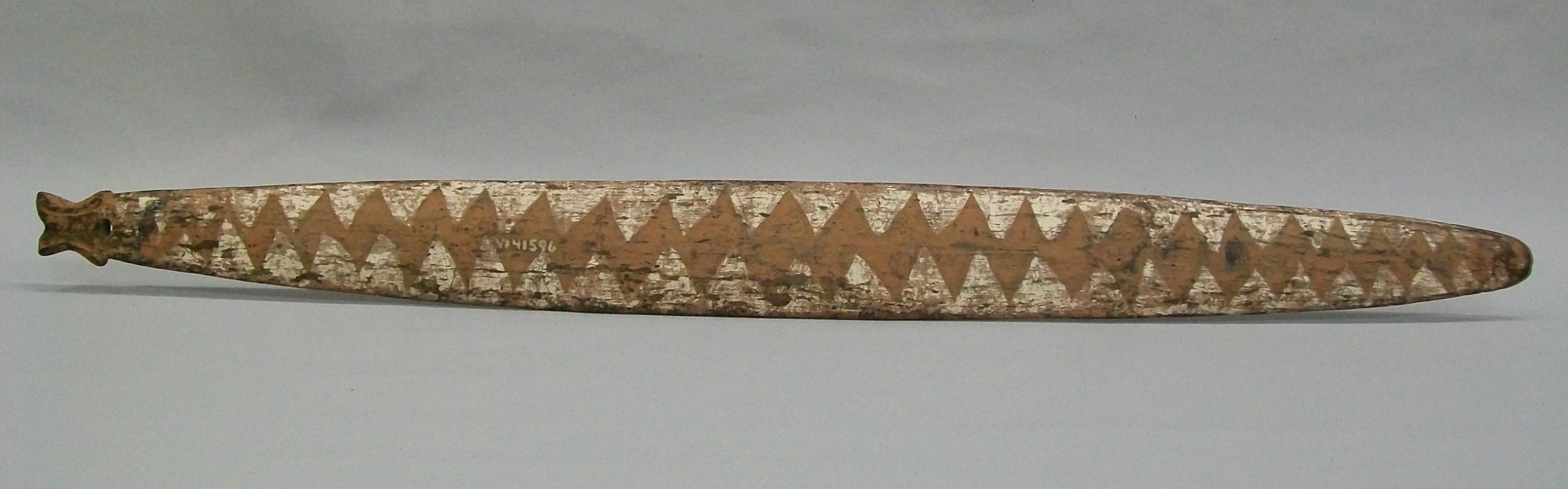
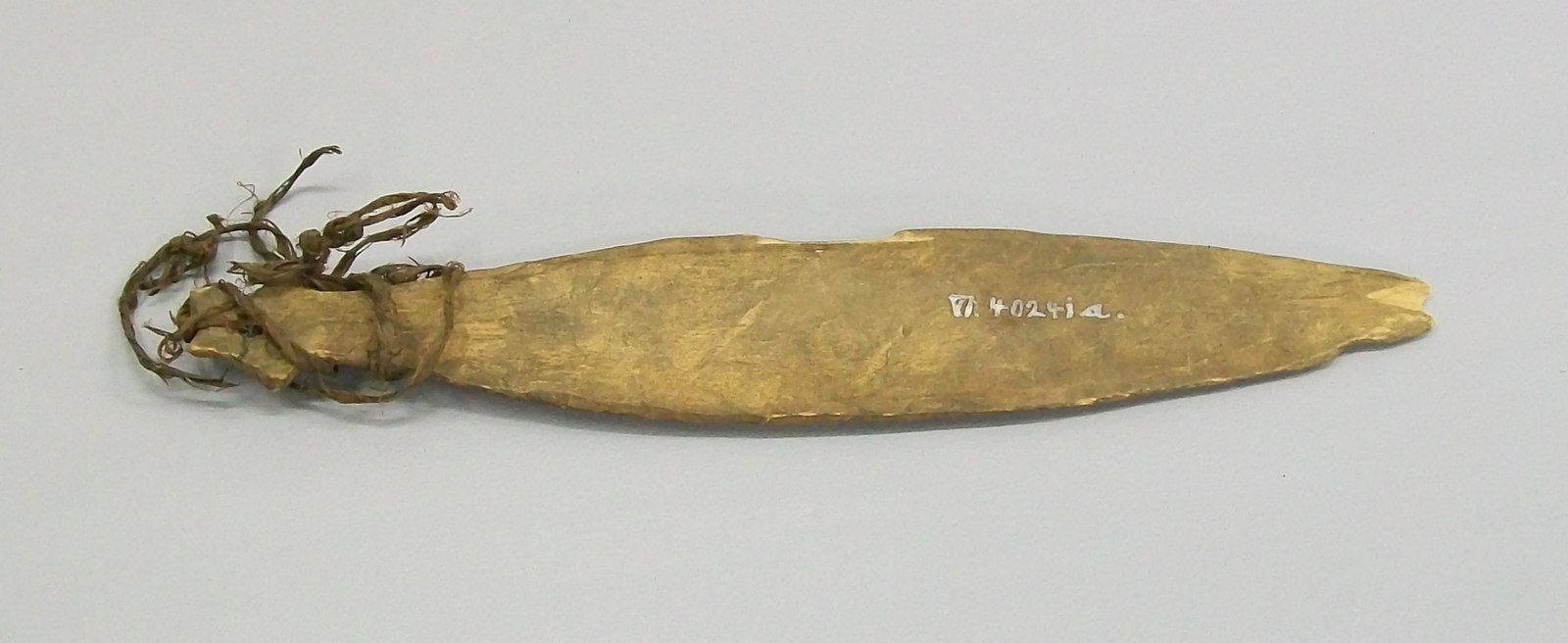
Niaura—Nyaura, the western branch of the Iatmul—names a people of the Middle Sepik who reckon descent from a great ancestral crocodile. Among the Iatmul the bullroarer and the sacred flutes are heard as the voices of mythical and ancestral beings; the flutes were played in pairs, and after the death of an important man two flutists would sound through the night beneath his house. Boys taken into seclusion in the men's ceremonial house were taught to swing the bullroarer and play the flutes as part of their initiation, and the instruments were kept hidden in the rafters and the men's house, where women and children were forbidden to see them. A 1925 photograph from the Iatmul village of Korogo, in the Chinnery collection of the National Library of Australia, shows an initiate swinging a bullroarer. Gregory Bateson, who lived among the Iatmul in 1929, saw that the secrecy was staged for an audience: the women gathered outside the ceremonial house to hear the flutes, gongs and bullroarers, and the men within, playing behind screens or in the upper storey, thought of the women as admiring their music; what they dreaded was a wrong note, and the women's laughter. His own Korogo blade, now in Cambridge, is a flat oval carrying a design of a face, starred diamonds and ovals on each side, with the design on one side filled with lime.
The bull-roarer is an esoteric instrument that is stored in the men's house and represents the voice of a certain mythical being
Ammann, "Middle Sepik music and musical instruments in the context of Melanesia," Journal de la Société des Océanistes, p. 188 n. 8
Particulars
- Object
- A 93 cm painted wooden bullroarer in Berlin, labelled as from a camp at Kaulagu — historical Korogo, in Western Iatmul country.
- Function
- Voice of a mythical being; swung by initiates in the men's house and hidden from women and children.
Source
K. A. Gourlay, Sound-Producing Instruments in Traditional Society: A Study of Esoteric Instruments and Their Role in Male-Female Relations, New Guinea Research Bulletin 60 (Canberra, 1975), Table 1, entry 20; Ammann, "Middle Sepik music and musical instruments in the context of Melanesia," Journal de la Société des Océanistes, p. 188 n. 8; Ethnologisches Museum, Staatliche Museen zu Berlin, VI 41596; Museum of Archaeology and Anthropology, Cambridge, 1930.429; National Library of Australia, E. W. P. Chinnery collection (Korogo, 1925)