No. HOWITT1904-002
Wurunjerri / Wurundjeri initiation messenger bullroarer
Australia · Yarra River · Kulin country, Victoria
Restricted
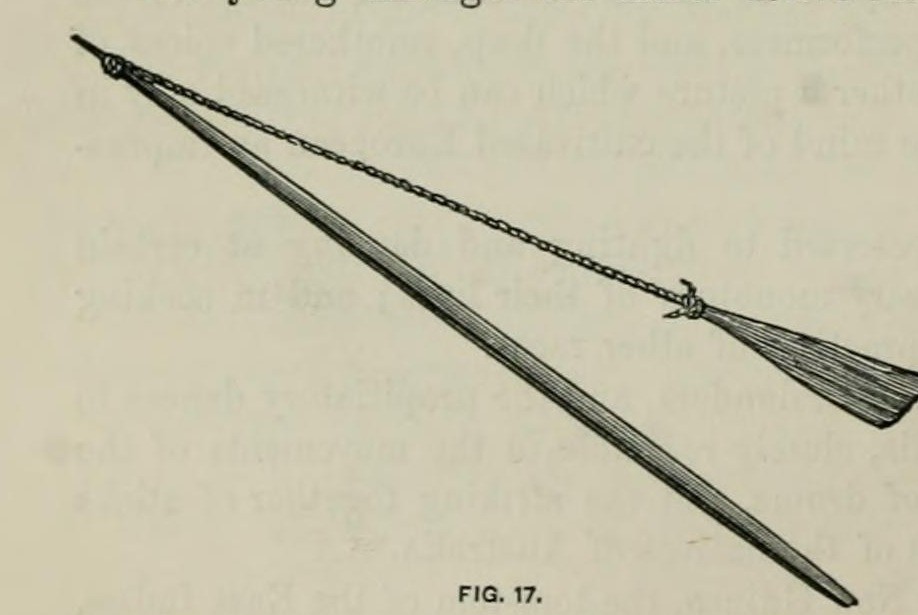
Ball-berau-gan
Source term: bull-roarer
Ball-berau-gan: Barak's Wurundjeri bullroarer term; also written Bau-berau or Berbero.
In the Kulin nation of the Yarra River, when a Wurundjeri headman wished to gather the people to make boys into men, he sent out a young messenger, a wirrigirt, hung with the emblems of his errand. For a friendly meeting he carried a man's belt and a woman's apron on a reed; to summon a fight, a jag-spear of ironbark; but when the message was to call a meeting for the initiation of boys, the Talangun, the messenger carried also a bull-roarer and a man's kilt, and that bull-roarer was kept hidden from the eyes of women and children. The detail comes from A. W. Howitt, who learned the secret of the instrument among the neighbouring Kurnai, where there were two bull-roarers: the larger, called Tundun, "the man," whose grandfather-name was Wehntwin, and the smaller, Rukut, "the woman," his wife. Howitt's Wurundjeri informant was Berak (William Barak), "an extraordinary repository of information as to his tribe." A 1901 letter preserves Barak's own word for the instrument: Ball-berau-gan.
People were always pleased to receive news, and no messenger known as such was ever injured.
Howitt 1904:700
Particulars
- Object
- A bull-roarer, carried together with a man's kilt hung on a reed.
- Function
- Initiation summons credential, carried by the messenger calling the Talangun; never shown to women or children.
Sources
- A. W. Howitt, The Native Tribes of South-East Australia (Macmillan, 1904), pp. 700-701, 609-613 View
- A. W. Howitt to Baldwin Spencer, Letter 27 (7 March 1901), William Barak’s Wurundjeri term Ball-berau-gan