No. MAT1898-011
Clarence Richmond dhooanbooka yoolundry dhalguñgun
Australia · Clarence and Richmond Rivers · Southeast
Restricted
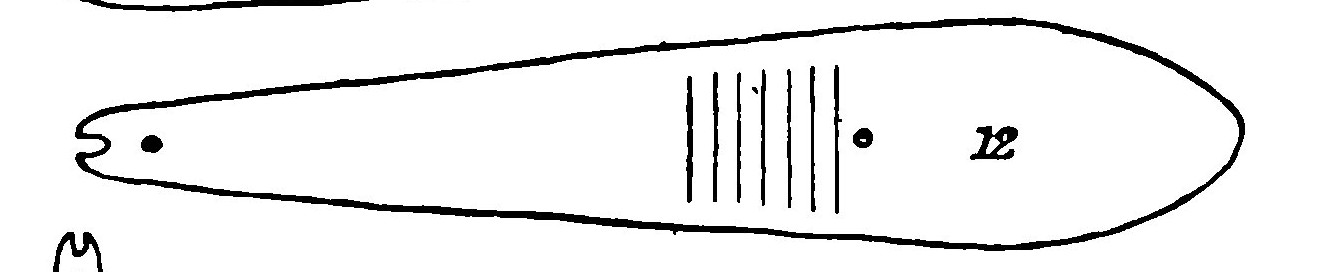
dhooanbooka / yoolundry / dhalguñgun
Source term: bull-roarer
dhooanbooka / yoolundry = the large bull-roarer of the Clarence and Richmond River tribes; dhalguñgun = its small companion bull-roarer. "Bora" and "Burbung" are regional names for the male initiation ceremony at which such instruments were swung.
Among the Clarence and Richmond River tribes of northern New South Wales, the surveyor R. H. Mathews recorded a matched pair of initiation bull-roarers: a large one, nearly two feet long, called the dhooanbooka or yoolundry, and a small companion, the dhalguñgun. Both carried the same carving — about half a dozen V-shaped devices running down the rounded face, points aimed toward the broad end, flanked by rows of dots, with a nick cut in the small end to seize the whirling string and a shallow pit and transverse lines on the hollowed back. Mathews placed every instrument on his plate within "the prominent use assigned to the bull-roarer in the initiation ceremonies" of the Kamilaroi and other tribes, and noted that the small dhalguñgun was the exact counterpart of the moonibear — the lesser roarer "sounded at the Burbung ground during the continuance of the ceremonies of initiation."
Fig. 12 represents the dhooanbooka or yoolundry, the bull-roarer in use among the Clarence and Richmond River tribes and those of adjacent districts.
Mathews 1898, "Bull-roarers used by the Australian Aborigines," Journal of the Anthropological Institute 27:52-60 (= Notes on the Aborigines of New South Wales, 1907)
Particulars
- Function
- Large and small bullroarers used among the Clarence, Richmond, and adjacent districts; Mathews describes carved markings and string attachment.
Source
Mathews, R. H. 1898, "Bull-roarers used by the Australian Aborigines," Journal of the Anthropological Institute 27:52-60; reprinted in Mathews, Notes on the Aborigines of New South Wales (1907)