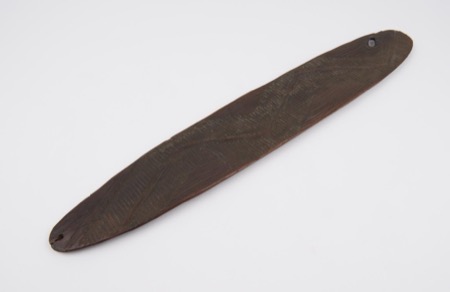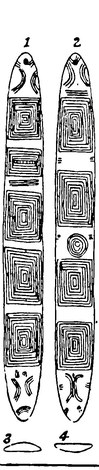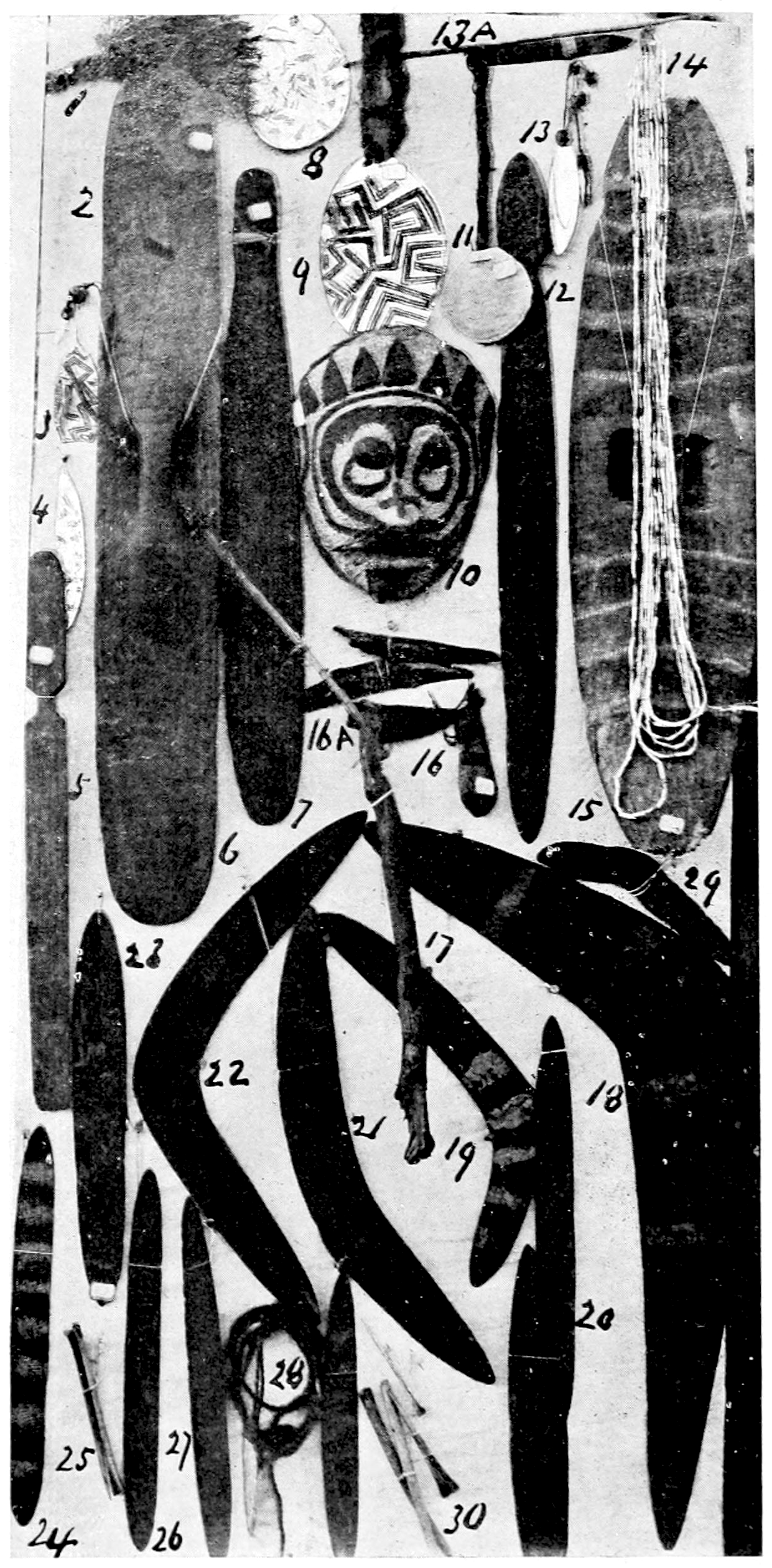
The Karajarri performer shortened the cord while the blade was still spinning. He held it upright before his belly and let it come to rest against his body. It had to touch him with its carved face; if the back touched first, he swung it again. The Karajarri call this meeting yambal, the same word as a ceremonial embrace between people. 1
A novice receives more than a secret
A Karajarri man, from the coast south of Broome, passed through a succession of rites from childhood to respected old age, and initiation went on after marriage. The first, Milya, brought blood decoration and later the piercing of his nose. Circumcision came at a later stage and followed one of two traditions, with different founders, songs, tools and procedures. 1
In the southern tradition the novice travelled along the coast with his guardians, visiting camps and inviting their people to the ceremony. At the ceremonial ground, new bullroarers made for him passed among the initiated men while he lay covered. After circumcision they were sounded and shown to him for the first time. He embraced them against his belly, was told that they were his and must be kept secret, and stayed secluded while he healed. 1
The northern wolawola tradition had its own approach. Men told the covered novice that rain was coming and he would hear thunder. When the bullroarer hung spinning on its cord, he was suddenly told to look and to embrace it as it stopped. At first the men teased him that it was a head ornament. Then they taught him its name, galiguru, and the ceremonies it served. 1
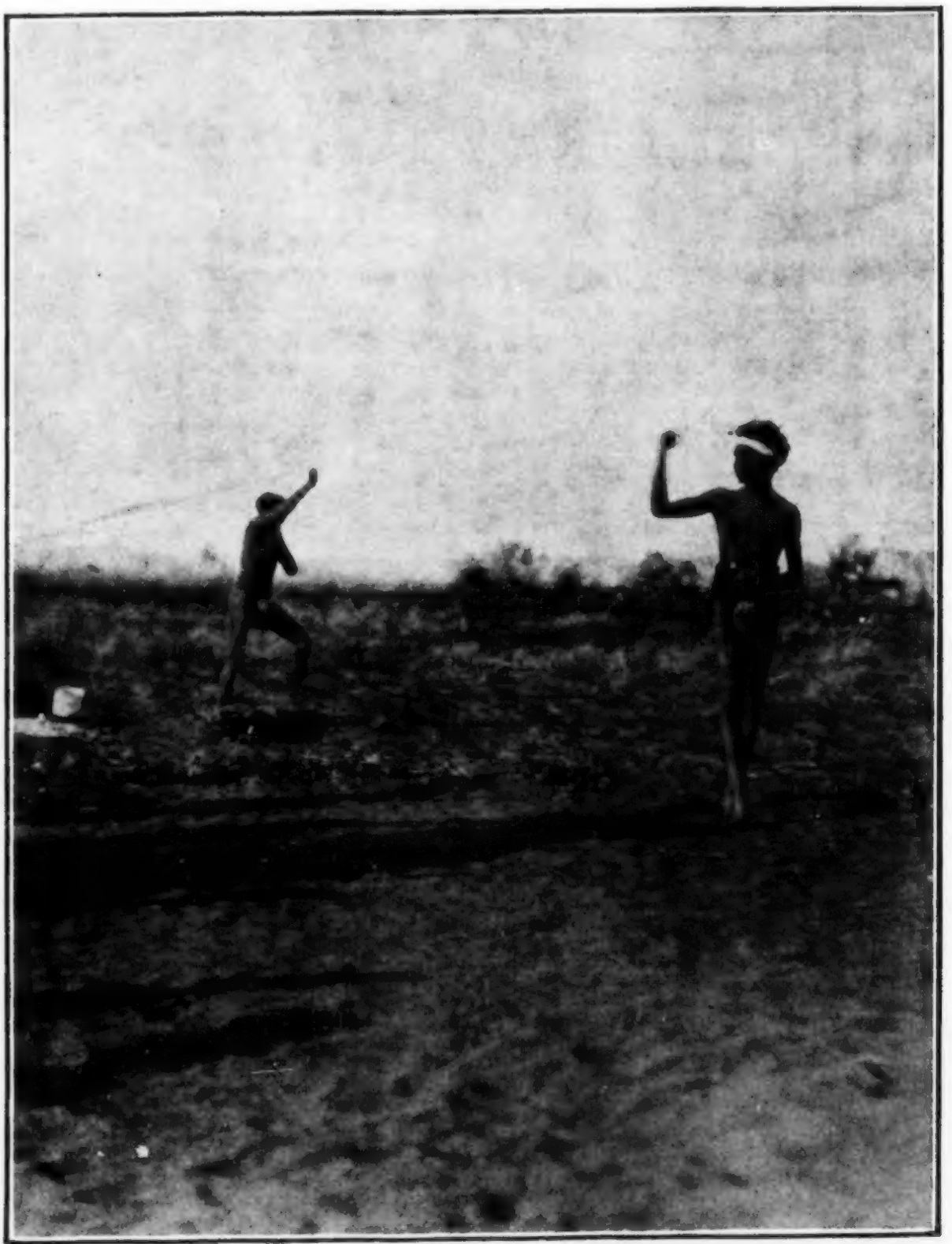
Karajarri men swinging bullroarers after circumcision, photographed by Ralph Piddington. 5
Two founding histories in one country
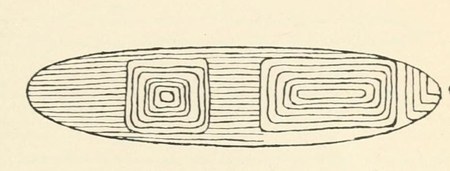
The southern tradition came from the Bagadjimbiri, brothers who first appeared as dingoes and grew into gigantic men. They travelled through Karajarri and neighbouring countries, giving names and making water sources and ways of living. Their sacred equipment included a stone knife, a galiguru and the larger pirmal, and they cut the key-shaped designs into their boards. When the younger brother tried to swing the great pirmal, its cord broke and the board flew into the long dark patches of the Milky Way. In this telling the Coalsack itself is a kangaroo the brothers speared. 1
The northern tradition gave the galiguru a zigzag design and different makers. Mirin and Panda made it while Panda’s wife Wonan was away, and hid it from her. Mirin later showed it to men who did not know its name; he named it and set its restrictions. He also instituted songs, hunting knowledge and circumcision with a shell tool. 1
On Roebuck Bay, at Broome, the Yawuru tell of Djäbulju, Grey-hair, who made the galiguru and came from the south. In the story another old man, Naldja, supplies the boomerang and club; Djäbulju also sets up the social sections and makes the increase places. The same word, galiguru, carries the board north to the Nyulnyul and Bardi of the Dampier Peninsula. 2
Djamar’s country can be carried
In 1949 Malngan, Balgalai, Damingur and Wambalag led Ernst Worms through bush and mangroves to Ngamagun Creek in Bardi country, at the tip of the Dampier Peninsula. Malngan was the acknowledged keeper of Djamar’s history; his companions added details and checked the pace of the telling. The young initiates brought there saw the places where Djamar had planted boards in stone, the trough that had held his blood and the country damaged by his powerful whirling. 3
Barda / Bardadjawa (Bardi / Baada) · Sunday Island (Bardi/Jawi), Kimberley
Djamar rose from the sea, travelled south and split the first galiguru from a tree his people call silver-blood. On Burumar sandhill its hair cord snapped as he swung it, and the board shot into the sky, into the Coalsack beside the Southern Cross: the realm of the dead, “with the fleshless,” where Djamar himself later went. He made another from a less powerful wood and sent it with Naljabi to the Karajarri at Migigi. Bardi elders repeat the making. They search out the tree under which Djamar rested, sing around it, cut it and lower it gently, then split the logs into boards and bore holes for cords of human hair. 3
Barda / Bardadjawa (Bardi / Baada) · Sunday Island (Bardi/Jawi), Kimberley · Karadjeri / Karajarri
The word galiguru covers more than the sounding blades: some boards are pierced and whirled, others kept and handled in silence. Damingur showed Worms a djidi set with pearl-shell for Djamar’s rock and yellow dots for the sea bubbling around it. People could not carry the rock to this place, he said, so they made the board, and Djamar was here. 3
Barda / Bardadjawa (Bardi / Baada) · Sunday Island (Bardi/Jawi), Kimberley
Learning to read Djamar
Some sounding boards pictured Djamar as a man. One showed young Djamar, for men who had passed subincision but were not yet fully initiated; another showed old Djamar, for senior men. Headdress and pearl-shell apron marked the difference, the same ceremonial dress the men wore themselves. The side on which a painted sash crossed his chest followed the wearer’s marriage section. 3, 4
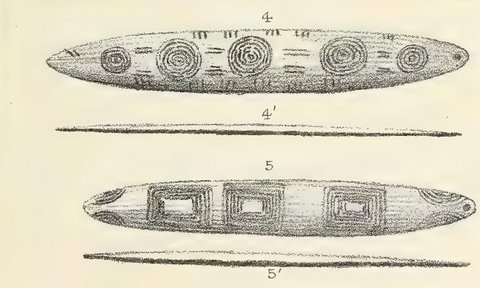
Another Bardi board drew the same being geometrically: concentric circles for the head, a spiral for the lower body and leaf-like forms for the feet. The man who explained it insisted that the realistic and geometric styles were made side by side. Reading the designs took more than one man. Men traced one half, and others carried the account on from the middle; a Karajarri speaker described it as one party singing half and another party the rest. 3, 4
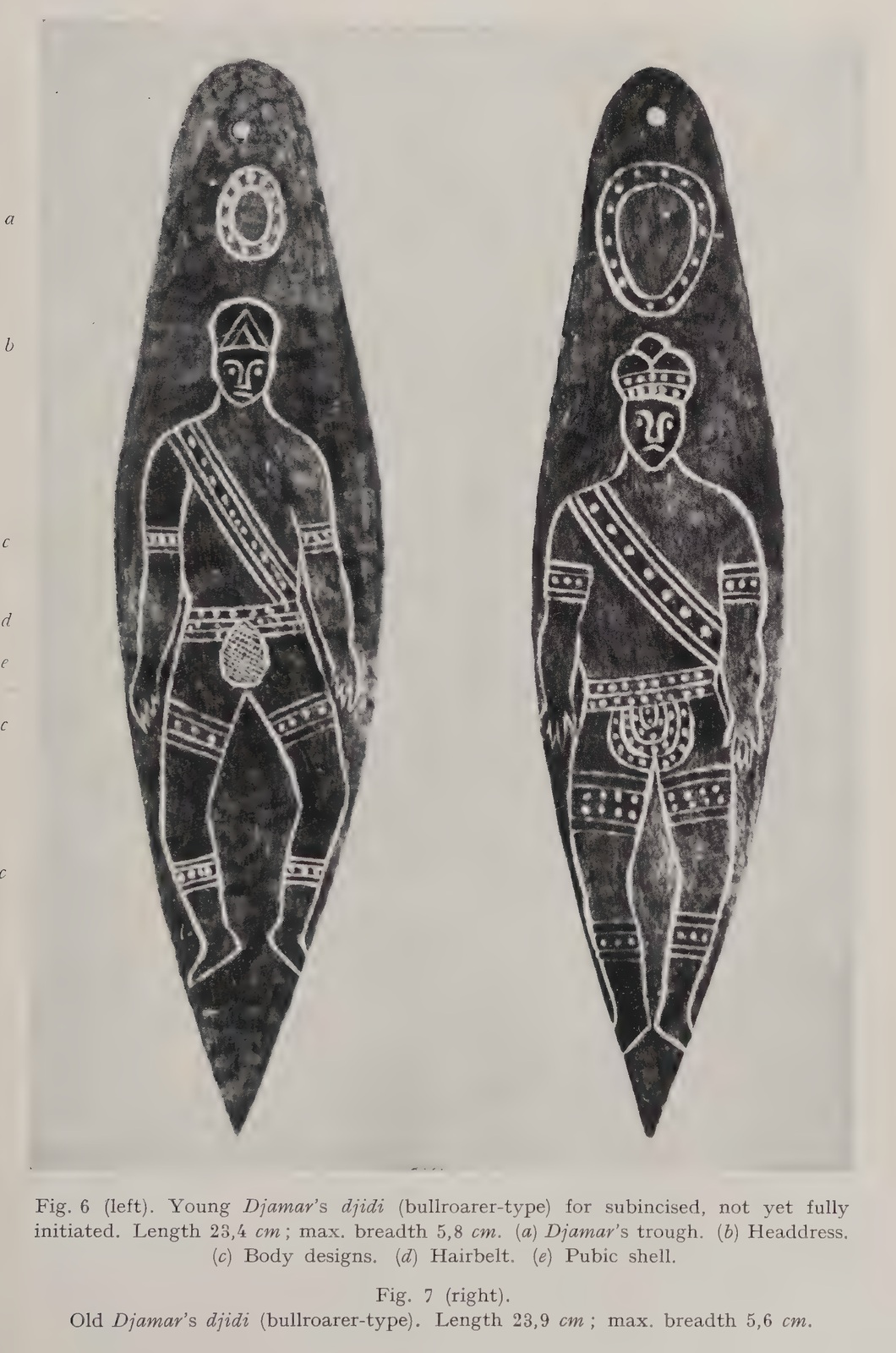
Young and Old Djamar on perforated djidi boards, illustrated by Ernest Worms in 1950. 6
A call on the coast, a board on the trade route
At Roebuck Bay, William cut a whistling-stick into shape, then spent much longer smoothing it with a piece of broken glass before adding its markings. It called a woman to a man, and it sounded at man-making ceremonies. 7
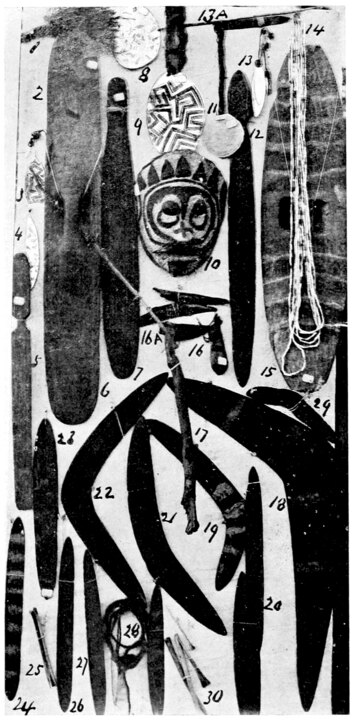
The Nyulnyul of the Dampier Peninsula made regular trading trips to Derby, Yeeda and Meda, and from Derby way they brought back a large bullroarer, the mudamud. Bardi exchanges brought spears and shells; other routes carried ochre, knives, belts and ceremonial equipment. 8, 3
Derby district · Nyulnyul (Nyul Nyul) · Barda / Bardadjawa (Bardi / Baada)
The arrival of a rite is remembered
Dugul, an old Bardi man, remembered when the malulu rites arrived from inland country to the east. Some people liked them as soon as they saw them; others turned away. He also remembered ololon giving way to nalja, and Djamar’s boards kept their place among the newcomers. 4
Barda / Bardadjawa (Bardi / Baada) · Sunday Island (Bardi/Jawi), Kimberley
Names that carry the tradition
| People | Name | Meaning or use |
|---|---|---|
| Karajarri / Karadjeri | kaliguru | Bullroarer named and received during initiation. 1 |
| Karajarri / Karadjeri | yambal | Ceremonial embrace, also performed with a sacred object against the abdomen. 1 |
| Yawuru | galiguru | The board made by Djäbulju, Grey-hair. 2 |
| Bardi | galaguru / galiguru | Sacred boards, including sounding and non-sounding forms with their own names. 3 |