No. PNG59
Busama
Papua New Guinea · Morobe · Oceania · Sahul
Restricted
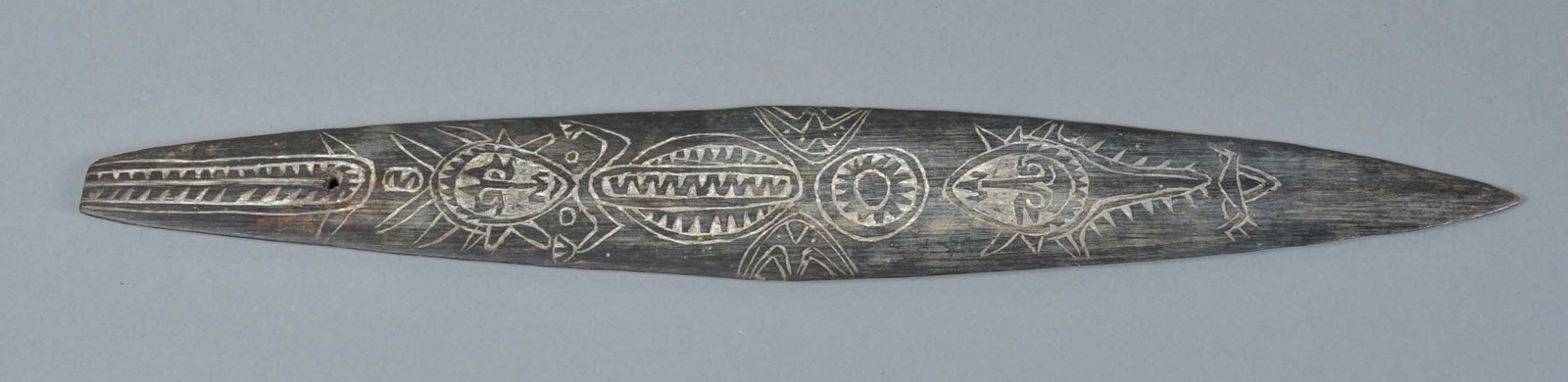
balum
Bukaua/Yabim word that names at once the bullroarer, the souls of the dead, and the monster that swallows boys at initiation
Etymology. Among the Bukawa and other Huon Gulf peoples the single word balum names at once the spirit-monster whose voice is the bullroarer and which 'swallows' and 'regurgitates' the initiation boys, the bullroarer itself, and the soul (katu) of a dead ancestor.
Busama is a large Bukawa-speaking village on the south coast of the Huon Gulf, in Morobe Province, where Ian Hogbin did his fieldwork after the Second World War and published it as Transformation Scene (1951). The Bukawa belong to a cluster of Huon Gulf peoples — with the Yabim, Kai, and Tami — for whom one word, balum, names three things at once: the bullroarer, the souls of the dead, and the monster that swallows the boys at circumcision. At initiation the novices were said to be devoured by this monster, whose roar the women and uninitiated heard as the humming of bullroarers swung by hidden men; after pigs were sacrificed the creature was induced to disgorge them, and the bites and scratches it left behind stood for the circumcision wound. Among the Bukawa each particular bullroarer bore the name of a particular dead man. At Busama the sacred flute sounded beside it. Across the Gulf on the north shore, the balum often took the form of a sea-snake. Hogbin recorded at Busama the fullest of all the Huon Gulf origin stories, and the only one in which the woman finishes the instrument herself: chopping firewood, she strikes off a chip that flies into the air with a whirring sound, and, intrigued, bores a hole in one end and strings it. Her husband borrows it to show his friends at the club house, who — having difficulty keeping the women out — see in it the means of making their cult secret, and settle on the story that it is the voice of a spirit no woman may see on penalty of death. One woman already knows, and would laugh at them. She is speared to death and her remains buried, and the women are told that an ogre has eaten her.
the tribal initiation, of which circumcision is the central feature, is conceived by them, as by some Australian tribes, as a process of being swallowed and disgorged by a mythical monster, whose voice is heard in the humming sound of the bull-roarer.
Frazer, The Golden Bough (abridged ed., 1922), ch. 67 "The External Soul in Folk-Custom"
Particulars
- Object
- Both the bullroarer and the slit-gong are in use here.
- Function
- Voice of a spirit represented as an enormous crocodile; women and children hid when they heard it.
Source
K. A. Gourlay, Sound-Producing Instruments in Traditional Society (New Guinea Research Bulletin 60, Canberra, 1975), Table 1, entry 59, and pp. 81, 101, after Ian Hogbin, Transformation Scene (London, 1951), pp. 214–215; J. G. Frazer, The Golden Bough, abridged ed. (London, 1922), ch. 67