No. EXH2026-038
Biliau (Rai Coast)
Papua New Guinea · Biliau, Rai Coast (Madang, near Saidor) · Oceania
Function not recorded
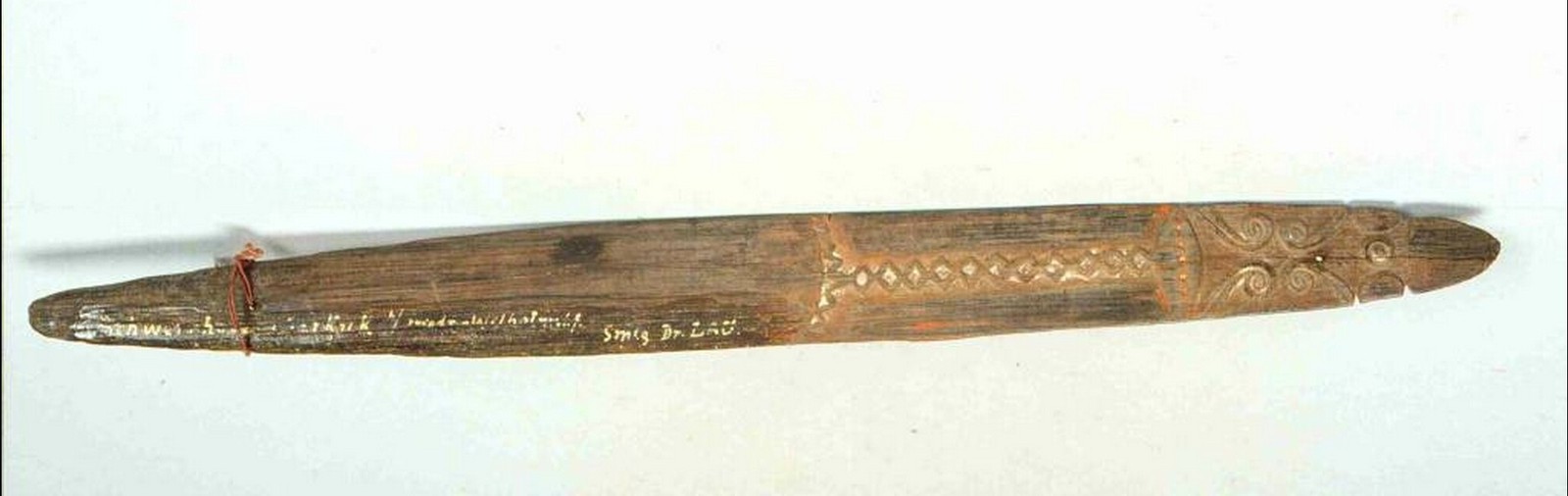
Source term: Schwirrholz
Schwirrholz = German for bullroarer (literally "whirring wood").
Black wood cut with zigzags, white pigment worked into the gaps along two-thirds of one face: Georg Höltker, the Divine Word missionary who collected on the Rai Coast in 1936–39, brought this heavy 47-centimetre blade back from the Biliau area. Even he could not name the wood, though he doubted it was palm. Two notches at the top show where its lost cord was tied.
Schwirrholz aus der Gegend von Biliau (Rai-Küste)
Bullroarer from the Biliau region (Rai Coast)
Georg Höltker, "Tapa-Mäntel und Schambinden, Schwirrholz und Häuserschmuck von der Rai-Küste in Nord-Ost-Neuguinea," Festschrift Alfred Bühler (Basel, 1965), p. 217, fig. 8
Particulars
- Object
- Black wooden bullroarer, 47 cm long and up to 6 cm wide. About two-thirds of one face is decorated with incised zigzag lines, with white pigment in the spaces between them. Two upper notches held its now-missing cord. The wood is heavy, of unidentified species and judged unlikely to be palmwood by Höltker.
- Function
- Not recorded.
Source
Georg Höltker, "Tapa-Mäntel und Schambinden, Schwirrholz und Häuserschmuck von der Rai-Küste in Nord-Ost-Neuguinea," in Carl A. Schmitz and Robert Wildhaber (eds.), Festschrift Alfred Bühler (Basel: Pharos-Verlag, 1965), pp. 197–219, esp. pp. 216–217, fig. 8; University of Fribourg, Sammlung Höltker no. 578