No. MUS2026-070
Payu, voice of the dead
Indonesia · Mimika regency, South Papua · Oceania · Sahul
Restricted
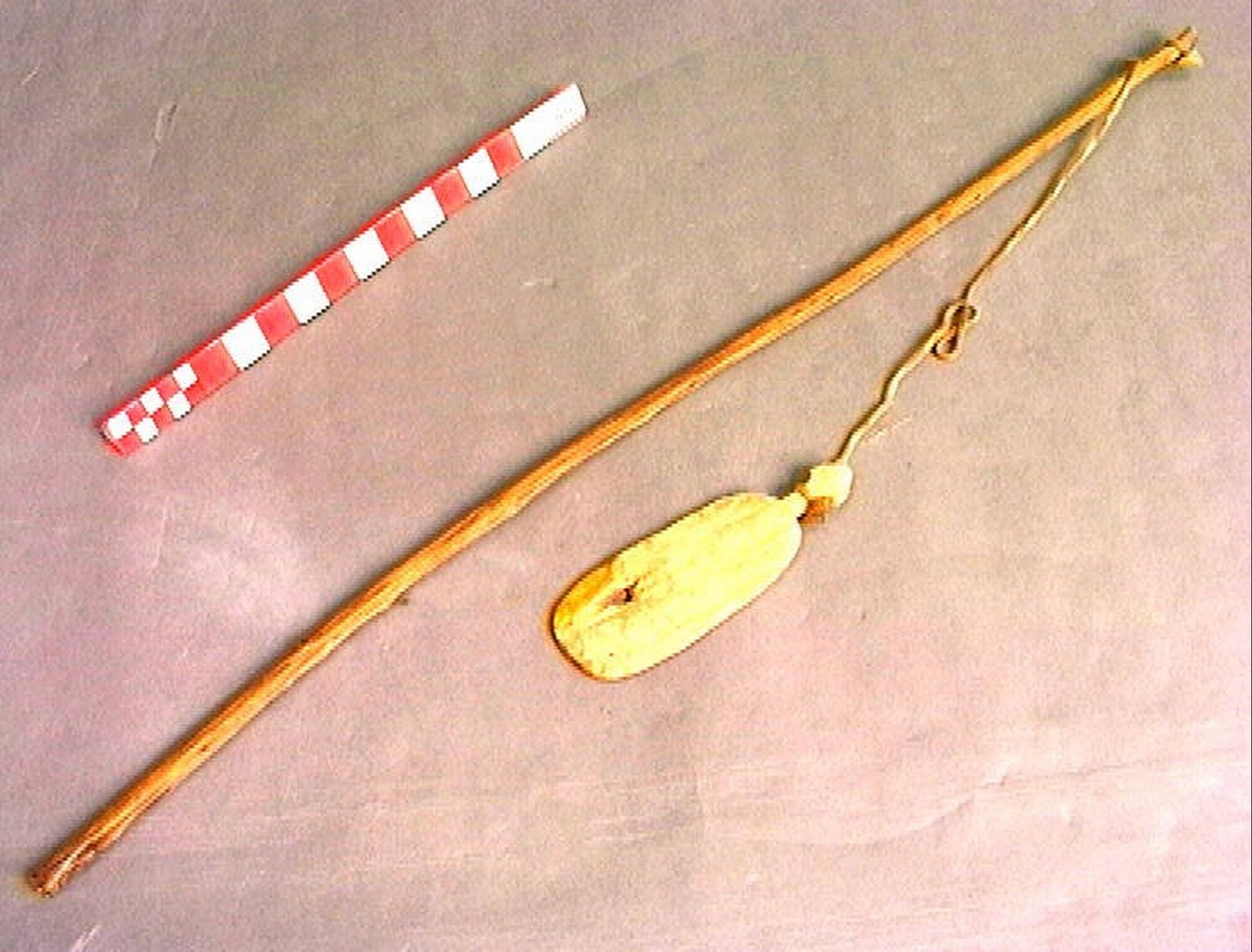
payu / mirapoway
Source term: bull-roarer
payu (also mirapoway): Kamoro word for the bullroarer, a 'very secret' instrument representing the voices of the dead, hung in the ceremonial house at Kaware feasts (Kamoro/Mimika). Pouwer 2010:54.
A Kamoro bull-roarer from the Mimika coast of southwest Papua, now in the Wereldmuseum (the former Rijksmuseum voor Volkenkunde) in Leiden. For what such an instrument did among the Kamoro the fullest account is Jan Pouwer's ethnography, drawn from fieldwork begun in the early 1950s. Swung on a string, the whirring of the bull-roarer was the voice of the dead. In the Ema Kame rites three sacred rattles (wayiri) spoke for a founding ancestress, her husband, and her "children," the peraeko, their three voices matched to three ancestral shields. In the Kaware feasts the "very secret" bull-roarers, called payu or mirapoway, were hung from the roof of the ceremonial house among the lances and the paired hunting-dog images, representing the voices of the honoured dead. Kaware’s origin story reaches into the world of the dead. Muanuru-from-above descends there and overhears a watersnake teaching his namesake the proper Kaware song. Trapped by spirit poles and wounded with arrows, the visitor is rescued and returns to earth with ritual paraphernalia and garden produce. Kaware is then celebrated among the living.
Very secret bullroarers (payu or mirapoway), representing the voices of the dead, new wooden sago bowls, equipment for pounding sago, and paddles are also suspended from the roof.
Pouwer 2010, Gender, ritual and social formation in West Papua, p. 54
Particulars
- Object
- Bull-roarer of the Kamoro, Wereldmuseum / NMVW (acc. RV-3070-90).