No. CAPELL1956-015
Alawa dudugulindji
Australia · Southern tributaries of the Roper River, upstream of the Hodgson River mouth, Northern Territory · Arnhem Land
Function not recorded
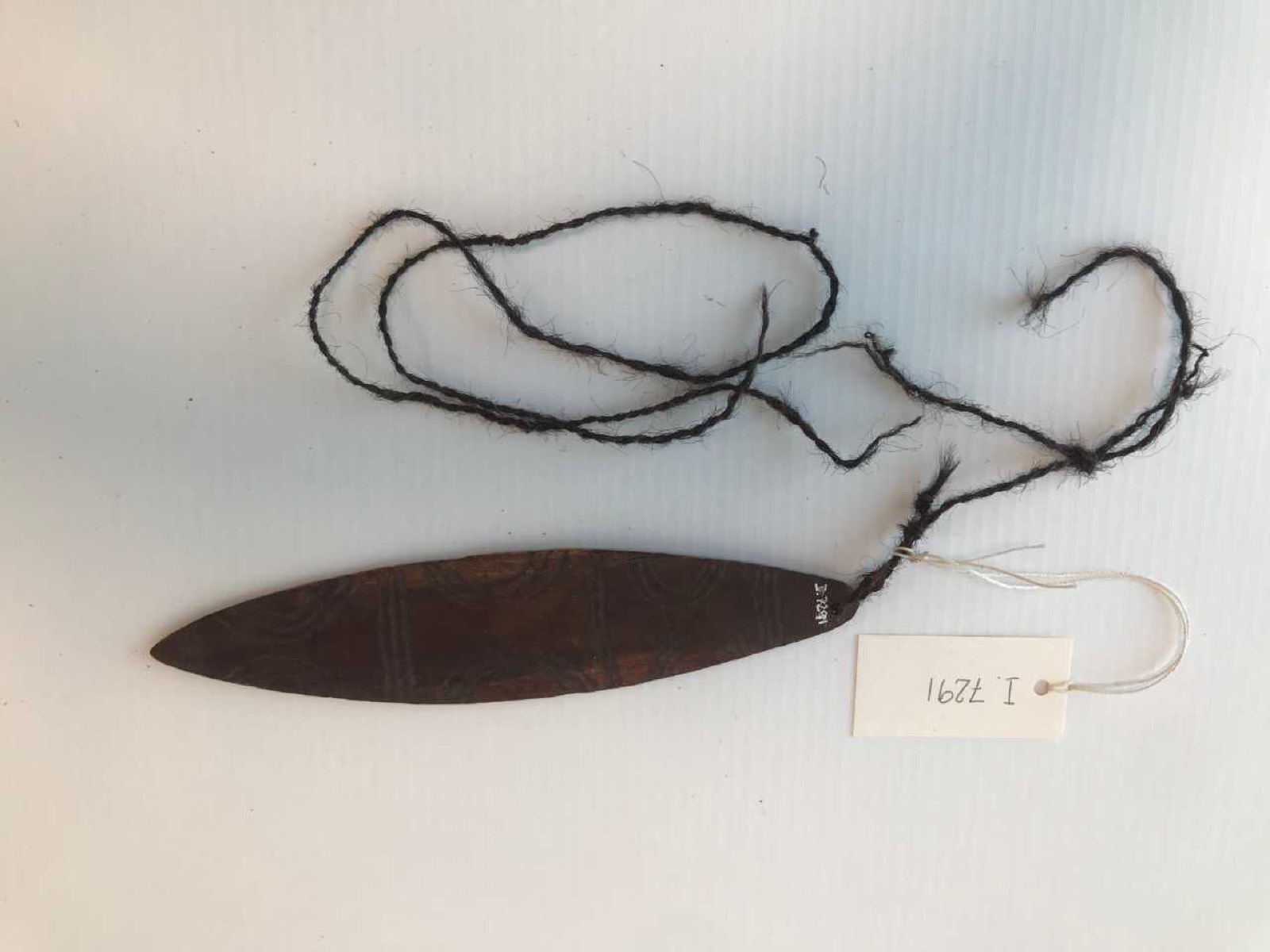
dudugulindji
Source term: BULLROARER: dudugulindji
dudugulindji: bullroarer (Capell 1956, p. 18, BULLROARER column)
Alawa speakers called the bullroarer dudugulindji. Their country lies along the southern tributaries of the Roper River, and the Alawa tell how the Mother, Gadjeri, rose out of the sea to rest on a sandbank at the Roper's mouth, then travelled upstream. Her daughters, the Mungamunga girls, merge into her when they go into the water: she comes out as one person, and on dry land stands again as the Mother among her girls. Through this country the Mother is also Kunapipi, and her husband is the Rainbow Snake. The neighbouring Mara called the bullroarer mamuna, the name of the Mother whose voice it is.
Particulars
- Object
- A bullroarer, called dudugulindji; its form is not recorded.
- Function
- Not recorded.
Sources
- Arthur Capell, A Vocabulary of 600 Words in Forty North Australian Languages (typescript, Sydney, 1956), State Library of New South Wales A 6929, p. 18 View
- Ronald M. Berndt, "Gadjeri", in Lindsay Jones (ed.), Encyclopedia of Religion, 2nd ed. (Detroit: Macmillan Reference, 2005), vol. 5, pp. 3249-3251
- Chris Knight, "Menstrual Synchrony and the Australian Aboriginal Rainbow Snake", in Thomas Buckley and Alma Gottlieb (eds), Blood Magic (Berkeley, 1988), pp. 232-255 View