MUS2026-368 - museum specimen
Witchetty-grub churinga with its hollow grip
Newcastle Waters, Northern Territory (historic South Australia attribution)
Restricted
Churinga ilkinia (Penn catalogue); peeta (collector J. T. Huston)
Source term: Bull-Roarer
churinga ilkinia: churinga, a sacred or secret thing; ilkinia, in Spencer and Gillen, the sacred designs that belong to a totem. The collector wrote the name as peeta.
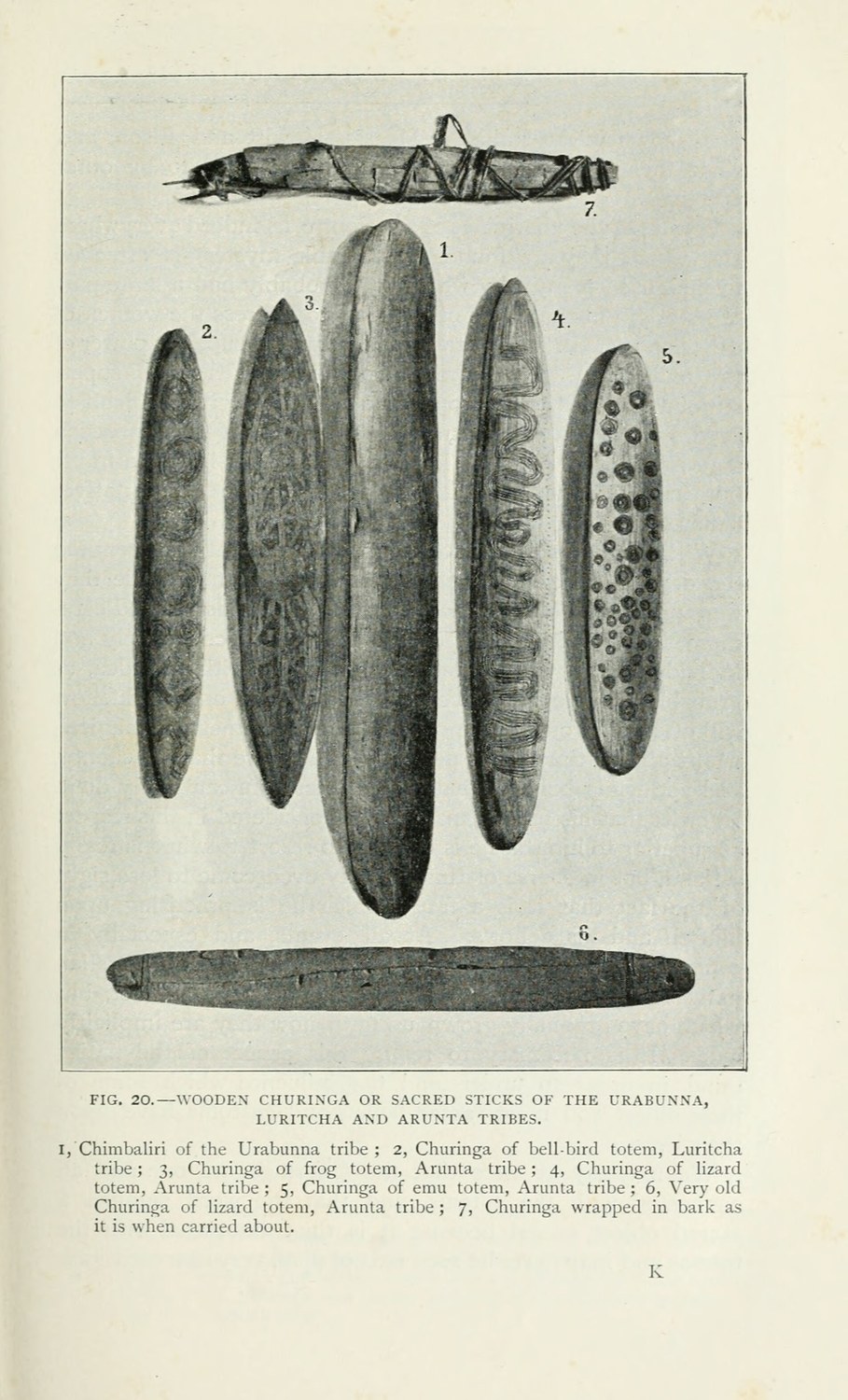
An old catalogue card gives this board its meaning in three words: "Witchitee grub totem." Among the Arrernte, to whom the museum attributes it, the witchetty grub was food and ancestor at once. Each man of the totem kept, beside his churinga, a few small round stones standing for the eggs that filled the bodies of the first grub people; when he lay dying they were fetched from the sacred storehouse, set beneath his head, and afterwards buried with him. Three spirals joined by straight lines run down the front of the pointed blade and four down its back, and its own hollow wooden grip survives with it.
Usually the older witchetty men carry a small number of these about with them, and when a man is dying a few of them are always placed under his head, being brought from the Ertnatulunga for this special purpose
Baldwin Spencer & F. J. Gillen, The Native Tribes of Central Australia (1899), pp. 156-157
- Object
- Pointed wooden blade, 35 x 6 cm, incised on the front with three spirals linked by horizontal lines and on the back with four; a small carved hole at one tip. A separate hollow wooden handgrip survives with it, now on a modern synthetic cord with a metal fastening.
- Function
- A board of the witchetty-grub totem (catalogue card); its own ceremony is not recorded. Among the Arrernte, bored wooden churinga were the bull-roarers of men's ceremonies and were kept from women and the uninitiated.
- Source
- Penn Museum P1856; culture Arrernte, provenience Newcastle Waters, Northern Territory; Late Colonial period, 1850-1900; gift of J. T. Huston, 1907; catalogue card "Witchitee grub totem." Context: Spencer & Gillen, The Native Tribes of Central Australia (1899), pp. 124, 128, 143, 156-157
- Source location
Page references
P1856; catalogue-card transcription
- Source confidence
- low to medium
- Location note
- Newcastle Waters, the provenience recorded by Penn; the exact collecting spot is unrecorded.
- Initiation rite
- Forbidden to women