No. MUS2026-389Oceania
Kangulut obip san for pig magic
Papua New Guinea · Kangulut, Yupno valley, Finisterre Range · Oceania
Sacred / spirit
obip san
Source term: Schwirrholz | obip san
obip san - the Yupno name written for this blade; the card guesses the wood came from the obip tree.
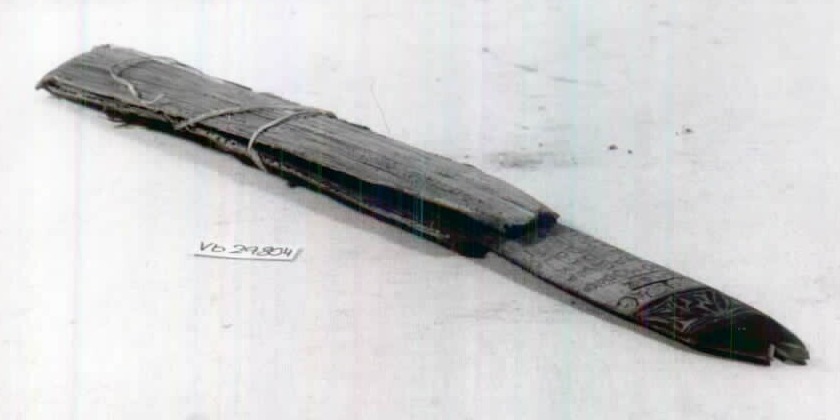
At Kangulut, in the Yupno valley high in the Finisterre Range, this short pointed blade worked pig magic. Its maker cut a pattern into the back and names into the front, then rubbed the grooves with mangot, a red earth, and simbu, a black paste made from the sap of the simbu tree. Verena Keck, who worked among the Yupno, brought it to Basel in 1988 still half-bound in its tied wrapping. Pigs and the bullroarer were old partners in these valleys: elsewhere among the Yupno, men told the women that the roar from the men's house was a hungry spirit crying to be fed, and ate the pigs the women brought it.
Particulars
- Object
- A 28 cm wooden blade narrowing to a point, incised on both faces, with names cut into the front, coloured with red earth (mangot) and a black tree-sap paste (simbu); photographed half-bound in a tied wrapping (MKB Vb 29804).
- Function
- Used in pig magic.