No. RAPPAPORT1999-001
Warlpiri bullroarers of the Mamandabari heroes
Central Australia · Tanami Desert · Warlpiri country
Restricted
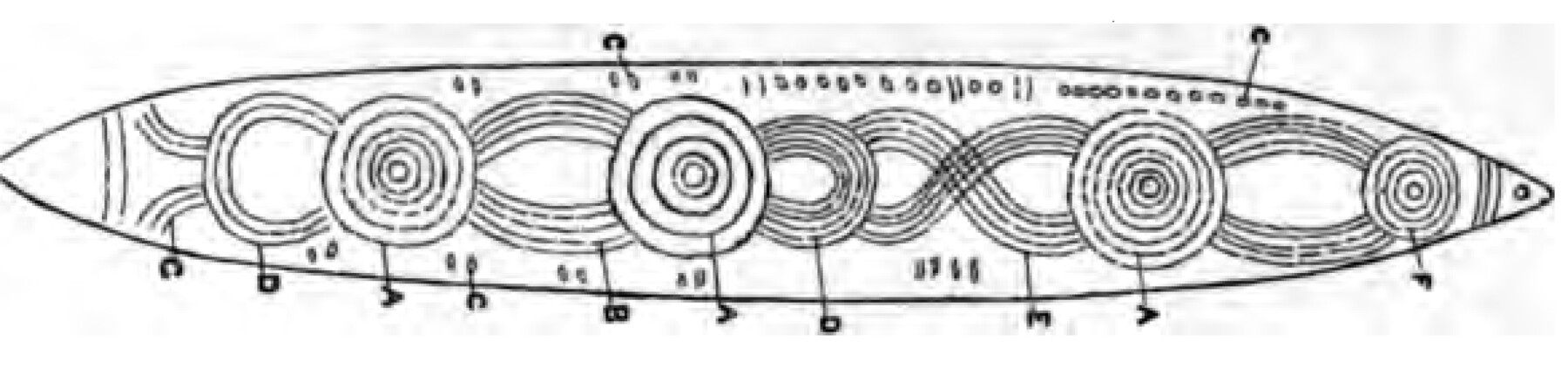
Source term: bullroarers
In the Warlpiri telling, the bullroarer came from the Mamandabari, two male Dreaming heroes who rose out of the ground in the north and walked southward across the Tanami country, founding as they went the circumcision rites, the raising of sacred poles, the digging of ritual pits, and the use of fire. M. J. Meggitt, who worked among the Warlpiri at Hooker Creek (Lajamanu) in the 1950s, translated the long Mamandabari myth and set out the meaning of the incised designs carried on the bullroarers, which encode the heroes' route and the order of the rite. The whole complex is classed as Gadjari, the "Big Sunday," staged yearly and forbidden to women, with novices held in seclusion. Three decorated Warlpiri wooden bull-roarers from Ali Curung and Yuendumu, collected in the late 1960s, are now held in the Royal Museum for Central Africa at Tervuren.
And as they make their way singing the world, their creative song is augmented by the roar of the incised bullroarers, which they swing continuously.
Roy A. Rappaport, Ritual and Religion in the Making of Humanity (Cambridge University Press, 1999), p. 213, after M. J. Meggitt
Particulars
- Object
- Incised bullroarers in the Gadjari/Mamandabari ritual-myth sequence; AfricaMuseum/RMCA also records three decorated Warlpiri wooden bull-roarers from Ali Curung and Yuendumu (MO.1969.34.4, MO.1969.34.5, MO.1969.34.6). A narrow blade of the same kind is in the Pitt Rivers Museum, Oxford — 1952.10.15, just 184 by 22 mm, grooved across both faces beneath a coat of red ochre.
- Function
- Swung in the Gadjari initiation cycle; their incised designs map the Mamandabari heroes' track, the ceremonial grounds and the novices.
Sources
- Roy A. Rappaport, Ritual and Religion in the Making of Humanity (Cambridge University Press, 1999), pp. 159-160, 213-214 View
- M. J. Meggitt, Gadjari among the Walbiri Aborigines of Central Australia, Oceania Monograph 14 (1966), pp. 5, 8, via Rappaport 1999 View
- M. J. Meggitt (1965a), pp. 8, 34, via Rappaport 1999
- AfricaMuseum / RMCA, object MO.1969.34.4
- AfricaMuseum / RMCA, object MO.1969.34.5
- AfricaMuseum / RMCA, object MO.1969.34.6