No. PNG10
Abelam (incl. Maprik)
Papua New Guinea · East Sepik · Oceania · Sahul
Restricted
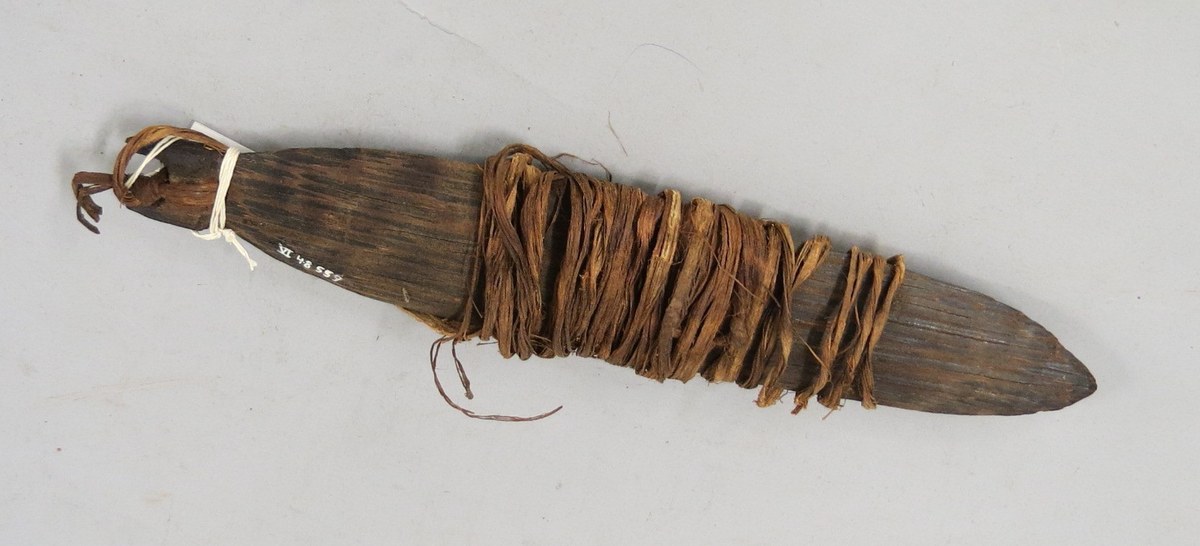
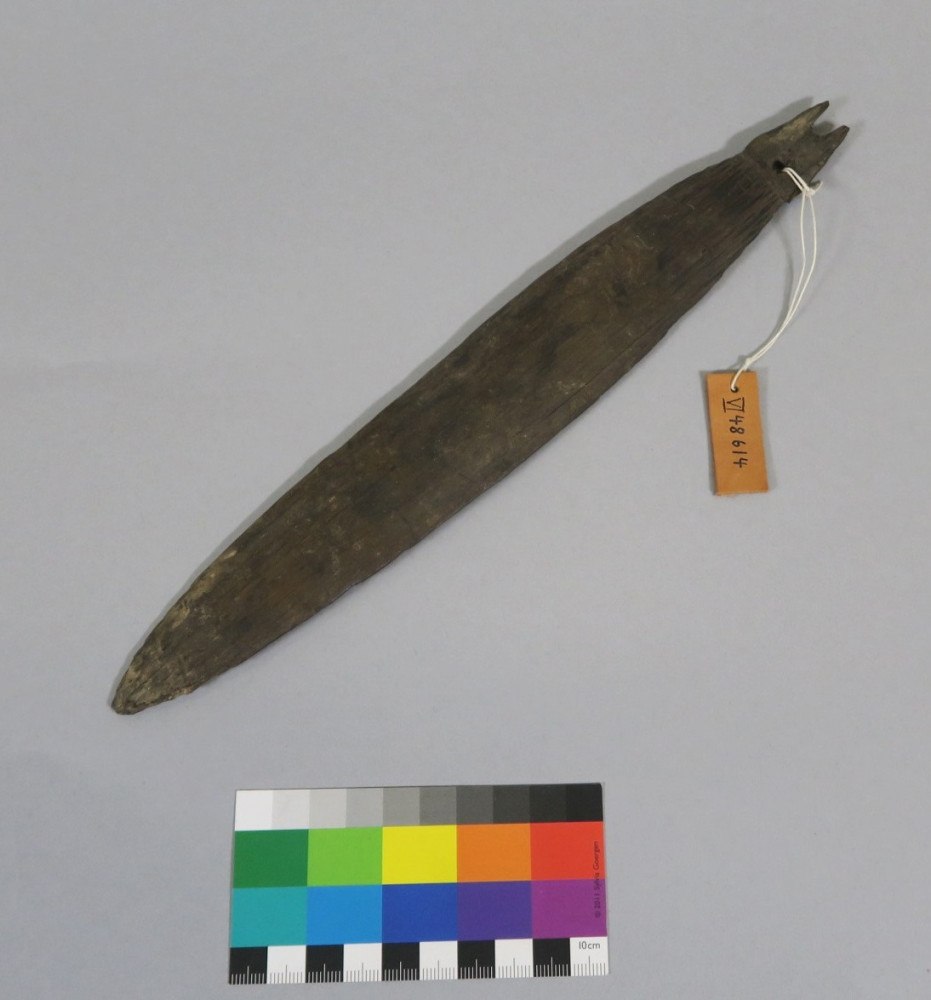
ulke / wulké; puku
wulké: Ambulas 'bullroarer'; puku: 'club (pig); bullroarer.'
Etymology. Ulke is the Abelam name for mostly female spirit beings of the bush pools, and also for the second grade of male initiation and its double-sided carvings (Hauser-Schäublin). The 1965 Berlin blade is catalogued as ulke-maira; maira means "miracle" or "secret", the word often rendered in Tok Pisin as tambaran.
Among the Abelam of the Maprik hills in Papua New Guinea's East Sepik, the bullroarer was one of a battery of hidden sound-makers, alongside flutes, ocarinas, resonators, soundboards and trumpets, whose sounds were taken for the voices of spirits. The great spirit ngwalndu, the clan being with whom a man's soul is thought to go and live after death, was known to women and the uninitiated only as noises issuing from the towering, triangular korambo, the men's ceremonial house. Initiation unfolded in many grades across decades, the first when a boy was five or six and the last between thirty and fifty, reaching at its height the rooms inside the spirit house where painted carvings of the ngwalndu were finally shown. The Berlin Ethnological Museum holds an Abelam bullroarer collected in 1965 under the name ulke-maira; ulke, the ethnographer Brigitta Hauser-Schäublin records, is the term for predominantly female spirit beings, associated with pools in the bush. In Ambulas speech the instrument is wulké, or puku, a word that serves for pig club and bullroarer alike.
Wulké lé bulu.
The bullroarer sounds.
Ambulas dictionary (SIL Papua New Guinea), entry wulké
Particulars
- Object
- Swung alongside flutes and slit-gongs; an Abelam blade collected in 1965 under the name ulke-maira is in the Berlin Ethnological Museum.
- Function
- Joined flutes and slit-gongs as the voices of spirits.
Source
K. A. Gourlay, Sound-Producing Instruments in Traditional Society, New Guinea Research Bulletin 60 (Canberra, 1975), Table 1, entry 10, and p. 53; Brigitta Hauser-Schäublin, "The String Bag of the Tambaran" (ANU Press), p. 61; Ambulas dictionary (SIL Papua New Guinea), entries wulké and puku