No. EECHOUD1952-001
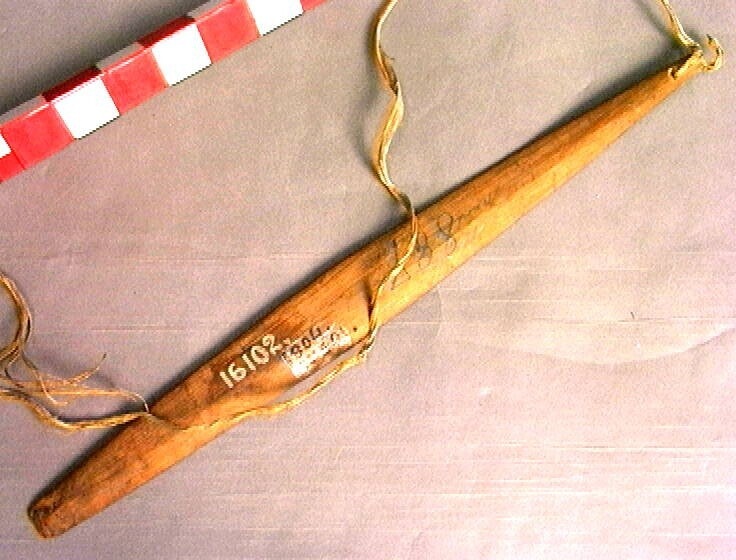
Only a model: Philip Kantoem's bullroarer
Indonesia · Hollandia (Jayapura) district, Netherlands New Guinea · Oceania
Sacred / spirit
Source term: bromhout
Philip Kantoem would not carve the earth spirit's voice. He came often to see Jan van Eechoud, the Dutch resident at Hollandia, in his best clothes with a large order of knighthood pinned to his chest, and when he spoke of the sacred house, the initiations and the blowing of the holy flutes his voice sank to a whisper and slipped into the present tense. The bullroarer was the earth spirit's voice and symbol. Asked to carve one, he was aghast: it would be his death, the earth spirit is so mighty. He had been a Christian for thirty years. After ten days he found a way. It would not be a real bullroarer, only a model, and a model could not rouse the spirit's anger. Van Eechoud got his bullroarer.
het zou maar een model zijn — dat kon geen kwaad, dat zou de toorn van de aardgeest niet opwekken.
it would only be a model — that could do no harm, it would not rouse the wrath of the earth spirit.
J. P. K. van Eechoud, Vergeten aarde: Nieuw-Guinea (2nd ed., 1952), p. 181
Particulars
- Object
- A bullroarer carved by Philip Kantoem for Jan van Eechoud as a model, not a real one; material and size not recorded.
- Function
- The voice and symbol of the earth spirit; to carve a real one was thought fatal, so Kantoem made a model.
Source
J. P. K. van Eechoud, Vergeten aarde: Nieuw-Guinea, 2nd ed. (Amsterdam: C. de Boer Jr., 1952), p. 181