No. PNG40
Maclay Coast
Papua New Guinea · Madang · Oceania · Sahul
Restricted
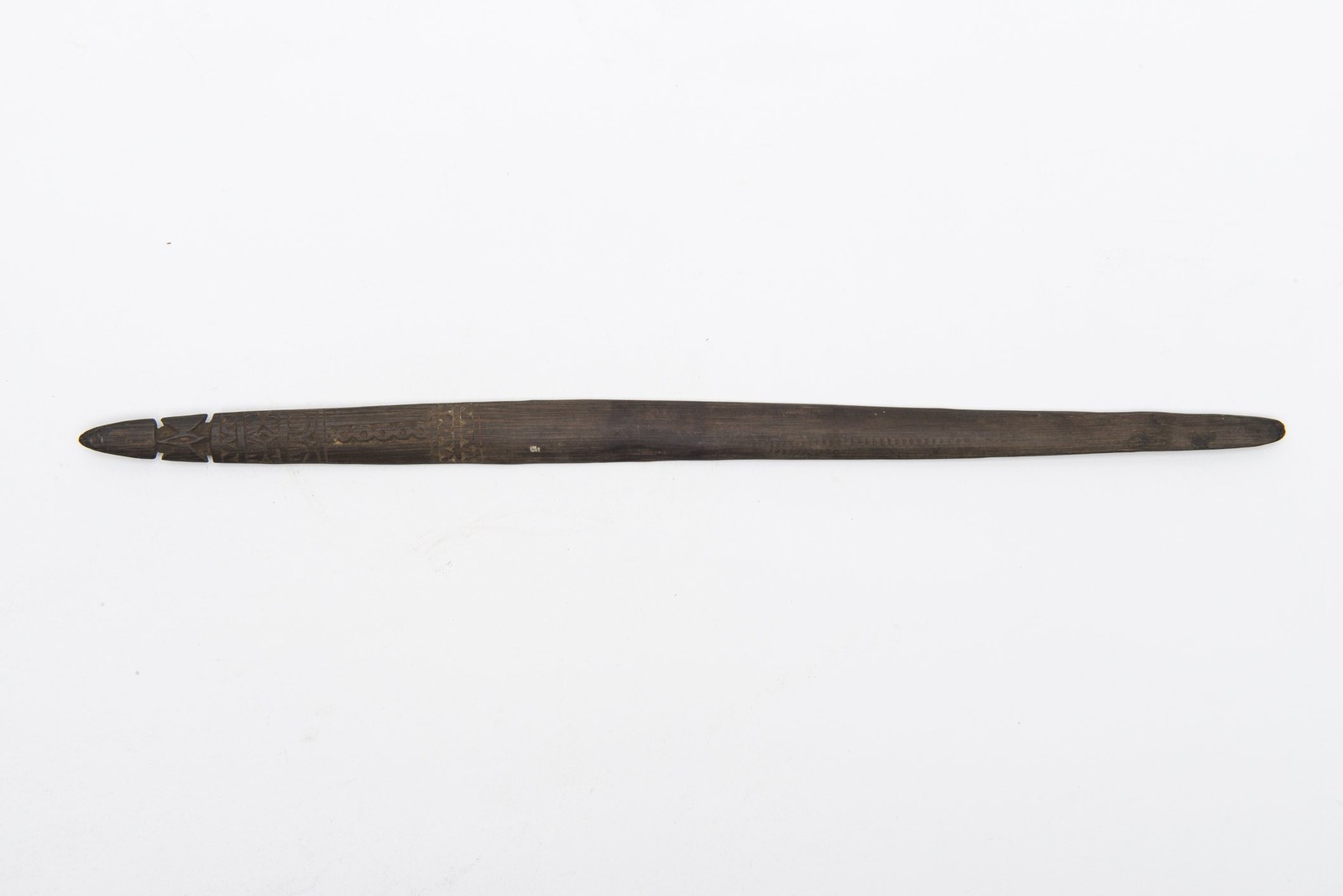
Lyop-lyop
On the Astrolabe Bay coast in Madang the bullroarer belongs to male initiation. Every boy of roughly twelve to eighteen is secluded for about a month in an initiation house standing deep in the forest, kept wholly closed to women and to uninitiated boys, and the swung blade is counted among the men's costume there. At Gorendu the instruments are called Lyop-lyop, carved and painted wood, recorded there by Miklouho-Maclay Foundation expeditions that returned to the same villages in 2017. The coast is named for Nikolai Miklouho-Maclay, the Russian naturalist who landed here in September 1871 and lived at Bongu, Gorendu and Gumbu long enough to learn the Bongu language.
male costume accessories during initiation
Miklouho-Maclay Foundation, Maclay Coast Collection catalogue, Lyop-lyop (bullroarer), items 4-6
Sources
- K. A. Gourlay, Sound-Producing Instruments in Traditional Society: A Study of Esoteric Instruments and Their Role in Male-Female Relations (New Guinea Research Bulletin 60; Canberra and Port Moresby, 1975), Table 1, entry 40 View
- Miklouho-Maclay Foundation, Maclay Coast Collection catalogue, Lyop-lyop (bullroarer), items 4-6 View · archived