No. MATHEWS1900-001
Western Cape York pipe-ra-chy initiation bullroarer
Australia · Western Cape York Peninsula · Batavia (Wenlock) River
Restricted
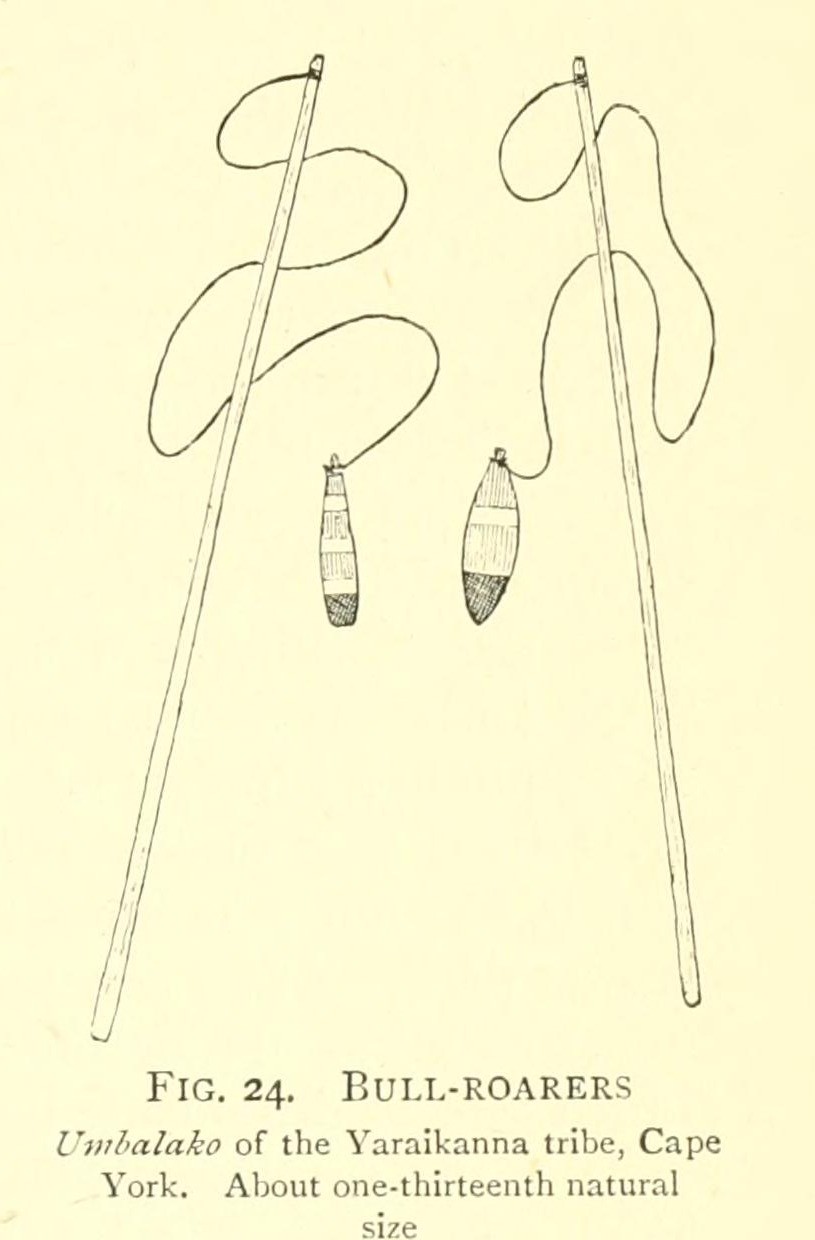
pipe-ra-chy
pipe-ra-chy: the name Mathews records among western Cape York tribes for the initiation bullroarer; no literal gloss given.
On western Cape York a youth's making stretched over years: at not less than three great meetings of the tribes, scars were raised on his body, his septum pierced, and a front tooth punched out. At these gatherings sounded the pipe-ra-chy, a bloodwood blade swung round the operator's head, its sides often barred with red ochre. Until he had graduated through it all, a man could not take a wife or sit in the councils of the men. Mathews knew the ceremonies best among the Tjungundji of the Batavia River, near Mapoon.
A 'bullroarer,' called by the natives pipe-ra-chy, is used by the tribes on these occasions; it is generally made of bloodwood, of the usual shape, with a hole drilled in the smaller end, through which a long string is fastened, to enable the operator to swing it round his head.
R. H. Mathews, 'Marriage and Descent among the Australian Aborigines,' Journal and Proceedings of the Royal Society of New South Wales 34 (1900), p. 134
Particulars
- Object
- Bloodwood blade about sixteen to twenty inches long, holed at the narrow end for a long string; often painted with one lengthwise and several crosswise bars of red ochre on one or both sides.
- Function
- Swung round the operator's head at the inaugural (initiation) ceremonies, in which youths are scarred, nose-pierced, and have a front tooth punched out over at least three tribal meetings.
Source
R. H. Mathews, 'Marriage and Descent among the Australian Aborigines,' Journal and Proceedings of the Royal Society of New South Wales 34 (1900), appendix 'Some Tribes of Cape York Peninsula, Queensland,' pp. 131-135, at p. 134