No. MUS2026-164
Gupapuyngu Daygurrgurr burala
Australia · Eastern Arnhem Land · Howard Island
Sacred / spirit
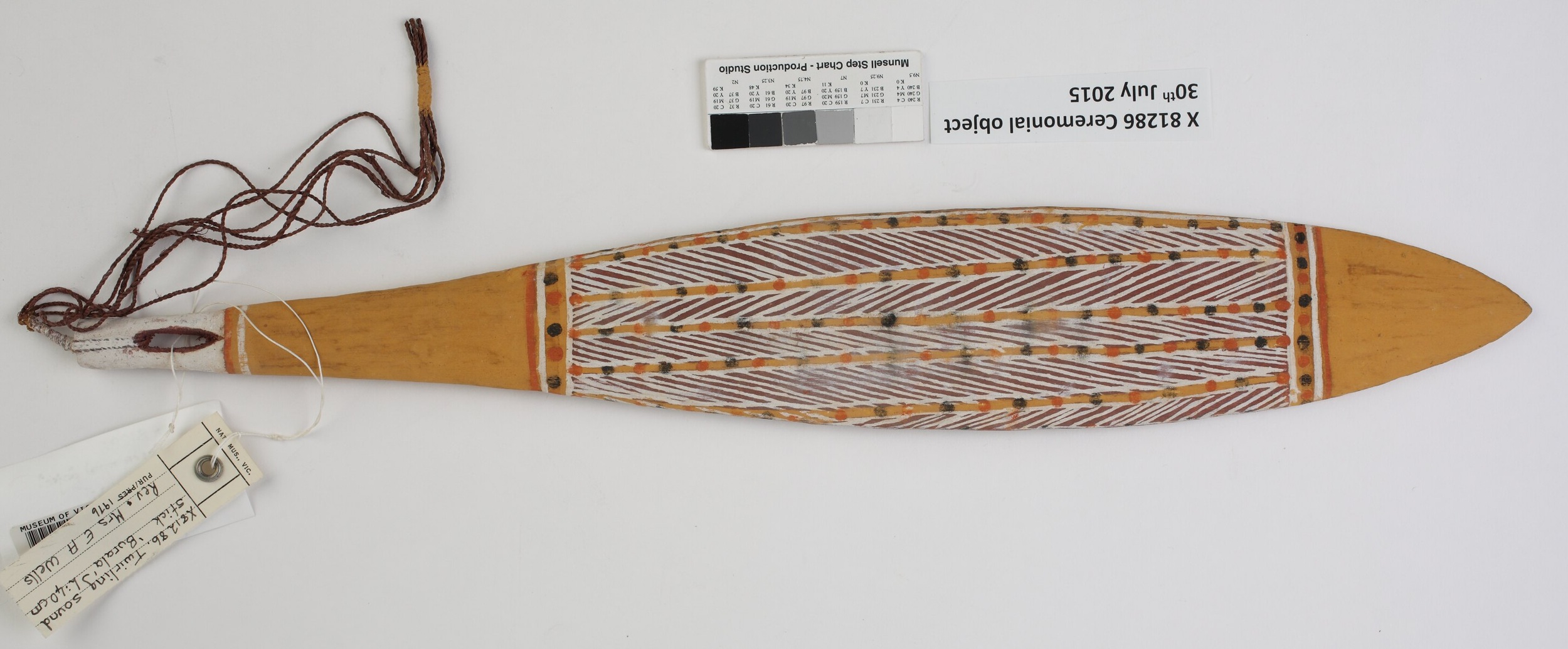
burala
Source term: Burala / ceremonial object
burala: the name of the roarer and of the diver duck whose plunge it sounds like.
On Howard Island in Eastern Arnhem Land, the Gupapuyngu Daygurrgurr called this painted wooden roarer burala. A vegetable-fibre cord passes through the narrow end of the 42.5-centimetre paddle; twirled above the head, it sounded like the diver duck that shared its name as it dove and swooped over the water. The painted lines represent a catfish skeleton. Museums Victoria attributes the circa-1950 object to Djawa Dhawarringu, an identification made by his son Joe Neparrnga Gumbula and other Milingimbi men.
The burala is attached to a string that is twirled above the head.
Museums Victoria X 81286
Particulars
- Object
- Painted paddle-shaped wooden slat, 425 x 70 x 30 mm, with vegetable-fibre string through a terminal hole at the narrow end.
- Function
- Twirled above the head; its sound is compared with a diver duck also called burala. The painted design represents a catfish skeleton.
Source
Museums Victoria, X 81286 (attributed to Djawa Dhawarringu; collected by Rev. Edgar A. Wells, Milingimbi, 1949-1959)