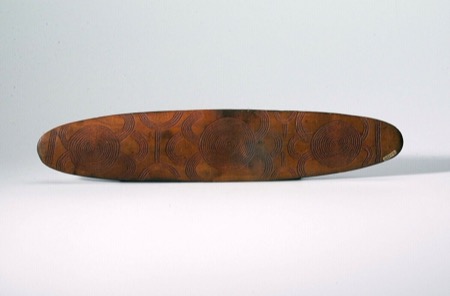
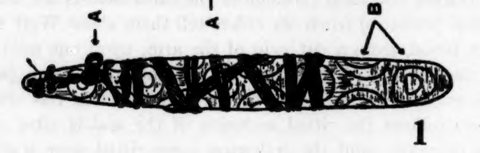
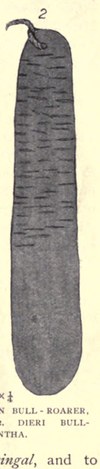
Across the Western Desert a board travels with a secluded novice, opens the way to his clan’s songs or draws a distant lover. The Ganabuda women held the sacred things first, until a man stole their power; Mardu men carve boards after the things the Dreaming beings carried; at Ooldea a man carves two snakes on a small board to call a woman to him.
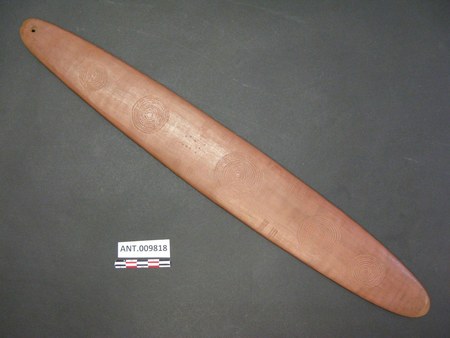
A Nambutji boy carries the windirpiri hidden in his spear-thrower, beside his spear. He must keep it safe, never leave it lying about and never let women or children see it. A Pitjantjatjara novice receives his mandagi only after the men have covered him in blood, and learns that the roar he feared was never the one-legged demon Apuju: the men make the noise. His grandfather tells him to stay low and quiet in the dark. 1
In the Warburton Ranges of Western Australia, a Ngadadjara youth first hears the bullroarers from a distance. Women and children withdraw; he hears the secret songs of his clan totem and sees men’s ceremonies before circumcision. Months of secluded healing follow, with rules on speech and food and journeys through the waters and named places of his country. He comes home only half a man. Subincision, another seclusion and more instruction still lie ahead. The roar opens an education that takes years. 4
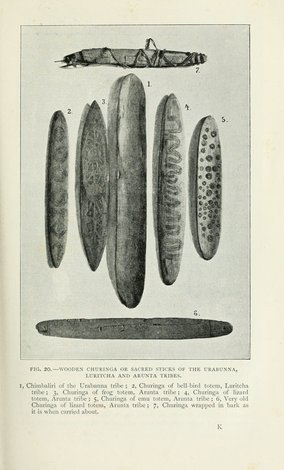
A Nambutji novice, of the Luritja-speaking northern desert, keeps to a separate waterhole so that women will not cross his track, and his windirpiri travels hidden in his spear-thrower. Pitjantjatjara youths swing their boards as they walk the long bush journey after circumcision. Once his subincision has healed, a young man may swing his mandagi to court a woman as well as to frighten the women away. 1
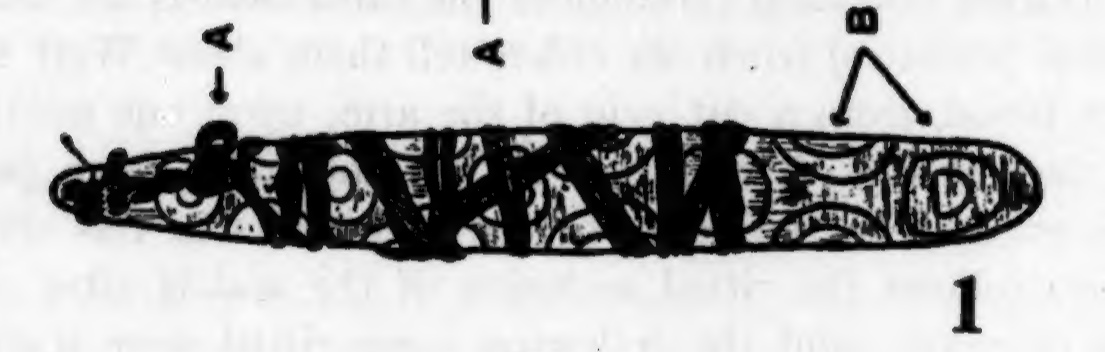
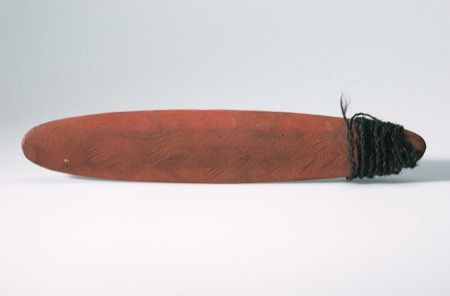
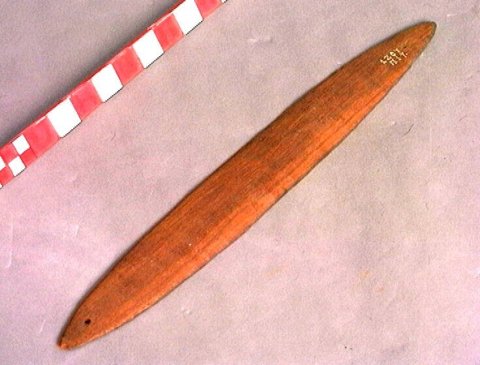
The Pintupi mataki is small enough to ride in a boy’s bulky chignon after circumcision, before he is shown the larger sacred tjuruna. A father passes it to his son, or to his sister’s son if he has no son. At Jay Creek, in the ranges west of Alice Springs, a Luritja board thirty-five centimetres long, on an eighty-centimetre cord of human hair, was kept with the instruments of a circumcision and subincision in June 1953. 3, 2
The Ganabuda women once owned the sacred things. They travelled the desert dancing and swinging bullroarers, and older women sent girls out to hunt and revealed rituals to them in return for meat. Djalaburu watched them in secret and stole their power at night; next morning they could scarcely swing their instruments. Men and women changed places, and the men took over the sacred responsibilities. 5
Around Balgo, in the northern desert, the dingari is the men’s ritual cycle of the Walmajarri and Kukatja. The men circumcise the youths and swing the boards, yet the cycle keeps the founding women’s name: Ganabuda, Gadjeri, the Old Woman, the Mother. 6
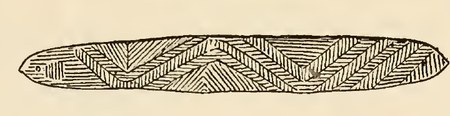
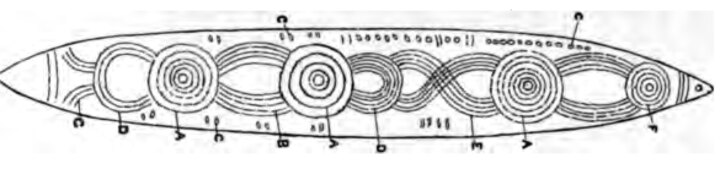
The Mardu, whose country lies around Lake Disappointment and who now centre on Jigalong, carve wooden boards after the power-laden things the Dreaming beings carried. At the Mirdayidi, a feast at his group’s secret cache, a novice sees its sacred objects for the first time; in a later stage he learns to carve them himself. 7
The japal, or Big Meeting, brings bands together when food and water permit. Initiation shares the gathering with marriage arrangements, the settling of disputes, gifts and the exchange of religious knowledge. Hosts and visitors work through kinship, men and women consult, and ritual leadership passes from man to man as the performance moves on. 7
Among the Antakirinya of north-west South Australia, two iguana ancestors made the first pulpiŋba, marked it like an iguana’s back and founded its sounding. The instrument warns women away before circumcision and subincision. After the second operation a youth receives one to hide and keep; only when both ceremonies are complete may he make his own. The same two heroes speared a great mother snake whose blood, urine and excreta became the red, yellow and white ochres of Mul’tan’tu. 8
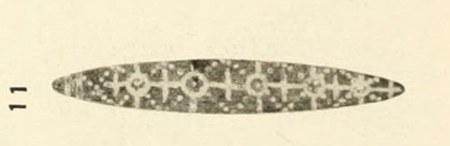
At Ooldea Soak, on the eastern edge of the Nullarbor, a man could carve a male and a female snake into one face of a small wooden urumbela and put his chosen woman’s mark on the other. If the Mission had taught him to write, he might use her initial. He swung the board above his head and sang to draw her towards him. In the collective madaki rite, men sang over a buried instrument until it seemed to rise through the sand, then came back to sound it on three afternoons. 9
Children from Ooldea were later taken to Gerard, a mission on the Murray near Loxton. There, in 1964, two men remembered Henry, who got a message on a bullroarer from Jalukari, ignored it and stayed at Gerard. 10
Among the Nambutji, a Luritja-speaking people of the northern Western Desert, the bull-roarer was the windirpiri, and behind it stood the myth of Witanygula — the penis of an old man who sat forever at the place called Kuna-tari. The organ travelled under the earth of its own accord, seeking the…
Representative — not this record’s object · A Luritja bullroarer worked in red ochre.
Among the Pitjantjatjara and their Western Desert neighbours, the bull-roarer belongs to men's secret-sacred initiation. The youth is not handed the instrument, the mandagi, at circumcision itself, but only once the older men have coated him in blood from their own veins. On the long…
Representative — not this record’s object · Incised bull-roarer from the Musgrave Ranges.
A newly circumcised Pintupi boy was not yet allowed to see his own tjuruna. First he was given a mataki, a small bull-roarer, and he carried it hidden in his hair, bound up in a bulky chignon. A man handed his mataki down to his son; a man with no son gave it to his sister's son. The tjuruna waited…
Representative — not this record’s object · Incised bull-roarer from the Musgrave Ranges.
The bullroarers sounded somewhere beyond the camp, and the women and children fled. For a Ngadadjara youth of the Warburton Ranges it was the end of boyhood. He had been seized at a great gathering of hordes in a season of plenty and paraded with his hair dressed like a girl's. Now he heard the…
Representative — not this record’s object · Ochre-dark Wiluna bullroarer carved with herringbone zigzags.
In the beginning the sacred things belonged to the women. The Ganabuda women travelled the desert hunting and holding their rituals; they brought down game by throwing their sacred boards, the darugu, at it, swung bullroarers, and rode the darugu through the sky. The men had nothing. One man,…
Representative — not this record’s object · A Table-land cora from the inland Pilbara, Wereldmuseum Leiden.
For the Mardu of the Western Desert, the world is the work of Dreaming beings who hunted and camped across it; when their wanderings ended they 'died' into landforms and celestial bodies, where their essence remains 'withdrawn from, but watchful of, human affairs.' They answer neither prayer nor…
Representative — not this record’s object · Hambly's plate of the Field Museum's Mount Margaret bull-roarer.
p.13: distinct Knatata/Aranda, witnessed Pitjentara and Nambutji passages; p.83: Pitjentara/Mularatara teaching. Local names and scenes retained with their own people.
I.7025 belongs to John Irex’s June1953 Jay Creek circumcision/subincision kit. Association with equipment, not a statement that it sounded during the operation.
Coming into Being among the Australian Aborigines, p.99: Pintubi mataki, chignon, father-to-son or sister’s-son transmission. Explicit secondary quotation of Fry1933 pp247–256.
pp.11–14, especially13: Ngadadjara family/initiatory life at Warupuju; p.250 distinguishes Warburton Ngadadjara from Róheim’s Jumu/Ngatatara. A reconstruction, not a dated eyewitness performance.
pp.224–225: Western Desert dingari scope and Ganabuda women’s teaching, power beneath armbands, theft and changed custody. This variant is kept separate from1984.
Life Cycle and Male Initiation; Ritual; Sites and Portable Objects. Sacred boards and teaching, without a claim that Tonkinson describes their sounding.
Oceania14(2), pp.138–143; distinct wooden urumbela and madaki practices, snake pair and women’s marks. Stone relics are not described as currently swung.
AA338/11/27 CDs1–4,25July1964: bullroarer summons from Jalukari and Henry’s decision to remain at Gerard. Practice-place is not equated with recording-place.