Atlas Essay —
This Is Your Body
Central Australia · the Huon Gulf · the Banks Islands · the Orinoco · Aotearoa · Zuni · Cameroon
An old man leads his grandson, a grown and married man, to a sacred cave the women never approach, and shows him a slab of wood worn smooth and red with ochre. Then he tells him what it is: not a thing he owns, but a thing he is. This is your body. The rite that Central Australians built around that sentence is, in its own telling, the moment a person is shown his own soul. And across the bullroarer world the same claim keeps surfacing in the same instrument: the whirled slat that opens initiation is described by the people who swing it as the vehicle of the soul at birth, the revelation of the self at initiation, and the voice that speaks for it after death.
In brief
- Among the Aranda, a grandfather shows a grown man the churinga of his totem ancestor — the class of sacred slab that includes the bull-roarer — and names it his second body: “Nana unta mburka nama,” “This you body are” (C. Strehlow, via Róheim 1945).
- In that same country the churinga is the soul-source at conception and the revealed self at initiation: one object class standing at both ends of a life.
- The traffic runs both ways. Twanyirika, whose voice is the bull-roarer, enters the Aranda boy after circumcision; in the Kunapipi the novice’s double passes into the bull-roarer he swings; at Ilahita and among the Ankave of New Guinea, boys take ancestral blood back into their bodies.
- The Anula bull-roarer was “made, in the first instance, by the whirlwind” — the same wind that, caught by a woman, was believed to put a spirit-child inside her (Spencer & Gillen 1904).
- From New Guinea to Brazil the roarer’s own name is a word for the soul or ghost of the dead: balum, kani, me-galo.
- Among the Bafia of Cameroon the roarer “embodies the invisible body of the ancestor, who lives again at birth in the child” — and Günther Tessmann, recording it in 1913, pointed to Australia.

The bullroarer is usually filed as an initiation instrument — the noise that frightens women and children while boys are made into men. But that is a description from the outside. From the inside, the people who swing it say something far stronger and far stranger: that the whirled slat is where a self comes from, what a self really is, and where a self goes. Follow that claim through their own words — an Aranda elder’s copular sentence, a conception-whirlwind, a name that means “ghost,” a Cameroonian ancestor reborn in a child — and take the practitioners at their word. The bullroarer complex is a technology of the person: one instrument that delivers the soul, reveals the self, and speaks for it after death.
“This is your body”
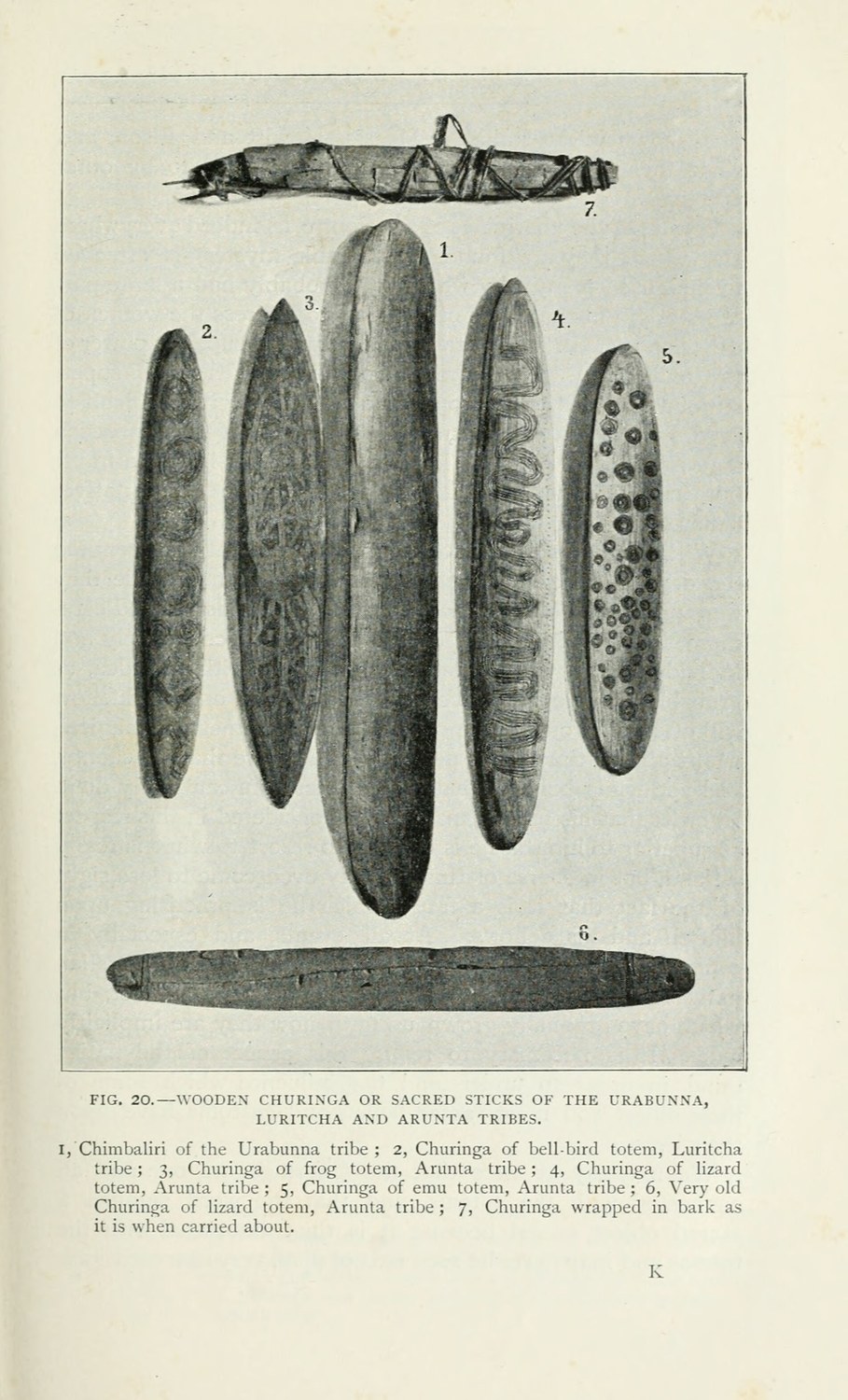
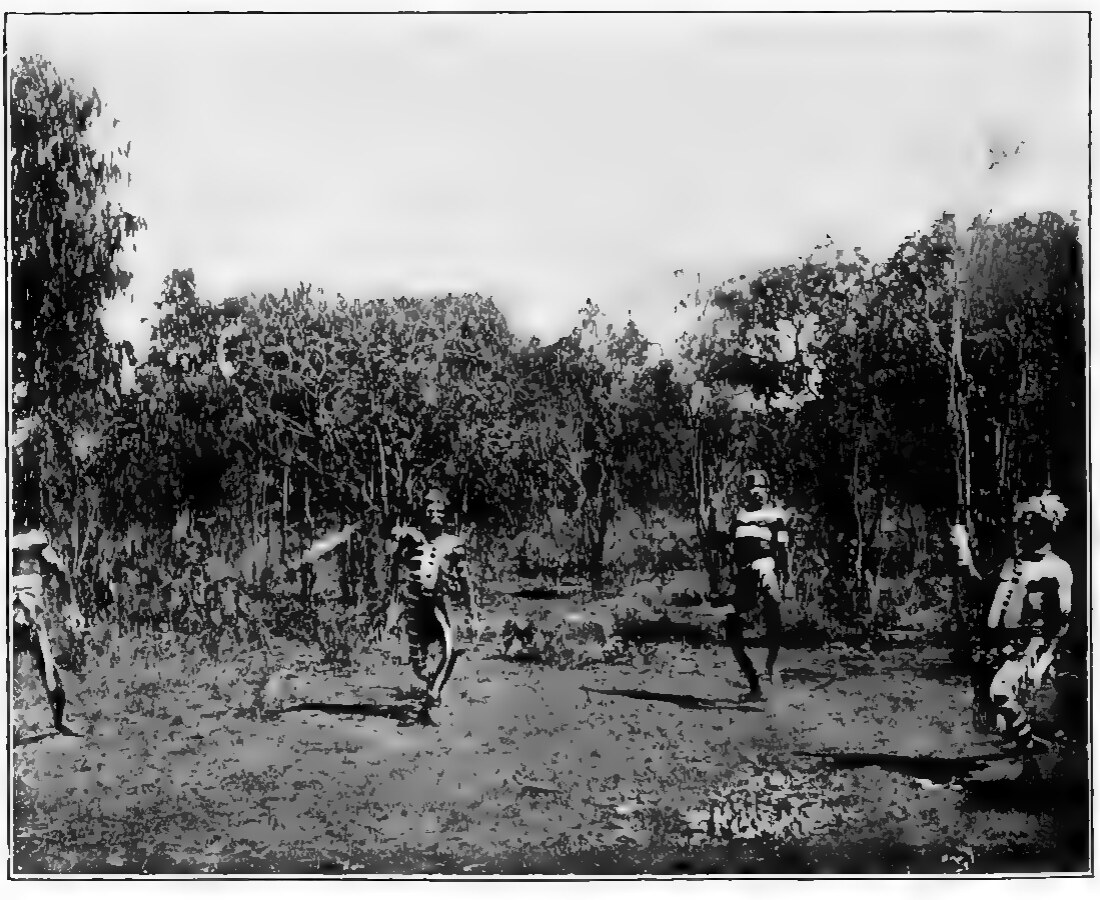
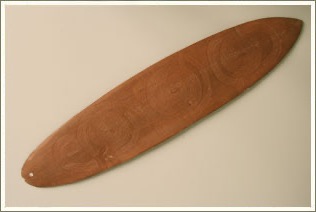
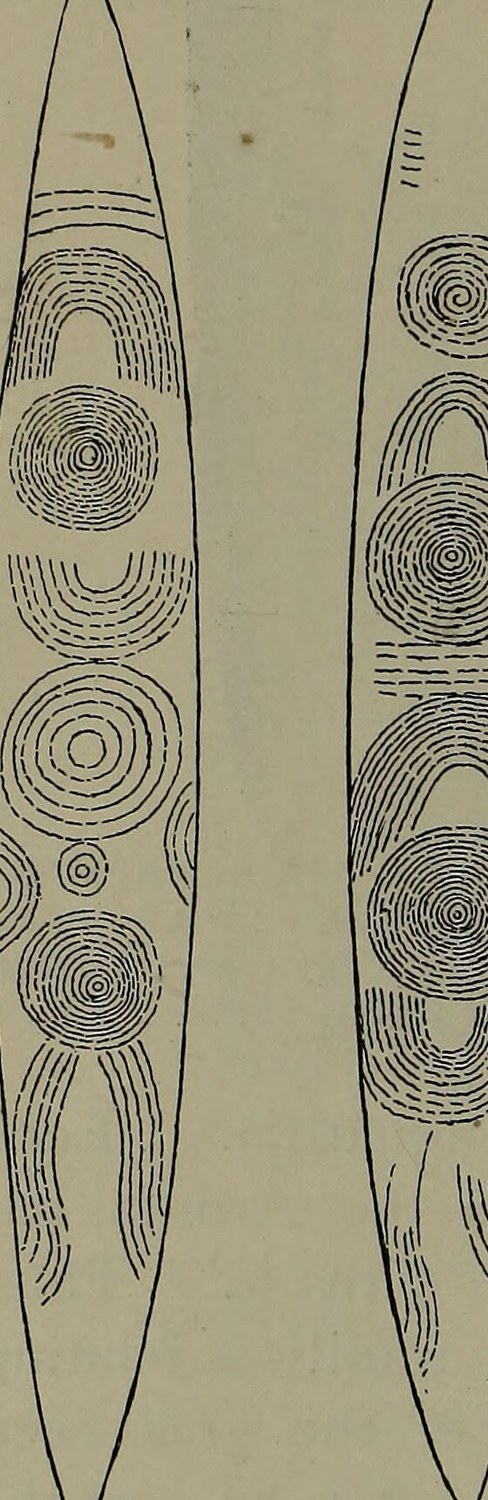
In the MacDonnell Ranges the Arunta kept sacred objects called churinga, hidden in storehouses among the rocks and shown to women or the uninitiated only on penalty of death. Spencer and Gillen, working the Alice Springs district in the 1890s, distinguished flattened stones from wooden slabs; the wooden ones, bored at one end and strung with human-hair string, were the bull-roarers proper, called churinga irula, “dressed wood.” Each was held to contain the spirit part of an ancestor of the Alcheringa: the ancestor’s body died, a rock or tree rose to mark the place, and his spirit stayed in the stone. When the sound rose around the ceremonial ground during a boy’s initiation, the women were told it was the voice of the great spirit Twanyirika, come to carry the boy away.
That is the public story. The private one is an identity-claim. Carl Strehlow’s informants gave the revelation as a spoken sentence, recorded by Géza Róheim in The Eternal Ones of the Dream (1945, p. 237, citing C. Strehlow, Die Aranda- und Loritja-Stämme, II, p. 80). When a man was grown and married, his grandfather led him to the sacred cave, showed him the tjurunga of his totem ancestor, and said:
“This is your body, nana (this) unta (you) iningukua (the same). Do not take it to another place or you will feel pain.”
Carl Strehlow’s Aranda informants, in Róheim, The Eternal Ones of the Dream (1945), p. 237
Strehlow reduced the doctrine to a copula. “The relation between a man and his tjurunga,” he wrote, “is expressed in the sentence, ‘Nana unta mburka nama’ (‘This you body are’). Every person has thus two bodies; a body of flesh and one of wood or stone.” The lizard ancestor, shaping the first shapeless beings, had given each a tjurunga and called it the body bound up with it; to a kangaroo-man he said, “This is the body of a kangaroo; you are derived from this tjurunga.” Swung on its cord, the pierced wooden churinga gave that hidden second body a voice.
Nana unta mburka nama.
This you body are.Carl Strehlow, Die Aranda- und Loritja-Stämme II:80, via Róheim 1945
The shape of the sentence is worth pausing on. A demonstrative, a second-person pronoun, a hidden thing, and the verb to be: this — you — body — are. It is, in form, one of the oldest identity-formulas in the philosophical record. In the Chandogya Upanishad (6.8.7), the sage Uddalaka instructs his son nine times over that the finest essence, the self of all that is, is the son himself: tat tvam asi — “That thou art.” The Aranda elder’s Nana unta mburka nama — this-thou-body-art — is the same terminal revelation, delivered by an elder to a junior, that the initiand’s true self is one with a hidden reality objectified in a token: on the Ganges, the imperishable essence of the All; in the desert, the immortal churinga in the cave. Róheim supplies the Aranda formula but reads it psychoanalytically, and the histories of religion that dwell on the tjurunga never set it beside the Upanishad. Two peoples reached the same sentence for the same rite: an elder telling a young man that the sacred thing in his hand is what he most deeply is.
One object, one soul-cycle
The revelation is only the middle of a longer circuit, because in Central Australia the same object class stands at both ends of a life. At conception it is the soul-source. Near a totemic site the ratapa, the unborn children, “emanate from it and incarnate themselves in their future mothers” (Róheim 1945, p. 97). The Western Desert peoples made the split explicit. Among the Pindupi and Yumu, whose initiation Róheim recorded from Hermannsburg in 1929, his informants’ theory (from Fry) ran:
“Two beings emanate from the kuntanka [tjurunga], or rather it is one being split into two halves. One of these goes into a woman and becomes a ‘real person’, and the other goes into the totemic cave and becomes the paluru nguampa (him-like).”
Róheim, The Eternal Ones of the Dream (1945), p. 98
Read that beside the revelation and the loop closes. The half that entered the woman is the boy; the half that stayed in the cave is the immortal double — the same hidden second body the Aranda grandfather shows the grown man, saying this is your body. The sacred object that split off his incarnating soul at conception is the one revealed to him in manhood as his eternal self; and at death the double travels on to be born again. One sacra, two-way traffic: soul out at the beginning, self revealed in the middle, reincarnation at the end. Spencer and Gillen’s independent record of the Arunta reincarnation doctrine describes the same machine.
The Kaitish even told how the machine was built. In the Alcheringa, two men themselves sprung from churinga heard the roaring the sky-dweller Atnatu made twirling his own churinga, and set about copying it; slats of bark failed, but a slab cut from mulga wood roared, and as they whirled it the down flew from their bodies and fell to earth, and mulga trees sprang where it fell — the trees churinga are cut from to this day. The instrument, the totem, and the ancestor come into being in one motion. And the desert peoples remembered that this soul-technology had not always belonged to men: among the Yumu, Róheim was told, the namatuna “was originally owned by the alknarintja women themselves,” and only later passed into men’s possession.
In through the wound, out into the wood
Twanyirika does not only carry the boy away. Spencer and Gillen set down what the women and the uninitiated youths were taught he does next:
“He enters the body of the boy after the operation and takes him away into the bush until he is better, when the spirit goes away and the boy returns, but now as an initiated man.”
Spencer & Gillen, The Native Tribes of Central Australia (1899), p. 246, note 1
The voice in the bull-roarer is a being that goes inside the boy, holds him through the healing of the wound, and leaves a man behind.
Farther north the traffic runs the other way. In the Kunapipi cult of Arnhem Land, A. P. Elkin records, the novice goes down into a curved trench cut as the Mother’s womb, its walls engraved with the male and female Rainbow Serpents, and is given a bull-roarer to swing. As he swings it, “his spirit-double, or ceremonial or ‘wood shade’, enters it.” When he comes out of the womb reborn he leaves board and shade behind in the trench. The wood rots, the double goes free to his spirit-home to wait for him, and when he dies a son performs a Kunapipi to reunite the two. The Aranda keep their second body safe in a cave; the Kunapipi novice pours his into a bull-roarer and lets it decay. Both say the same thing: a man is larger than his flesh, and the board is where the rest of him goes.
In New Guinea the substance itself moves. At Ilahita, among the Arapesh of the East Sepik, boys entering the Lefin grade were secluded for weeks in a roofless house built over a stream where ancestral and cult spirits lived. Men cut them with bamboo razors, and the boys lay with their penises between the floorboards, bleeding into the water. Days later an initiator threw a stone into the stream, cried that he had lost his shell pendant, and sent the boys in to search. Groping through the mud, they coated themselves in their own blood, which had lain all that while among the spirits. The boy’s male identity, Donald Tuzin writes, is affirmed “through the mingling of his essences with those of the ancestral and cult spirits.” In a separate ceremony of the same grade the boys met the bull-roarer, the voice of the spirit Lefin, and were each handed one to swing.
Among the Ankave of the Papua New Guinea highlands the ancestor feeds the boy directly. The first man, Pierre Lemonnier records, was killed; red pandanus grew where his blood soaked the ground, his bones became the punch that pierces the novices’ septa and the first bull-roarer, and his spirit taught the ancestors in dreams how to make men. Novices drink the red pandanus juice as his blood and are smeared with it, and so are born again and grow. While their noses are pierced, their mothers lie under bark capes in silence, listening to what they are told are the words of the spirits: the bull-roarers, first made from the ancestor’s bones.
The self is not sealed inside the skin. A spirit moves into the boy, his double moves into the wood, ancestral blood moves back into him, and the voice in the bull-roarer belongs to whatever is crossing over.
The wind that carries the soul
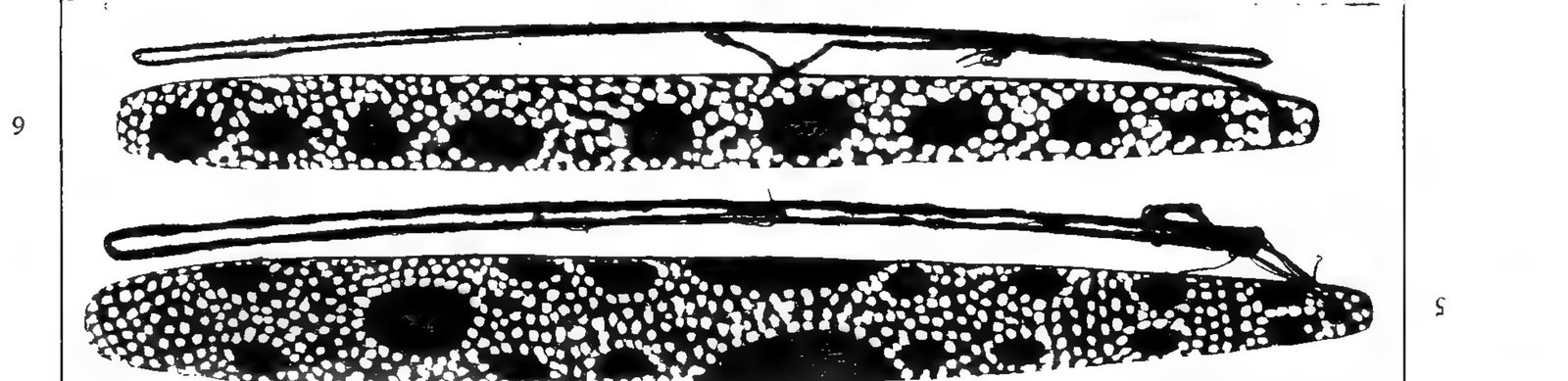
If the soul travels, it travels on wind — and the bull-roarer is a wind made by hand. Among the Anula of the western Gulf of Carpentaria, a newly subincised novice was handed a sacred stick, the mura-mura, and told that it had been made, in the first instance, by the whirlwind; the women and children took its roaring for the voice of a spirit named Gnabaia, who swallowed the boy and afterward disgorged him in the form of an initiated youth. That much is the ordinary swallowing rite. What makes it a soul-mechanic sits three hundred pages later in the same book. In their section on whirlwinds, Spencer and Gillen record that Arunta women “are much afraid of them, thinking that spirit children travel about in them, and that if they should happen to be caught in one the children would enter their bodies” (Northern Tribes of Central Australia, 1904, pp. 631–632).
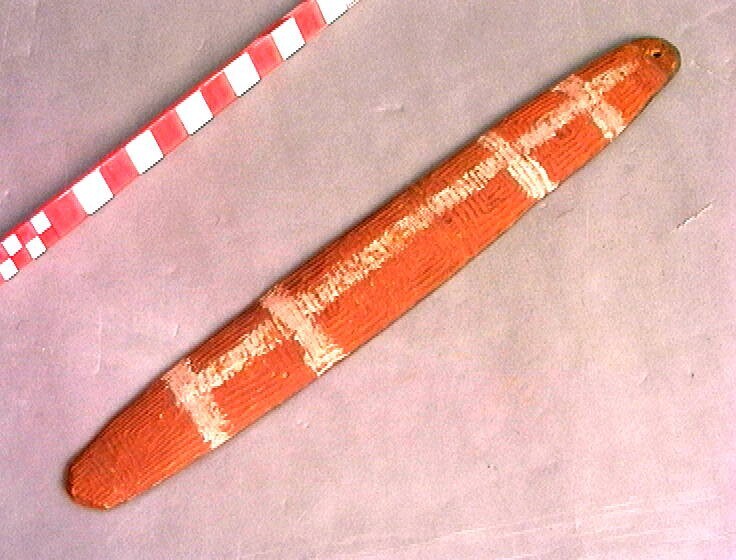
So the whirlwind does two jobs. Caught by a woman, it installs a spirit-child — conception as ensoulment. Manufactured on a cord and roared over a novice, it opens the rite that kills the boy and returns a man. The bull-roarer is a portable, controllable whirlwind: it literally makes a roaring wind, wielded at exactly the moment a self is being remade. Spencer and Gillen themselves felt the pull of it, calling the relationship between the whirlwind and the initiation bull-roarer “very suggestive,” though they never joined it to their own whirlwind-conception passage. The neighbouring cults carry the same freight in the instrument: the Mungarai ancestor Kunapippi carried his spirit-children in dilly bags and owned the sticks named after himself, and at Opobinga the Yungman ancestor “kept many bull-roarers” where his spirit-children still live in the trees and stones, “coming out to enter the right women and be born.”
The word for the soul
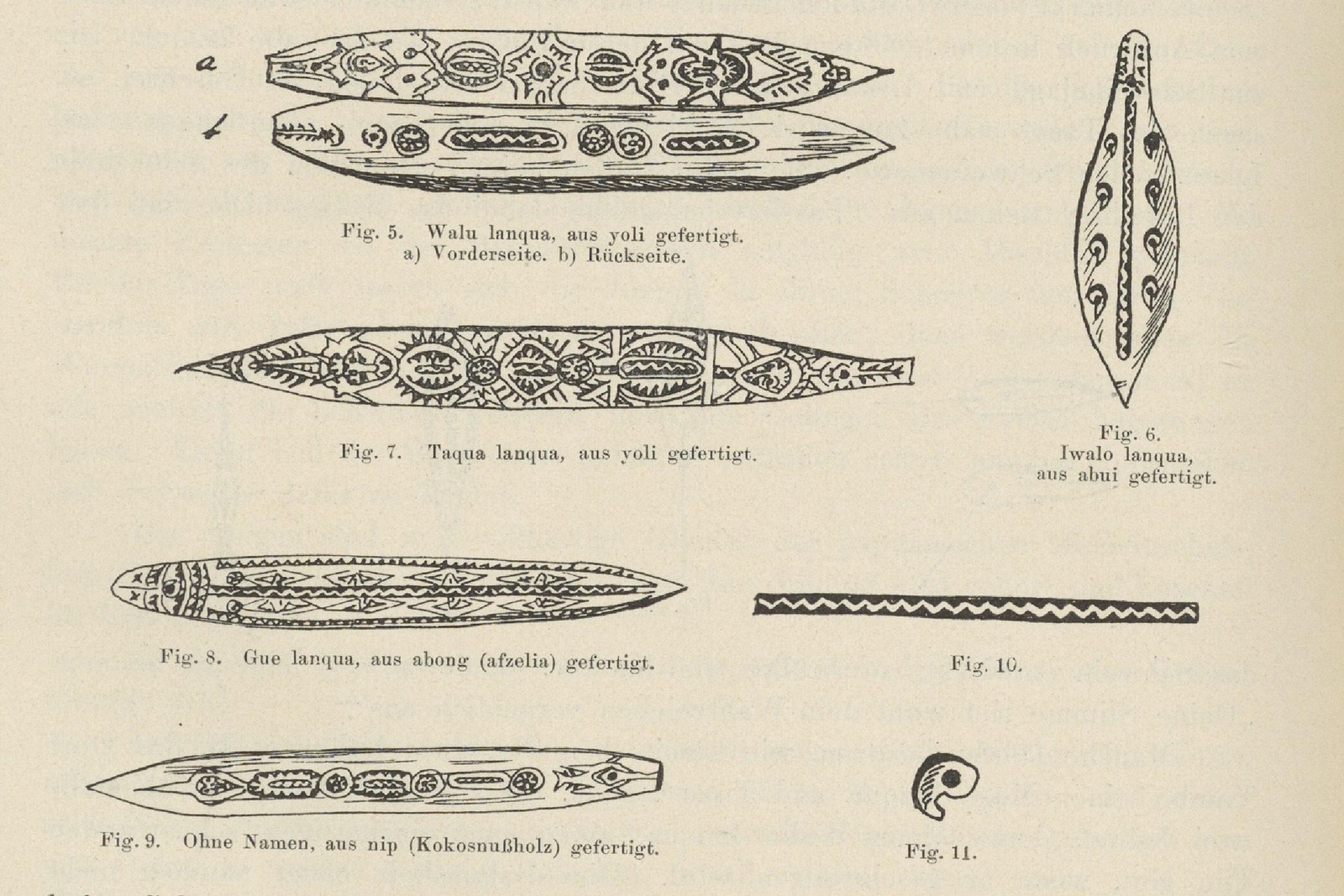
Where Australia states the doctrine, other regions carry it in the name. On the Huon Gulf of New Guinea one word, balum, names three things at once: the ghost of the dead, the monster that swallows boys at initiation, and the bull-roarer whose droning hum is that monster’s voice. Among the Bukaua and Yabim, the boys taken for circumcision were “swallowed” by balum and released only when enough pigs had been sacrificed to make him vomit them up; in the spewing-out he bit them, and that wound was the circumcision. Lodged in a hut a hundred feet long that narrowed like the monster’s belly, they were “held to be killed and restored to a new and better life — no longer boys, but men.” And the same dead had power over the living harvest: Yabim men twirled the balum while naming the departed, so that the taro would flourish.
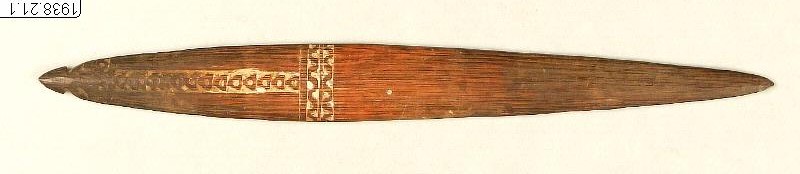
The same fusion recurs along the coast. Among the Kai, inland from Finsch Harbour, the roarer is the voice of Ngosa, the monster who swallowed boys at circumcision, and one word — Ngosa — names the monster, the swinging wood, and the grandfather. Among the Tami, it is kani, the dragon-like beast said to eat children and the roarer alike, and a ghost of the dead. Frazer, comparing these tongues, found the same word doing triple duty in each: the bull-roarer, the swallowing monster, and the departed soul. Half a world away the Gê of Brazil kept the semantics after the ritual had faded. Among the Apinayé, the bull-roarer slipped into the toy basket, but its name did not soften: me-galo is the single word for soul, ghost, shadow, and the image of the dead. And in the Banks Islands of Vanuatu the instrument is glossed as bluntly as a tool can be: on Mota it is nanamatea, “death-maker,” swung to drive a ghost away; on Merlav it is worung-tamb, “a wailer,” sounded through the night after a death to mourn.
| Native name | People | What the word also means |
|---|---|---|
| balum | Yabim, Bukaua, Gawac (Huon Gulf) | ghost of the dead; the monster that swallows the novices |
| ngosa | Kai (Huon Gulf hinterland) | the swallowing monster; the grandfather |
| kani | Tami (Siassi Islands) | the child-eating monster; a ghost of the dead |
| me-galo | Apinayé (Brazil) | soul, ghost, shadow, and image of the dead |
| nanamatea | Mota (Banks Islands) | “death-maker” |
| worung-tamb | Merlav (Banks Islands) | “a wailer” |
| pūrerehua | Māori (Aotearoa) | the moth; the sound “caused by wairua,” the free-soul |
| aelamo’otom | inland Yuki (California) | “thunder breath” |
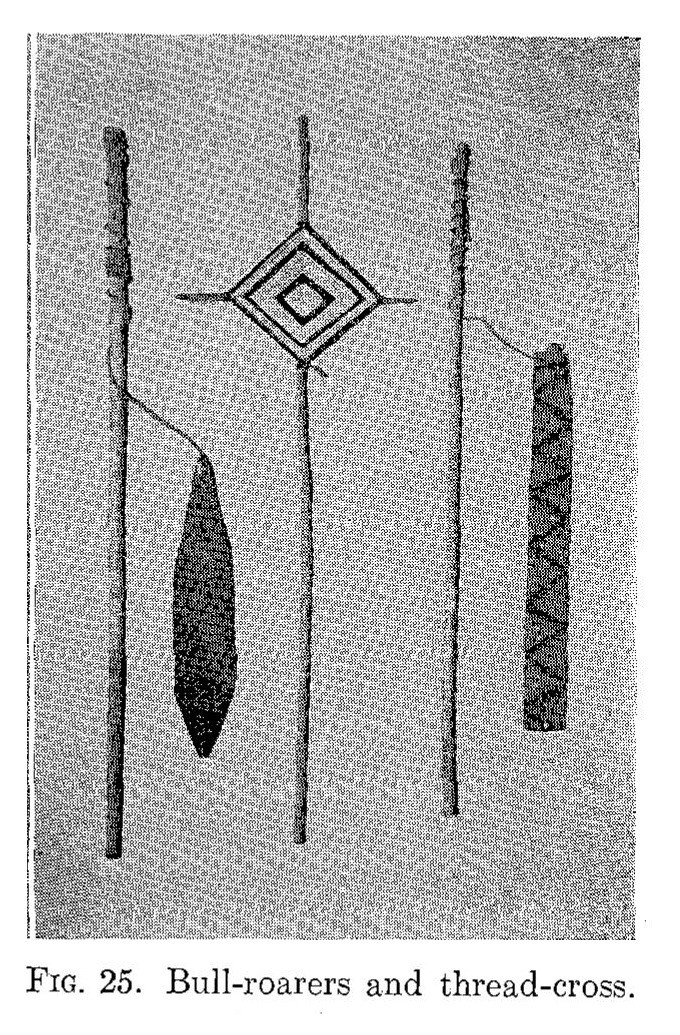
And where the name does not carry the soul, the sound sometimes does. Elsdon Best, in the middle of his exposition of wairua — the Māori free-soul that leaves the body, sees at a distance, and survives death — sets down a small, decisive sentence:
“The booming sound made by a pūrerehua, or ‘bull-roarer,’ is said to be caused by wairua.”
Elsdon Best, Spiritual and Mental Concepts of the Maori (1922), p. 33
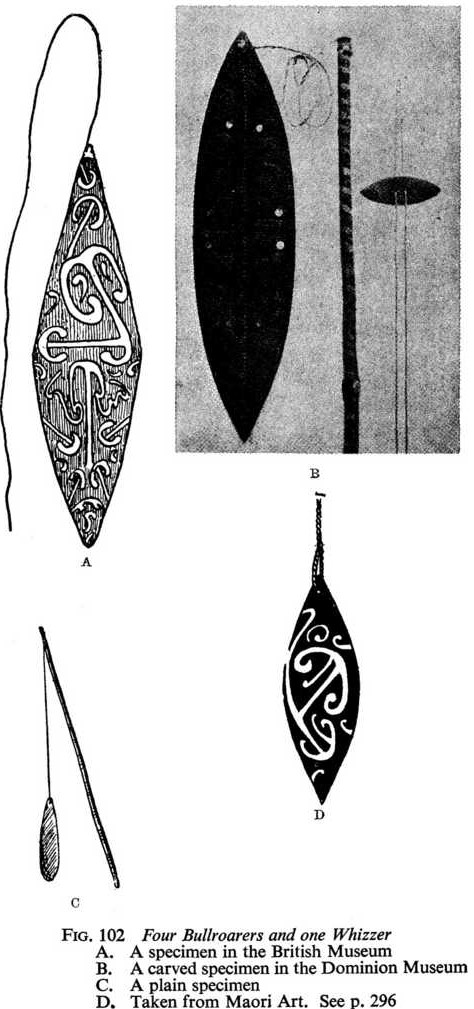
The pūrerehua is heard, too, as the voice of Tāwhirimātea’s wind-children, carrying the player’s hopes out on ngā hau e whā, the four winds. Among the Piaroa of the Orinoco, the unseen voices that circle the roundhouse at the Warime festival — the Imu-chuwo among them — are “the demiurges themselves, vital breath turned to music.” At Zuni, Matilda Coxe Stevenson recorded that the rhombus is whirled to stir the u’wannami, the rain-makers who pour water through the cloud masks, “the clouds themselves being the breath of the gods” — and there, tellingly, women were never barred from the sound; at Zuni the roar belongs to rain, not secrecy. The inland Yuki of California simply built the idea into the name, calling the instrument aelamo’otom, “thunder breath.” Four separated peoples gloss the roar itself as breath or soul — not merely as wind, but as the exhaled substance of a living being.
Cameroon, 1919
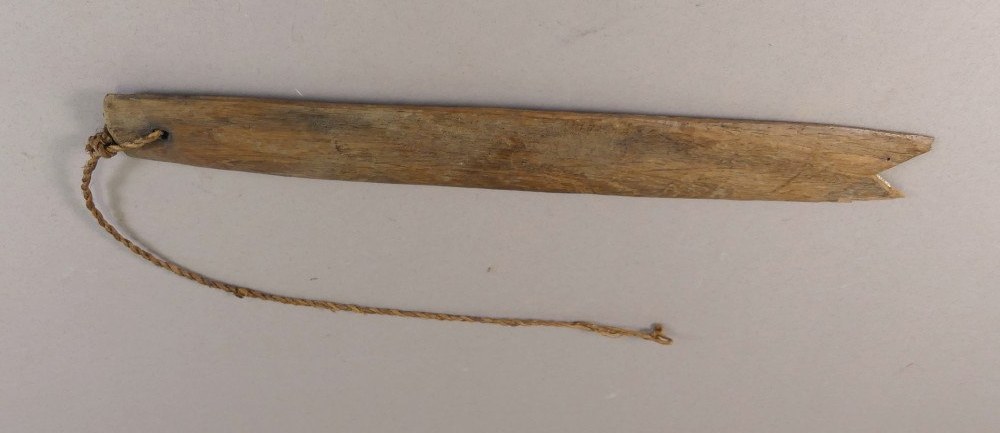
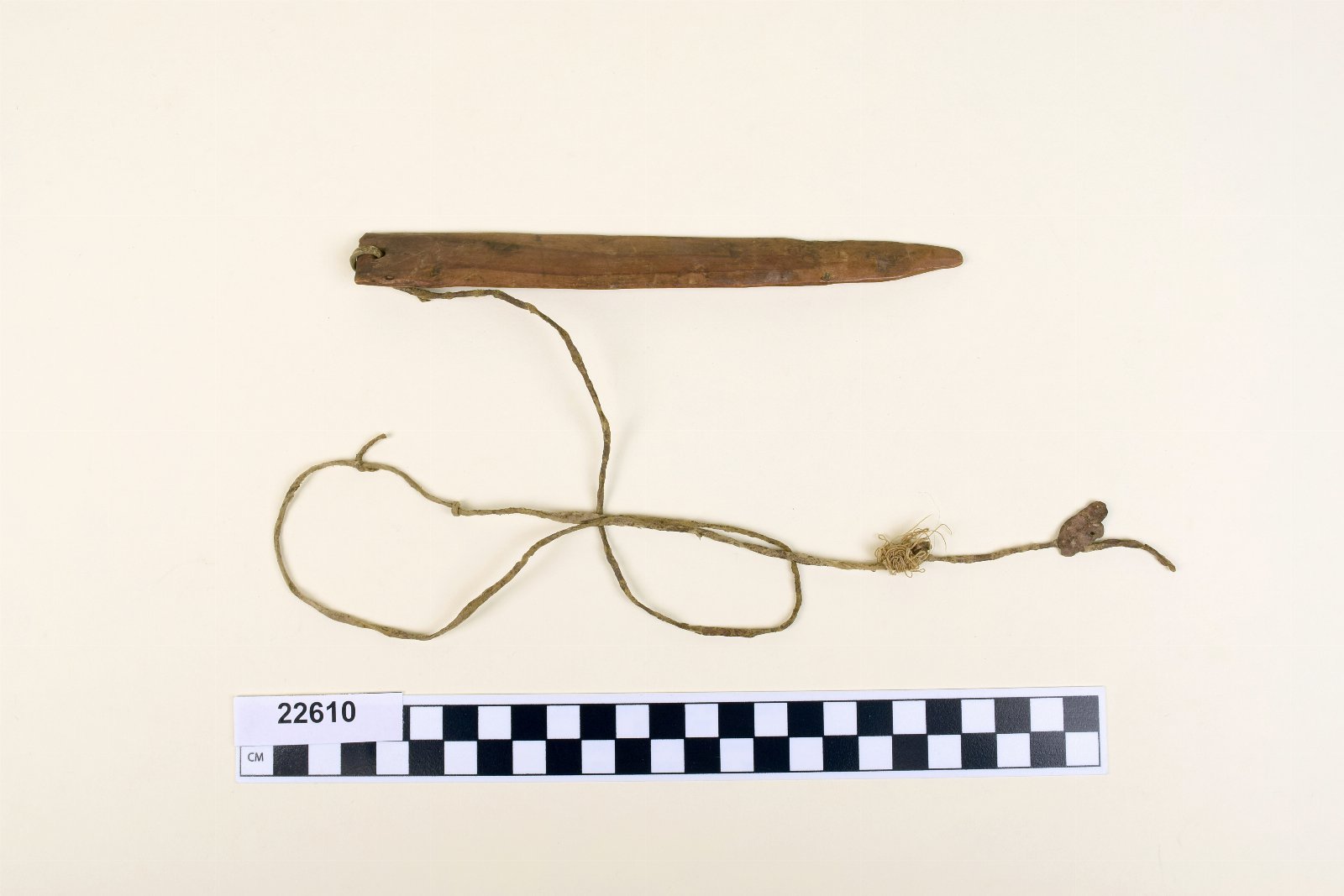
The most striking witness is not an Australian at all. Among the Bafia of the middle Mbam in central Cameroon, the bull-roarer was one of four supreme secret implements of the cult the Bafia called elume, shown to a novice only at his initiation. Günther Tessmann, who recorded the rite on the German colonial expedition sent out in 1913, read its sound as a sign of rebirth: the whirring wood, he wrote, embodies the invisible body of the ancestor, who lives again at birth in the child (Zeitschrift für Ethnologie 51, 1919, pp. 144–145). For that reason its shape copied the ancestor-figures, ending in a swallow-tail between whose points the forebear’s head was imagined — a face conceived into the blade. The other three implements filled out the same theology of return: carved sticks for the tribal father and mother, bone mirlitons whose voice was meant to show the bones coming back to life, and a wooden dog, the emblem of generation.
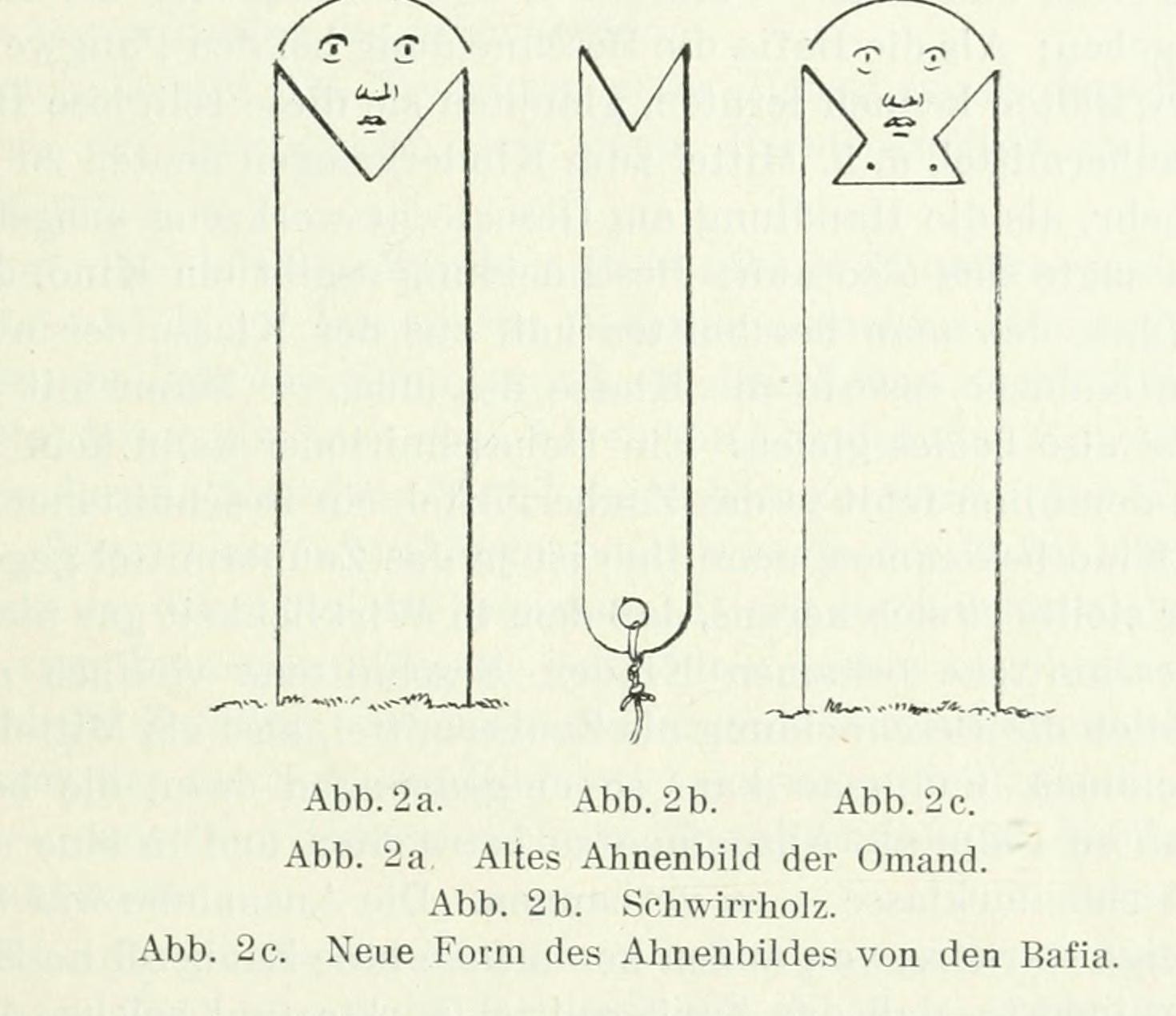
And Tessmann himself drew the line. The place the bull-roarer held among the Bafia, he wrote, showed a further kinship with Australia. A first-rate ethnographer, working in equatorial Africa a century ago, independently reported the Central Australian doctrine — the roarer as the ancestor’s other body, revealed at initiation, reborn in the child — and pointed back across the Indian Ocean to say so. The claim that the same person-making instrument surfaces on far continents is in the sources themselves, made by the man who collected the blade.
A technology of the person
Set the pieces in a row and a single machine appears. At the beginning of a life the whirlwind-instrument carries the spirit-child into the mother and the churinga splits off the incarnating soul. In the middle of a life a spirit enters the wounded boy, a double passes into the board, ancestral blood goes back into the novice, and the elder holds the sacred object up and names it the man’s true and imperishable body: this is your body. At the end of a life the roarer is swung to voice, mourn, or drive off the departed — nanamatea, the death-maker; worung-tamb, the wailer; balum, the ghost that once swallowed him. One instrument delivers the soul, reveals the self, and speaks for it after death. That is not three unrelated uses of a noisy toy. It is the working of a single idea about what a person is and how a person is made, worn smooth by use on continents that had no contact in living memory.
The recurrence is the point. A copular self-formula shared in shape between the Aranda cave and the Chandogya Upanishad; a conception-wind that is also an initiation-roar; a name for the instrument that is also the word for the ghost, turning up on the Huon Gulf and in Gê Brazil; an African ancestor reborn in a child, flagged as Australian by the man who recorded it — these are not the scattered coincidences of peoples who each happened to notice that a whirled slat sounds eerie. They are the fingerprints of one deep tradition about the soul, left on the same instrument again and again. What the bullroarer roars, wherever it is swung, is a claim about the self. Sometimes the claim is spoken aloud, and then it is very plain. This is your body.
Key sources
Strehlow, C. 1908. Die Aranda- und Loritja-Stämme in Zentral-Australien, Band II, p. 80 — the presentation formula “Nana unta mburka nama,” as reported and translated in Róheim (below), pp. 237–238.
Róheim, G. 1945. The Eternal Ones of the Dream. New York: International Universities Press, pp. 97–98 (the ratapa conception-split, from Fry’s Pindupi/Jumu (Yumu) informants), 237–238 (the cave revelation and the two-body formula).
Chandogya Upanishad 6.8.7 — Uddalaka’s instruction to Švetaketu, tat tvam asi, “That thou art.”
Spencer, B. & Gillen, F. J. 1899. The Native Tribes of Central Australia. London: Macmillan, pp. 128, 143 (the churinga as external soul; churinga irula), 246 n. 1 (Twanyirika enters the boy after the operation and leaves at his recovery), Fig. 20.
Elkin, A. P. 1964. The Australian Aborigines: How to Understand Them, 4th ed., pp. 255–256 (the Kunapipi womb-trench; the novice’s “wood shade” entering the bull-roarer; its release by decay and reunion after death).
Tuzin, D. F. 1982. “Ritual Violence Among the Ilahita Arapesh.” In G. H. Herdt (ed.), Rituals of Manhood, pp. 321–355, section “Lefin” (the stream ordeal, the lost-pendant search, and the separate bull-roarer revelation).
Lemonnier, P. 2010. “Mythes et rites chez les Anga.” Journal de la Société des Océanistes 130–131, pp. 213–214, 216 n. 7; and 2019, “Condensation rituelle et matérialité,” in Au seuil de la forêt, p. 648 (the Ankave first man’s blood as red pandanus; his bones as the septum punch and first bull-roarer). Bonnemère, P. 2018. Acting for Others, p. 96 (the bull-roarers heard as spirit words during the boys’ septum-piercing).
Spencer, B. & Gillen, F. J. 1904. The Northern Tribes of Central Australia. London: Macmillan, pp. 280–281 (the Anula whirlwind-made bull-roarer; the “very suggestive” note), 631–632 (spirit-children in whirlwinds enter women).
Spencer, B. 1914. Native Tribes of the Northern Territory of Australia. London: Macmillan, pp. 217–218 (Mungarai Kunapippi), 267 (Yungman spirit-children and bull-roarers), Plate II.
Frazer, J. G. 1913. The Belief in Immortality and the Worship of the Dead, Vol. I. London: Macmillan — the Huon Gulf balum/ngosa/kani triple-gloss (ghost, swallowing monster, bull-roarer).
Nimuendajú, C. 1939. The Apinayé. Washington: Catholic University of America Press, p. 140 (me-galo: soul, ghost, shadow, image of the dead).
Codrington, R. H. 1891. The Melanesians: Studies in their Anthropology and Folk-Lore. Oxford: Clarendon, p. 342 (Mota nanamatea, “death-maker”; Merlav worung-tamb, “a wailer”).
Best, E. 1922. Spiritual and Mental Concepts of the Maori (Dominion Museum Monograph 2), p. 33 (the pūrerehua’s sound “caused by wairua”).
Stevenson, M. C. 1904. The Zuñi Indians (23rd Annual Report, Bureau of American Ethnology) — the rhombus and the u’wannami; “the clouds themselves being the breath of the gods.”
Muller, J.-C. 2010, on the Piaroa Warime — the roundhouse voices as “the demiurges themselves, vital breath turned to music”; Loeb, E. M. 1932, on the inland Yuki aelamo’otom, “thunder breath.”
Tessmann, G. 1919. “Die Urkulturen der Menschheit und ihre Entwicklung.” Zeitschrift für Ethnologie 51, pp. 144–145, Abb. 2 — the roarer as the ancestor’s reincarnating body, and the author’s own comparison to Australia.
The pairing of the Aranda revelation-formula with the Upanishadic tat tvam asi is, as far as we know, original to this page.