Old Arrernte boards are patched with sinew and resin; an Anmatyerr novice must keep his board sounding or a sky-being will carry him off; Kaytetye and Warumungu ancestors give the timber its voice. In central Australia the bullroarer is one of the churinga, a great company of ancestral objects kept in storehouses among the rocks, and Warlpiri boards carry whole ancestral journeys cut into the wood.
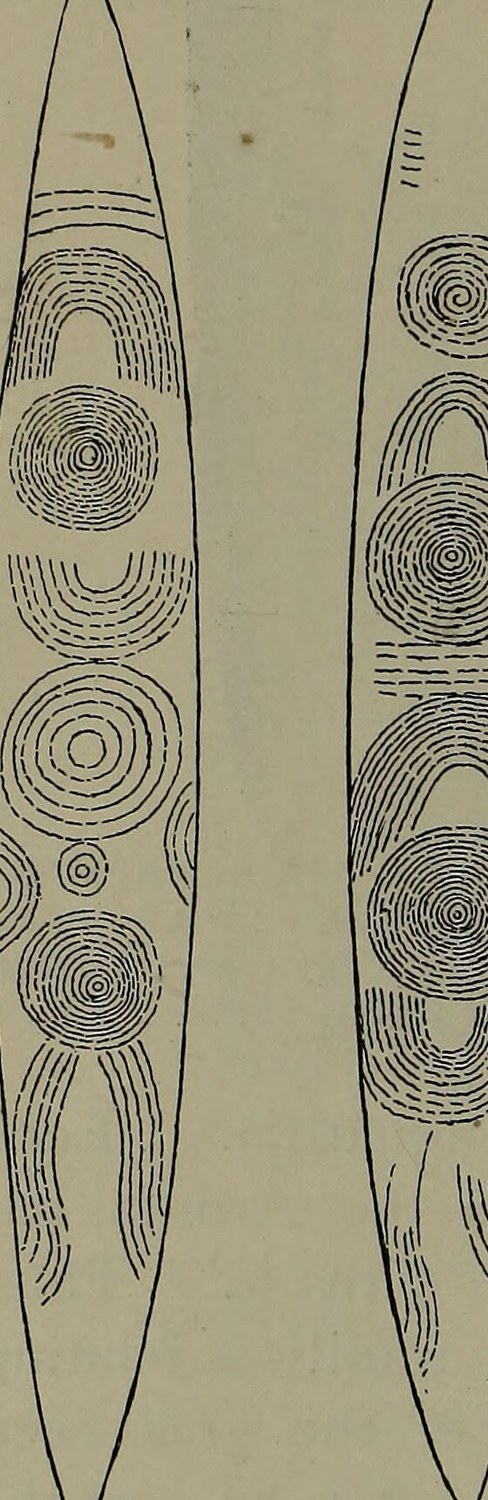
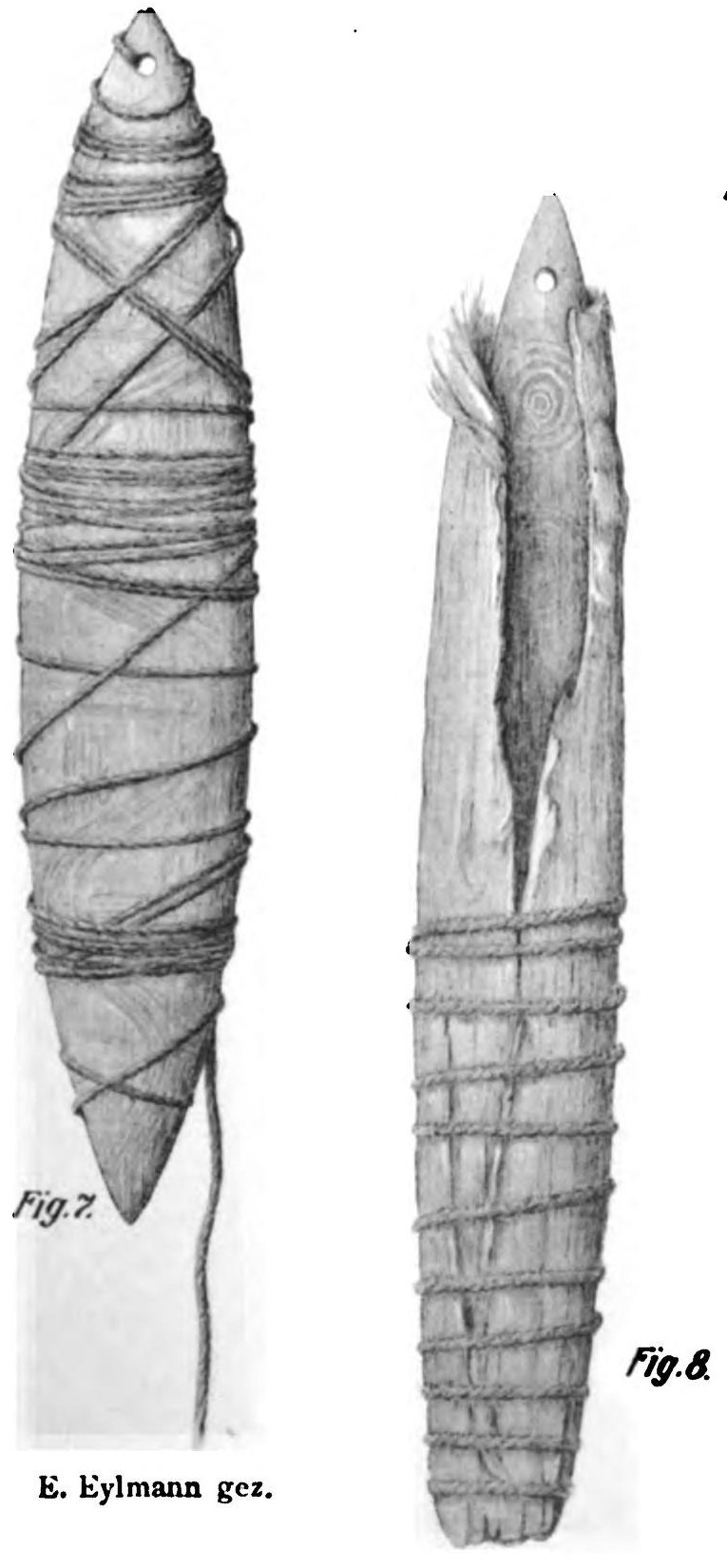
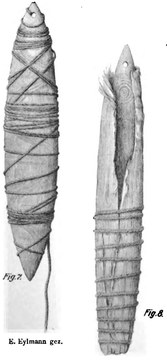
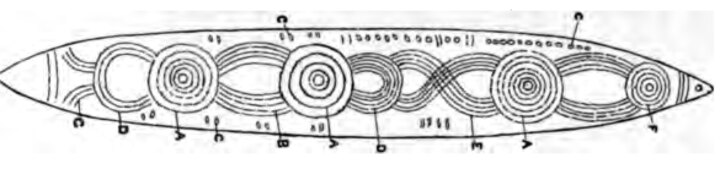
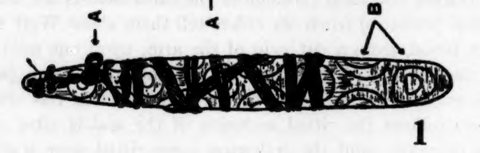
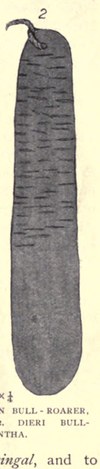
Arunta / ArrernteA West Arunta bullroarer carved with a long wavy line, drawn by Eylmann.Kaitish (Kaytetye)Spencer & Gillen Fig. 91: a Kaitish (Kaytetye) wooden churinga / bull-roarer ('murtu-murtu') of the grass-seed totem.Warumungu (Warramunga)Two Warumungu bullroarers drawn by Eylmann; one remains inside its bast-fibre case.
The most precious board may be the least handsome. Its design has almost vanished under repeated rubbing; resin fills its holes, and kangaroo or emu sinew holds its decaying wood together. Among the Arrernte, such mended churinga are valued as highly as the stone ones. A small sounding board is one member of this great company of ancestral objects, each tied to a name, a place and the men who keep it. To hear it roar at initiation is to meet one part of that inheritance. 1
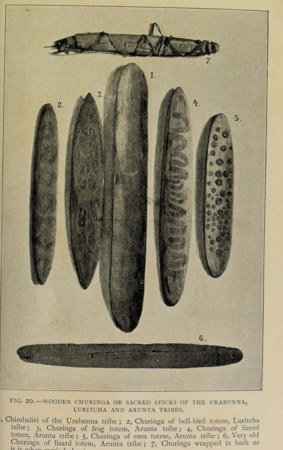
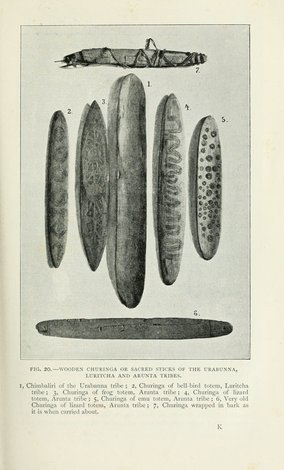
Churinga, now commonly written tjurunga, is a wider word than bullroarer. Arrernte sacred objects include stone and wooden forms, some a few inches long, others several feet. Small wooden boards, pierced for a cord of hair or fur, are whirled in ceremonies; stone churinga are never sounded, even when they too are pierced. The wooden ones are churinga irula, “dressed wood.” Mulga supplies the durable timber, and other woods serve where it is lacking. 1
Some wooden churinga are patched again and again. Some are tied to named ancestors or stand for their equipment: an ancestral woman’s digging stick, an ancestral carrying dish. An old board may matter most while it lies wrapped and resting among them. 1
In the Arrernte accounts, a spirit-child enters a woman near a certain tree or rock and leaves its churinga behind. After the birth, the father and older male relatives search there. If they do not find it, they make a wooden one from a nearby tree and mark it for the child’s totem. It goes into the storehouse of that place, even if the child is born and grows up elsewhere. 1
Women and men alike have this tie, although only the men may handle the objects. A cave or crevice, closed with carefully arranged stones, holds the bundles, and the headman and senior custodians care for them. When white men removed churinga from one storehouse, the men of its group stayed in camp for two weeks, weeping and covering themselves with the white pipeclay used in mourning the dead. 1
An Anmatyerr youth, from the country north of Alice Springs, carries his churinga into the bush after the operation. He must keep it sounding, or another arakurta, a being in the sky, will come down and carry him away. The women are told that the spirit Twanyirika, who lives in a rock, has come out to take possession of him. Rules about food, obedience and marriage surround his time in the bush, and he comes back through smoke into the care of his women relatives. 2
Farther south, toward Lake Eyre, Northern Arabana men obtained their initiation instruments from Southern Arabana people or borrowed them from Southern Arrernte neighbours, who would object, they said, if the Arabana made their own. Arabana women heard Witurna in the noise: the being who took a boy away, replaced his insides and returned him initiated. The instrument crossed from one people to another and took a new voice on the way. 2
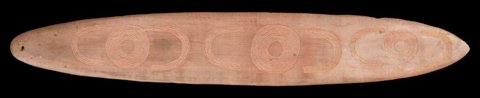
On a frog-totem wooden churinga from Imanda, on the Hugh River, large circles are gum trees, lines spread from them as roots, and dotted tracks follow frogs across the river sand. On the reverse, smaller circles joined by lines are the frogs themselves. On the churinga of Ilatirpa, of the honey-ant totem, circles mark parts of a body. Only someone who knows the object can tell its history. 1
At a Warumungu revelation, a father puts the murtu-murtu into his son’s hands by firelight, points to its marks and explains them. The roar heard before the operation now has a visible form and a history. The instruction ends with a command: carry it, keep it safe, and never let the uninitiated see it. 2
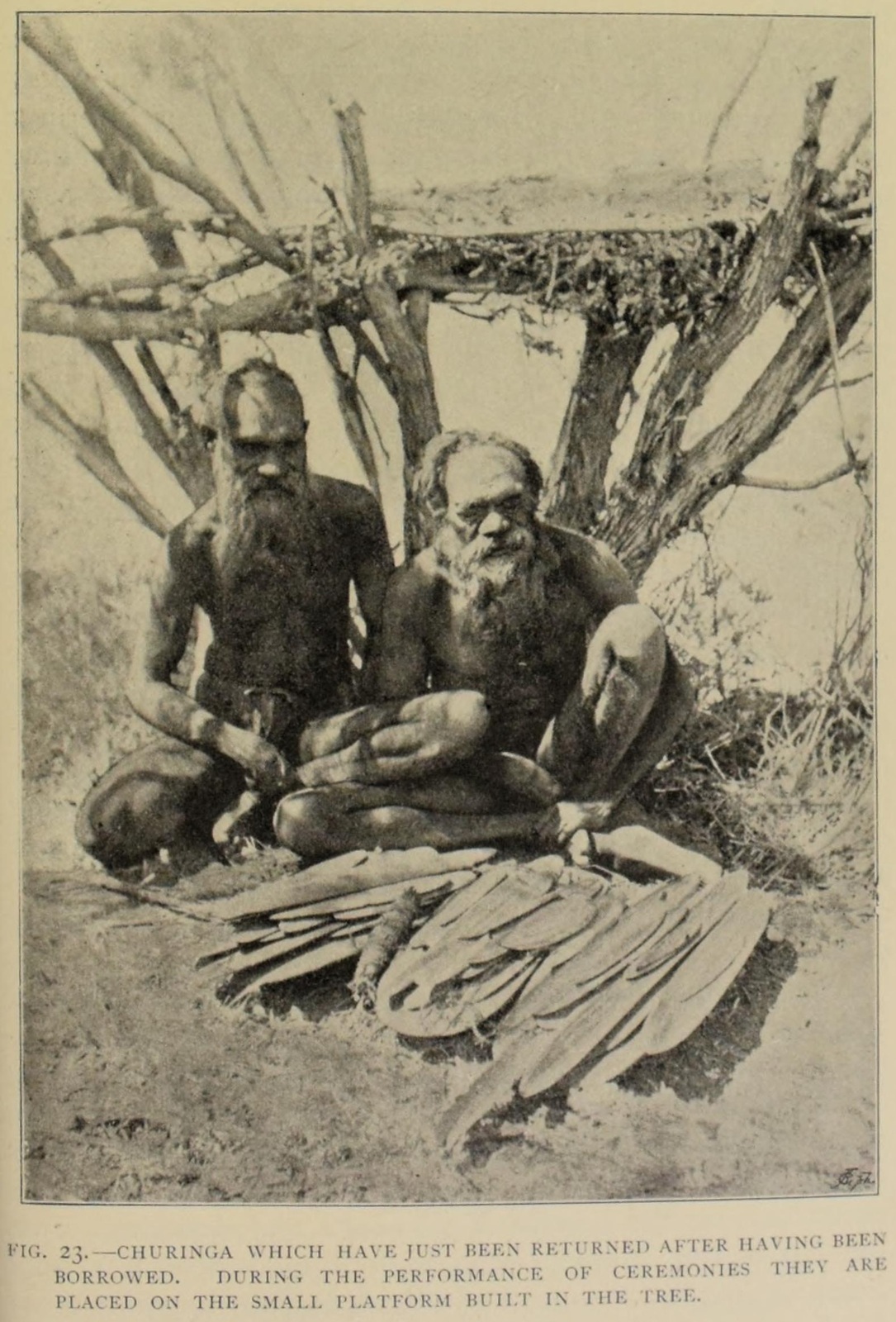
The Arrernte lent churinga between friendly groups. When men from Ulatherka in the western MacDonnell Ranges brought forty-two borrowed stone churinga back to the Alice Springs group, a long reception awaited them. Men painted the designs of the witchetty-grub totem on their bodies and shields: its trees, its places and the stages of the insect’s life. 2
Unwinding the hair-string took an hour and a half. The hosts chanted mournfully, and some wept for dead relatives represented among the objects. Each churinga was pressed against the senior men’s stomachs, then laid on shields with the strings and girdles. Food, water, gifts and further instruction completed the return. The guests had fasted through the ceremony, and the first carefully offered mouthfuls came before their meal. 2
Returned churinga with their Arrernte custodians, published in 1899. The tree platform held the objects during ceremonies. This is an earlier return than the forty-two-stone bundle described above. 3
The Kaytetye story begins with two Tumana, beings who themselves arose from churinga. They hear Atnatu sounding his instruments in the sky and try to answer. Bark tied to string fails. Mulga wood gives the right sound. When the makers decorate their boards with down and swing them, the down scatters, and mulga trees arise where it falls. 2
Wild dogs kill the two inventors, but two men, Kallidinlidina and Atnabubu, have secretly watched them, and they teach others to make the boards and swing them at initiation. Atnatu remains a demanding listener: in another Kaytetye story he hurls spears down when exhausted men stop sounding their instruments during a boy’s operation. 2
Murtu-Murtu comes out of the ground, round-bodied, with only a tuft of hair, making the roaring sound with his mouth. Two enormous wild dogs follow it. They attack him and fling pieces of his flesh through the air; the flying pieces roar, and Grevillea trees rise where they fall. The dogs bite the trees too, trying and failing to destroy the ancestor’s spirit. Living makers cut their murtu-murtu from this wood. 2
After his father reveals the board, the novice carries it through a moon of secluded healing and finally gives it back to him. His return to ordinary company runs through food and relatives: women bring yams, he supplies cooked game, and later gifts release him from silence toward certain men. 2
West of the Arrernte, Luritja, Pintupi and Pitjantjatjara novices carry small boards through their seclusion, hidden in a chignon of hair or a spear-thrower. Northwest of Alice Springs, in the Warlpiri Kajirri, the Mamandabari heroes fashion boards as they travel. Their incised designs show the next stretch of the route, the ceremonial grounds, the heroes themselves and the novices who take part. Creative song goes with the roar of the instruments. 5, 6, 4, 7
Kajirri is also worked out in separate spaces. During its five-month performance in 1979, women’s ritual bosses met the men daily to decide which Dreaming tracks to celebrate. Women celebrated the Two Women; men celebrated two heroes travelling the same route. In 1984 a ritual convoy travelled from Lajamanu towards Docker River for a ceremonial transfer, stopping at Yuendumu for women’s ritual. 8
Among the Jingulu and Wambaya of the Barkly Tableland, wooden boards are prized for their totems. At Beetaloo Waterhole a Wambaya purtuli is kept for Katakitji, the snake who made the waterhole in ancestral times, and that serpent is why it is hidden from the uninitiated. Its value comes from Katakitji himself; no spirit lives inside the wood. 2
Among the Arunta of the MacDonnell Ranges, the sacred objects called churinga could be seen by women or uninitiated men only on penalty of death, or of being blinded with a fire-stick. There were two kinds: flattened stones and wooden slabs, often incised, kept hidden in storehouses among the…
The Kaytetye tell how the roarer was invented. Two Alcheringa men named Tumana — the word for its roar — heard the sky-dweller Atnatu making that noise with his own churinga and tried to imitate it: bark failed, but a churinga cut from mulga wood roared. The down on it flew as they whirled it, and…
At dawn, after hours of ceremony and ancestral songs, the exhausted novice heard the murtu-murtu roar behind him and was “too frightened to do anything.” Men pinned him across two bodies, pressed a fur-string tassel into his mouth, and circumcised him with a stone knife; his blood was caught in a…
Among the Unmatjera of central Australia, a boy recovering in the bush from circumcision had to keep the bull-roarer swinging. If he let it fall silent, another arakurta — a youth between circumcision and subincision — would come down out of the sky and carry him off. Tradition held that this…
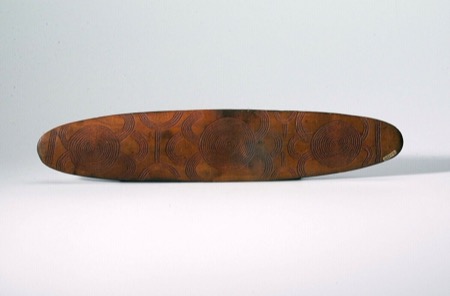
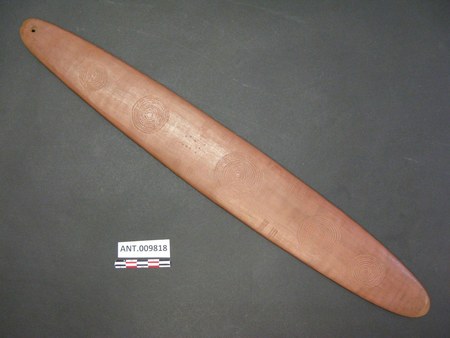
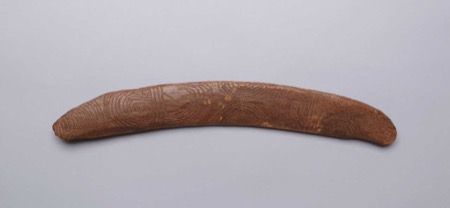
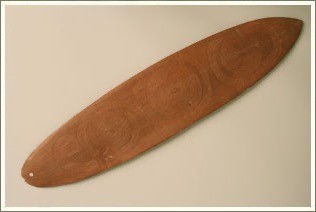
Representative — not this record’s object · A red-ochred Aboriginal Australian bullroarer.
Among the Urabunna of the Lake Eyre country, the women and children were taught that the droning of the bull-roarer was the voice of a spirit called Witurna, who carried the boys off into the bush, cut out all of their insides, gave them new ones, and brought them back as initiated men. When…
Among the Nambutji, a Luritja-speaking people of the northern Western Desert, the bull-roarer was the windirpiri, and behind it stood the myth of Witanygula — the penis of an old man who sat forever at the place called Kuna-tari. The organ travelled under the earth of its own accord, seeking the…
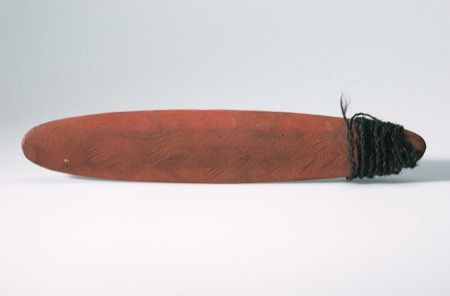
Representative — not this record’s object · A Luritja bullroarer worked in red ochre.
Primary field account: pp.128–144, sacred objects, country, custodianship, repair and sounding forms; pp.145–150, individually explained designs; pp.161–166, lending and return. Fig.21 p.131 and fig.23 p.163. Authors distinguish testimony from witnessed ceremonies, but their evolutionary interpretations are not adopted here.
p.13: distinct Knatata/Aranda, witnessed Pitjentara and Nambutji passages; p.83: Pitjentara/Mularatara teaching. Local names and scenes retained with their own people.
I.7025 belongs to John Irex’s June1953 Jay Creek circumcision/subincision kit. Association with equipment, not a statement that it sounded during the operation.
Coming into Being among the Australian Aborigines, p.99: Pintubi mataki, chignon, father-to-son or sister’s-son transmission. Explicit secondary quotation of Fry1933 pp247–256.