Atlas Guide —
Bullroarer Sound: Listen and See How It Works
A bullroarer sounds like a deep, throbbing roar: a low growl that swells and fades with every circle of the arm, and every few seconds dies away almost to nothing before it builds again. It works because the flat blade, whirled round on a long cord, also spins fast about its own long axis, and each turn of that spin shoves the air to and fro twice; the pulsing air is the sound, and its pitch is roughly twice the spin rate.
Listen
An 18-second recording of a bullroarer in flight. It starts from near silence and rises into a low roar that throbs with each turn of the arm, its pitch sliding as the blade speeds up and slows; listen for the sag where the blade stops and reverses. Most of the energy sits between about 30 and 75 Hz, so headphones or a good speaker help: a phone speaker drops much of it.
See it move
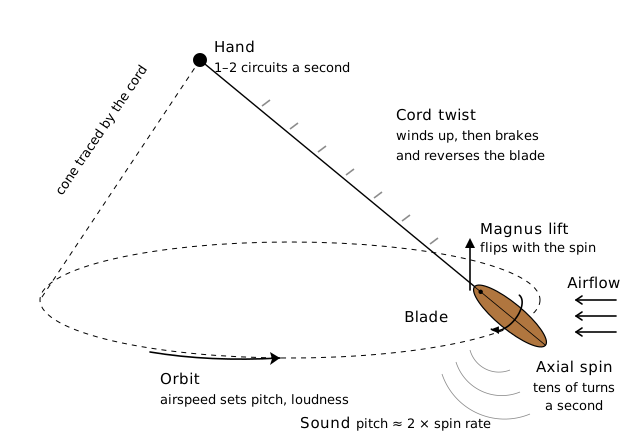
Two motions happen at once. The player swings the blade round in a wide circle, and the wind of that swing turns the blade over and over on its long axis, many times for every circle. The spin twists the cord; the twisted cord brakes the spin; the blade stops, reverses and twists the cord the other way. Watch the sound trace at the bottom of the diagram: it swells as the blade passes the listener, rises in pitch as the spin speeds up, and shrinks to a flat line at each reversal.
How does a bullroarer work?
A bullroarer is a flat blade, usually wood, sometimes bone or stone, tied by one end to a cord. Hold the cord and swing, and the air rushing past turns the blade over on its long axis, the way a flat card tossed into the wind tumbles instead of gliding. Engineers call this autorotation. Once started, it feeds itself: the faster the swing, the faster the spin.
The sound comes from that spin. As the blade turns, the force of the air on it swings back and forth, and the blade pumps the surrounding air like a small paddle. A symmetrical blade presents the same shape to the wind twice in every revolution, so the air is pushed twice per turn and the main tone is about twice the spin rate. In the physicist Neville Fletcher’s measurements, a blade spinning 35 times a second gave a tone of about 70 Hz. The blade itself does not need to vibrate like a ruler on a desk edge; the sound is made in the air.
Three rhythms are layered in what you hear, each on its own timescale:
- The tone, tens of cycles a second: twice the axial spin rate, heard as the roar itself.
- The wow, about once or twice a second: the swell and fade as the blade comes round the circle. A spinning blade throws its sound unevenly in different directions, so the listener hears a surge each time the loud side swings past; the changing distance adds to it, and the Doppler effect bends the pitch a few hertz up and down as the blade approaches and retreats.
- The reversal, every few seconds: the spin winds the cord tight, the twist brakes the blade, and it stops and turns the other way. The acousticians Michel Roger and Stéphane Aubert put it in one line: “At reversal the sound pitch and level almost vanish.” In their recordings this happened about every four seconds.
That is why a bullroarer never roars steadily. It throbs with the arm and breathes with the cord, and the silences are part of the instrument. The same spin also explains the path. A blade spinning as it moves through the air is pushed sideways by the Magnus effect, the force that curves a spinning ball; it lifts the circle into a cone, and when the spin reverses the cone flips with it.
What sets the pitch and loudness of a bullroarer
Two rules cover most of it. Swing faster and the pitch rises: the tone is proportional to the airspeed of the blade divided by its width. Make the blade wider and the pitch falls; in Fletcher’s words, “wide slats produce sound of lower frequency.” For the blades they tested, 40 to 100 mm wide and swung once or twice a second, the fundamental typically lands between 20 and 150 Hz, the bottom of the audible range, where the lowest notes of a bass guitar and an organ live. Fletcher’s example spectrum is close to a pure tone, with the second harmonic some 30 dB below the first, which is part of why the roar sounds so smooth and so deep.
Peoples who use bullroarers in pairs hear the same law. Among the Kurnai of Gippsland the larger blade, the Tundun or “man,” was whirled to a dull roar, while the smaller, the woman, gave a high screech.
Loudness climbs far more steeply. The radiated power rises with the sixth power of airspeed and the square of the blade’s length. Double the speed of the swing and the power goes up 64 times, about 18 decibels: the difference between a murmur and a roar from one extra push of the arm. Fletcher’s outdoor tests bear this out. Raising the orbit from 72 to 120 turns a minute lifted the level at the microphone from 60 to 72 dB, close to what the rule predicts.
| Test | Result |
|---|---|
| Blade spinning 35 times a second (Fletcher et al.) | Tone about 70 Hz |
| Blades 40–100 mm wide, swung 1–2 times a second (Fletcher et al.) | Fundamentals typically 20–150 Hz |
| Aluminium blades 335 × 40–100 × 1 mm on a 70 cm cord, outdoors (Fletcher et al.) | 40–160 Hz |
| Same rig, orbit 72 turns a minute, microphone 4 m away on the orbit axis | 60 dB |
| Same rig, orbit 120 turns a minute | 72 dB |
| Blade 4 cm wide at 138 turns a minute, airspeed 11.6 m/s (Roger & Aubert) | 95 Hz, swinging ±3.5 Hz with Doppler shift |
| Interval between reversals (Roger & Aubert) | About 4 seconds |
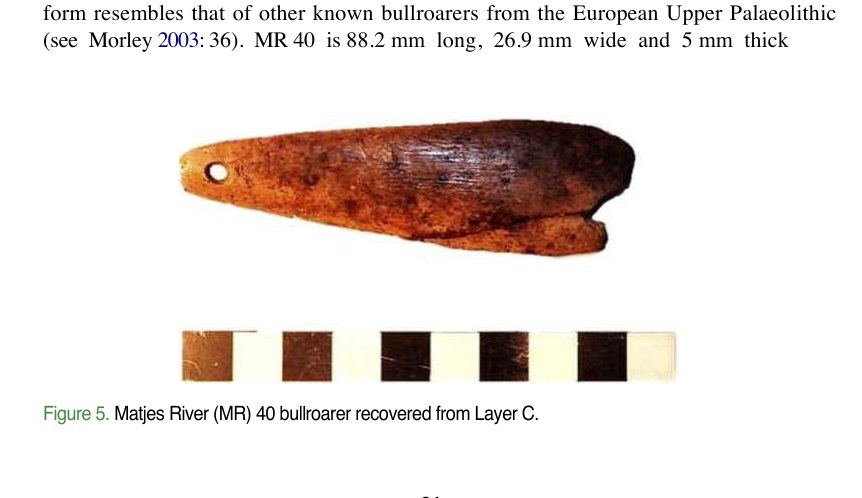
| Replica of the Matjes River bone blade MR 40, South Africa (Kumbani et al.) | Up to about 77 Hz on a leather string, 56 Hz on plant fibre |
How far a bullroarer carries
Far enough to fill a valley. Lucía Ruano Posada and Mario Freire Ruiz whirled five replica bullroarers in the open, one player and one listener, and walked the listener out until the sound faded. The large fir blade, 247 mm long and 43 mm wide, was clearly audible at 192 metres and still caught at 251.
| Replica | Clearly audible | Barely audible |
|---|---|---|
| Large fir | 192 m | 251 m |
| Deer antler | 96 m | 124 m |
| Holm oak | 69 m | 77 m |
| Bovine bone | 66 m | 82 m |
| Small fir | 47 m | 67 m |
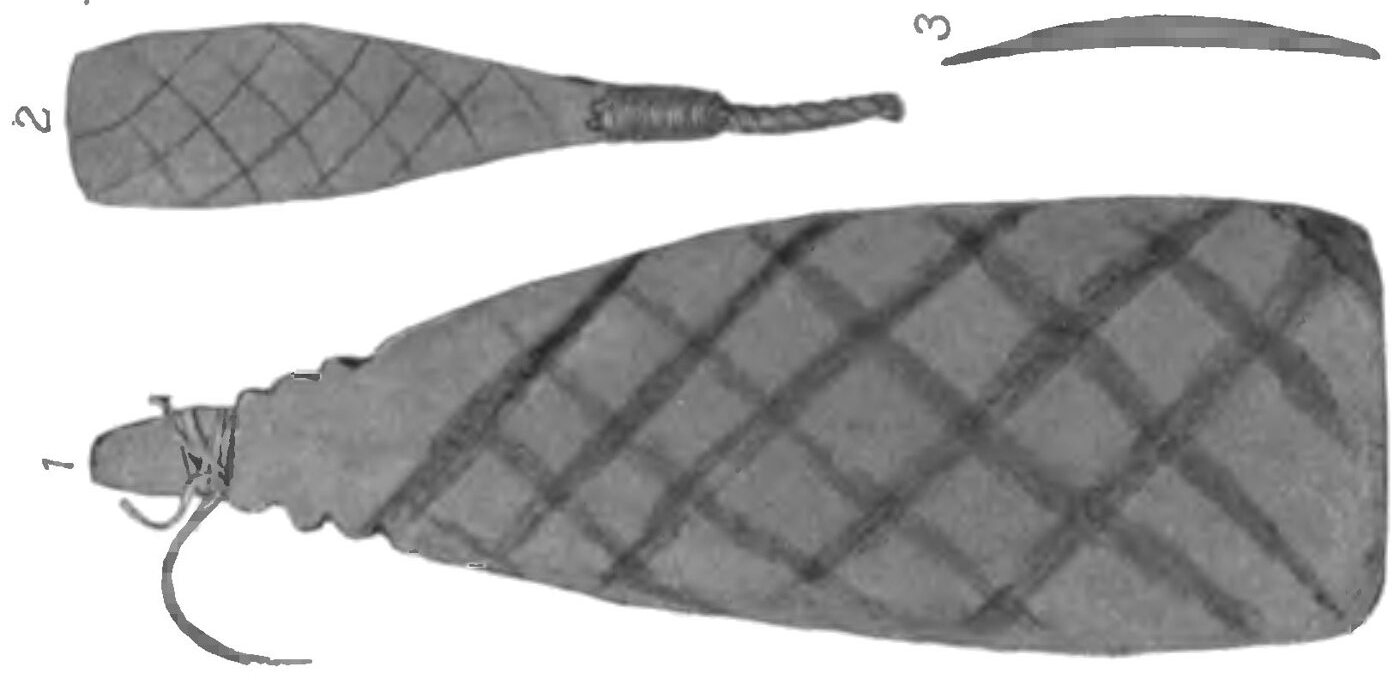
Experienced hands do better than experiments. Writing to E. B. Tylor from Gippsland on 14 April 1884, A. W. Howitt described the smaller Kurnai bullroarer, swung with a stick in a whip-like stroke, giving “a ‘screech’ which I have distinctly heard at a distance of 2000 paces.” On a still night that is the whole camp and well beyond it, which is exactly where the voice of a being who walks round the camp needs to reach.
What do serrated edges do?
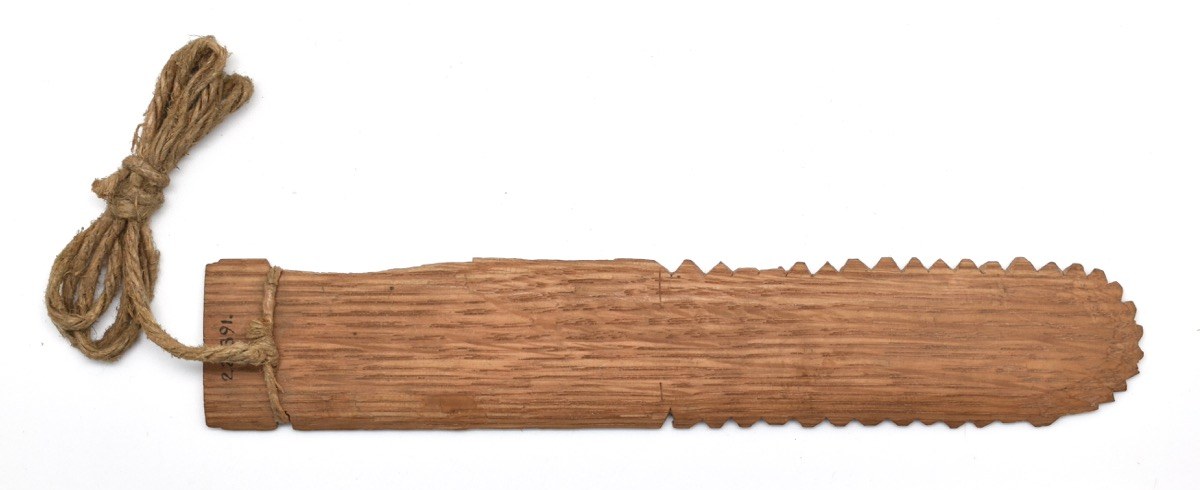
Many bullroarers have notched or toothed edges, from Arctic bone blades to English schoolboys’ “bummers.” No controlled test has yet settled what the teeth do to the sound. Roger and Aubert’s smooth, symmetrical blades spun and roared perfectly well, and they noted that roughness or a little asymmetry may help a blade start turning.
Questions about the bullroarer’s sound
Why does a bullroarer stop and start?
Because the blade’s spin winds up its own cord until the twist stops it and turns it the other way. With no spin there is no sound, so the roar fades at each reversal and returns as the blade picks up speed, every few seconds for as long as the player keeps swinging.
Why does a bullroarer need a long cord?
The cord sets the radius of the circle. At the same number of circuits per second, a longer cord makes the blade travel faster, raising both pitch and loudness, and loudness climbs very steeply with airspeed. A long cord also takes more turns of twist before it brakes the blade, which lengthens the stretch of sound between reversals.
Is a bullroarer infrasound?
Its tone sits at the bottom of the audible range: measured fundamentals typically fall between 20 and 150 Hz. Below that runs the instrument’s rhythm, a swell once or twice a second as the blade circles and a slower cycle every few seconds as it reverses. Those slow pulses are felt as throbbing rather than heard as a note, and they are a large part of why the sound seems to breathe.
Is a bullroarer dangerous?
Yes. The blade can strike anyone inside its circle, and a broken cord can send it flying well beyond that circle. Swing it in open ground, well clear of people, and check the cord and its knot before each use.
How far away can you hear a bullroarer?
Hundreds of metres. In outdoor trials a large fir replica was clearly audible at 192 metres and still faintly audible at 251 metres. In 1884 A. W. Howitt wrote that he had distinctly heard the smaller Kurnai bullroarer at 2000 paces.
Why is it called a bullroarer?
Bullroarer was an English boys’ name for the whirled toy, and anthropologists took it over in 1880 for the sacred instrument; see What is a bullroarer? for the full story.
Where to go next
Key sources
Fletcher, N. H., Tarnopolsky, A. Z. and Lai, J. C. S. 2002. “Rotational aerophones.” Journal of the Acoustical Society of America 111(3): 1189–1196, doi:10.1121/1.1446053 — 70 Hz from 35 rotations a second and the amplitude envelope (p. 1190, Fig. 4); outdoor aluminium-blade tests, 40–160 Hz, 60 and 72 dB at 72 and 120 rpm (p. 1191); radiation model, power ∝ airspeed⁶ × length².
Fletcher, N. H., Tarnopolsky, A. and Lai, J. 2002. “Australian Aboriginal musical instruments — the bullroarer.” Innovation in Acoustics and Vibration (Australian Acoustical Society), pp. 186–189 — reversal (p. 187); envelopes near 1 Hz and 0.2 Hz or less; fundamentals of 20–150 Hz for 40–100 mm blades at 1–2 rev/s.
Fletcher, N. H. 2003. “Australian Aboriginal musical instruments: the didjeridu, the bullroarer and the gumleaf.” Acoustics Australia 31(2): 51–54, §3 — the oscillating dipole, tone at twice the spin rate, “wide slats produce sound of lower frequency,” second harmonic about 30 dB down.
Roger, M. and Aubert, S. 2006. “Aeroacoustics of the bullroarer.” Acta Acustica united with Acustica 92(5): 826–841 — Magnus lift and the conical path (p. 827); Doppler excursion and serrated edges (p. 838); reversal about every four seconds, “At reversal the sound pitch and level almost vanish” (p. 839); directivity and the orbit-rate wow (p. 840).
Ruano Posada, L. and Freire Ruiz, M. 2015. “Bramaderas: ¿instrumento o sistema de comunicación? Un acercamiento experimental.” Boletín de Arqueología Experimental 10: 45–60, doi:10.15366/baexuam2015.10.004 — outdoor audibility trials (Tables 1–2, pp. 57–59).
Howitt, A. W. Letter to E. B. Tylor, 14 April 1884. Howitt–Tylor papers, Pitt Rivers Museum, Oxford (“Howitt 14”) — the Kurnai bullroarer heard at 2000 paces. Howitt, A. W. 1904. The Native Tribes of South-East Australia. London: Macmillan — Fig. 37.
Kumbani, J., Bradfield, J., Rusch, N. and Wurz, S. 2019. “A functional investigation of southern Cape Later Stone Age artefacts resembling aerophones.” Journal of Archaeological Science: Reports 24: 693–711, doi:10.1016/j.jasrep.2019.02.021 — replica frequencies (Table 5, p. 708).
Iversen, J. D. 1979. “Autorotating flat-plate wings: the effect of the moment of inertia, geometry and Reynolds number.” Journal of Fluid Mechanics 92(2): 327–348 — the aerodynamics of autorotation.