Atlas Essay —
The Summons
Aboriginal Australia · and the trail beyond
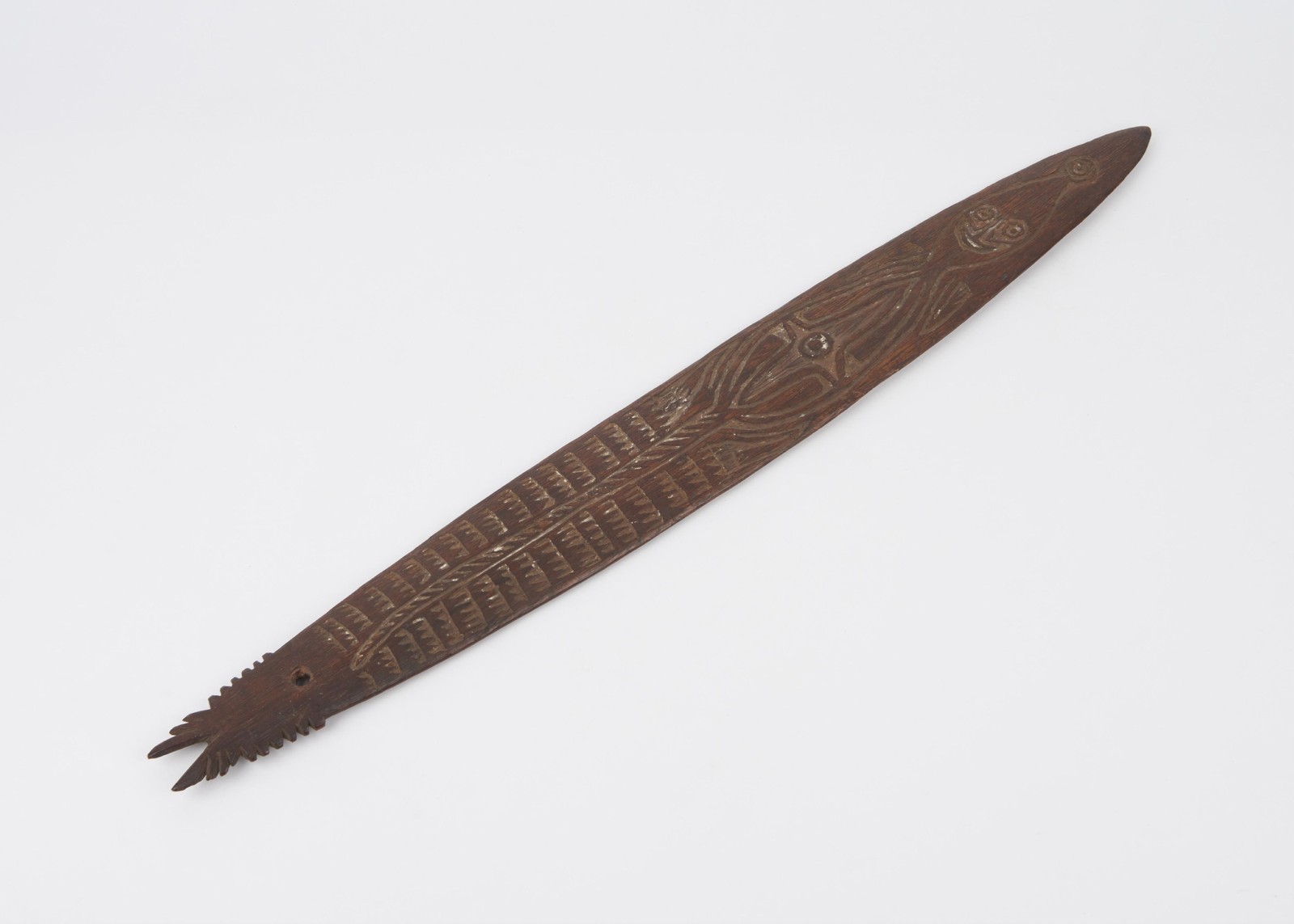
In July 1964, at Gerard on the Murray, a man recalled a message that had come from Jalukari on a bullroarer. Henry ignored it and stayed where he was. Refusal names what the blade expected: movement. A thin board had crossed the country carrying another place’s claim upon him. Across Aboriginal Australia the bullroarer was a summons before it was a spirit voice — carried between camps or sounded over them, it called people to ceremony and made the road there safe.
On this page
In brief
- Mungarai messengers carried kunapippi up to two and a half feet long into distant camps as the invitation to ceremony, and Baldwin Spencer wrote that the blades kept them safe even in the camps of other tribes.
- William Barak told A. W. Howitt that a Wurundjeri messenger summoning the Talangun initiation carried a bullroarer and a man’s kilt on a reed; the Kurnai said that no man the kalk reached could stay away.
- On the Darling River, pairs of Kurnu buruki carried the yantamakaddya when they summoned the tribes; the Nukunu leader Malbunga mustered his people with the wiithanha; a Lardil blade from Mornington Island was “used to assemble the group.” Below the Murrumbidgee the Tati Tati called the blade Kalk, “that is to say, word.”
- The same institution recurs where the object went: southern California, the Comanche Southern Plains, Zuni, the Upper Xingu, southern and northern Nigeria, the northeast Congo, and the eastern Papuan Gulf, where a Toaripi mai karu sounded the blade in a fight and all fighting had to stop.
Across Aboriginal Australia the bullroarer was a summons before it was a spirit voice: carried between camps or sounded over them, it called people to ceremony and made the road there safe.
The message Henry refused
Norman Tindale recorded the Gerard reels on 25 July 1964, and the summary of the first of them keeps Henry’s decision: a bullroarer from Jalukari, a message on it, and a man who remained where he was. Instrument, message, travel and refusal belong to one chain of cause. A blade had been sent, and to refuse it was to refuse an obligation someone else had the standing to impose.
Fuller Australian accounts preserve the protocol that makes the chain legible. A recognized object leaves a ceremonial centre. Its bearer enters another group’s country under protection. Elders inspect the emblem and hear the spoken invitation. They agree, appoint people, and travel. Later the same class of blade sounds at night, at a novice’s departure, and at the approach to camp: the still object moves the message, and the moving object publishes the moment.
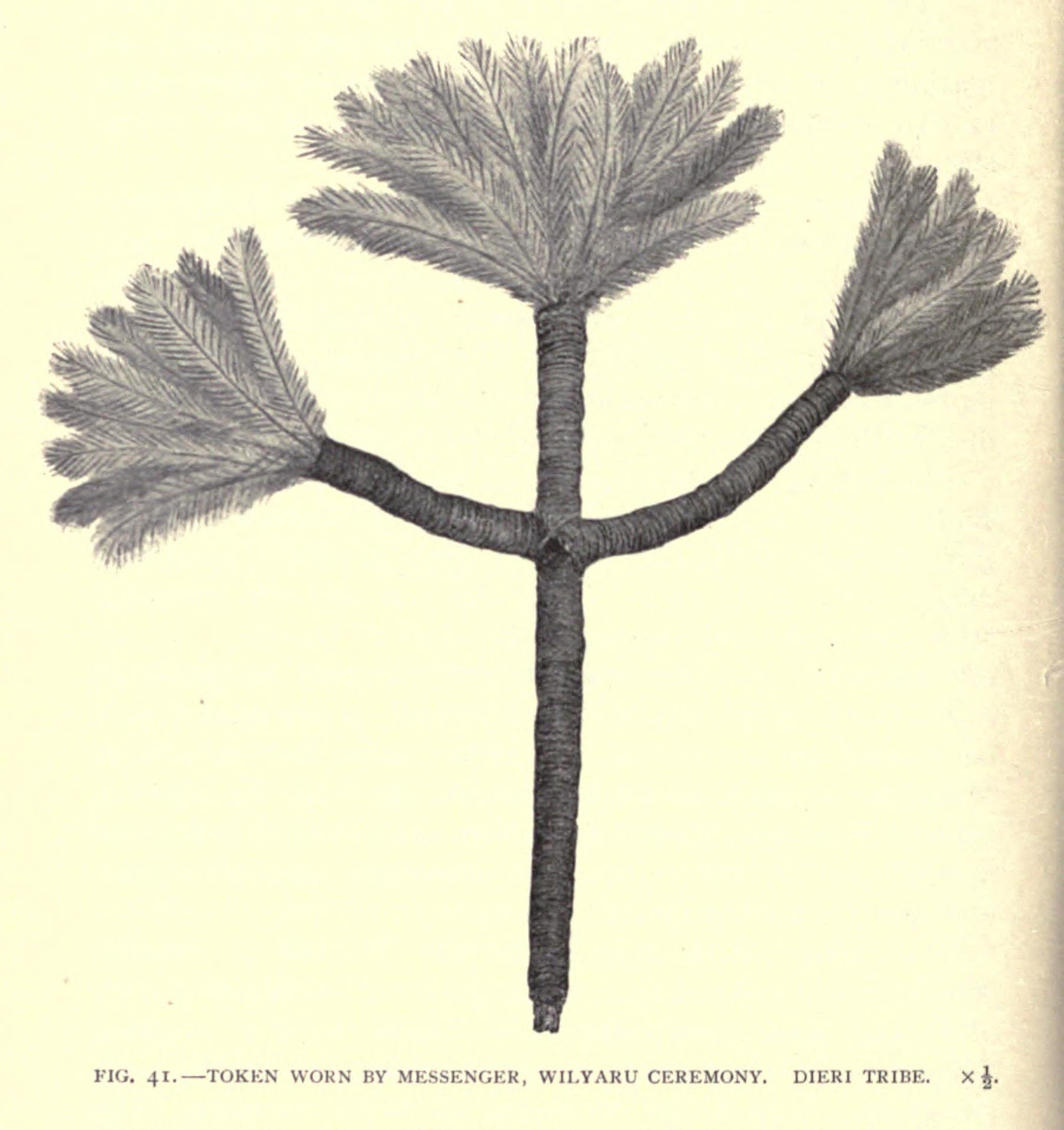
The blade in a messenger’s hands was a warrant on a cord, and the camp it reached read it as a summons. A credential says who sent the bearer; a summons says who must move, and when. One blade does both, because authorization and assembly are two halves of a single institution.
The ceremony begins on the road
Baldwin Spencer saw that beginning among the Mungarai of the middle and upper Roper River, in the Northern Territory. Before the sacred performance itself, the invitations went out in the hands of men carrying the instrument they were inviting people to hear.
Some time previously, messengers carrying kunapippi or bull-roarers have been sent to various camps inviting them to come and take part in the ceremony. These messengers go to distant groups in the Mungarai tribe and to the camps of friendly tribes such as the Nullakun. Carrying the kunapippi they are perfectly safe and, on the return journey, they collect the visitors and leisurely return to the home camp, the numbers of the party increasing as they come nearer home.
— Baldwin Spencer, Native Tribes of the Northern Territory of Australia, 1914, p. 164
The safety was not a courtesy added to the invitation; it made the invitation possible. A regional ceremony required men to cross jurisdictions, approach camps where an unexplained arrival could be read as hostile, and come back with people whose presence carried political as well as ritual weight. Spencer’s Mungarai blades reached two and a half feet, and he lists that size as belonging to the instruments “carried by messengers, who go out to summon members of distant groups to take part in sacred Ceremonies.” A board that long does not slip into a bag; it makes its bearer visibly answerable to the ceremonial order behind him.
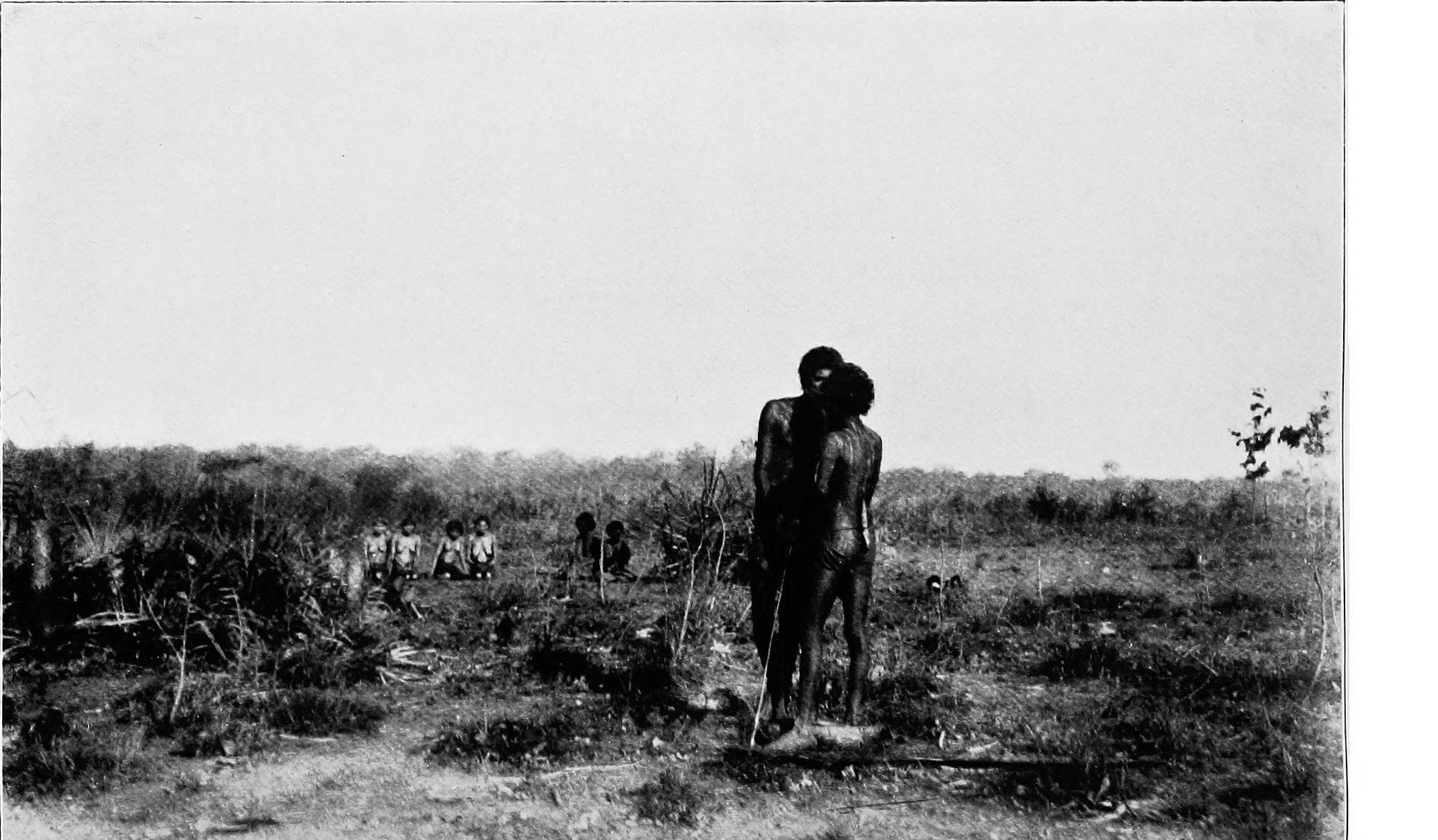
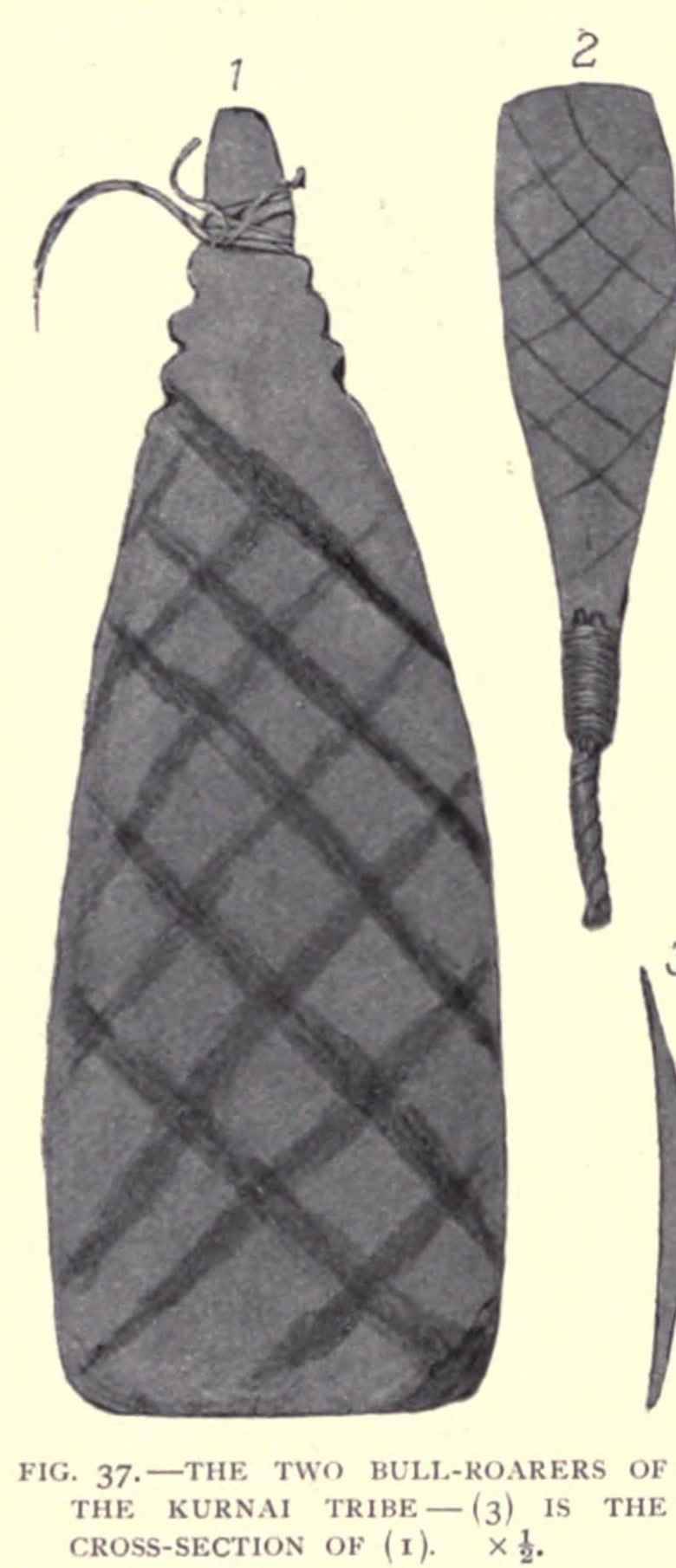
William Barak gave A. W. Howitt an equally exact account for the Wurundjeri of the Kulin nation, in what is now Victoria. A messenger carried different things for different business. To call the Talangun, the meeting for the initiation of boys, he carried a bullroarer and a man’s kilt hung upon a reed, and the bullroarer was kept from the sight of women and children. The bundle classified the visit and named the gathering before the messenger opened his mouth.
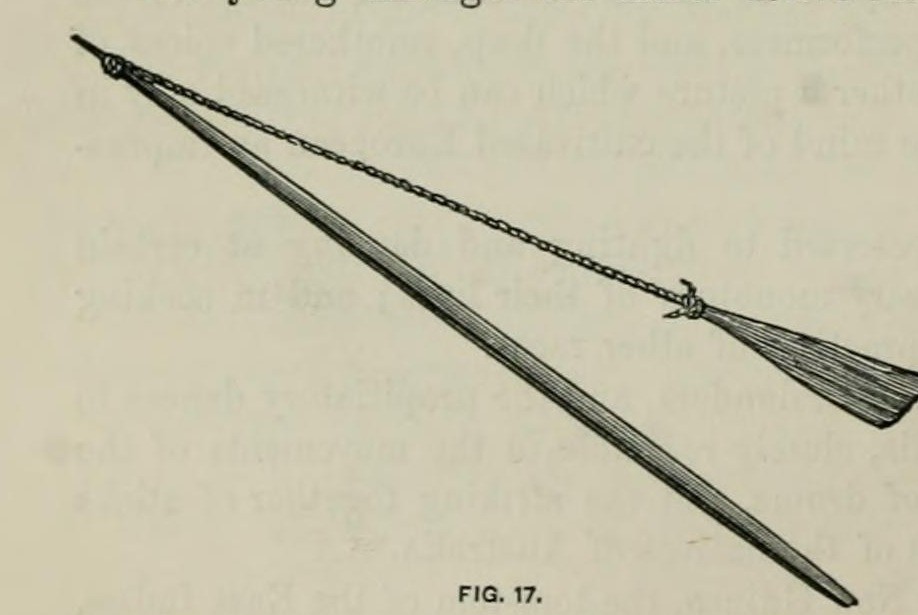
On the Darling River the Kurnu named the blade for its place in the journey. Pairs of buruki messengers carried the yantamakaddya with the other emblems of their standing and recited the summons to the tribes they reached. At the ceremony the same name belonged to the roarer sounded as the novices were led away; at their return the blades sounded again as wambinggulli, with the smaller nyugara. R. H. Mathews wrote the sequence down in 1904 as outward summons, departure and return — one gathering divided into authorized movements, each with its own voice.
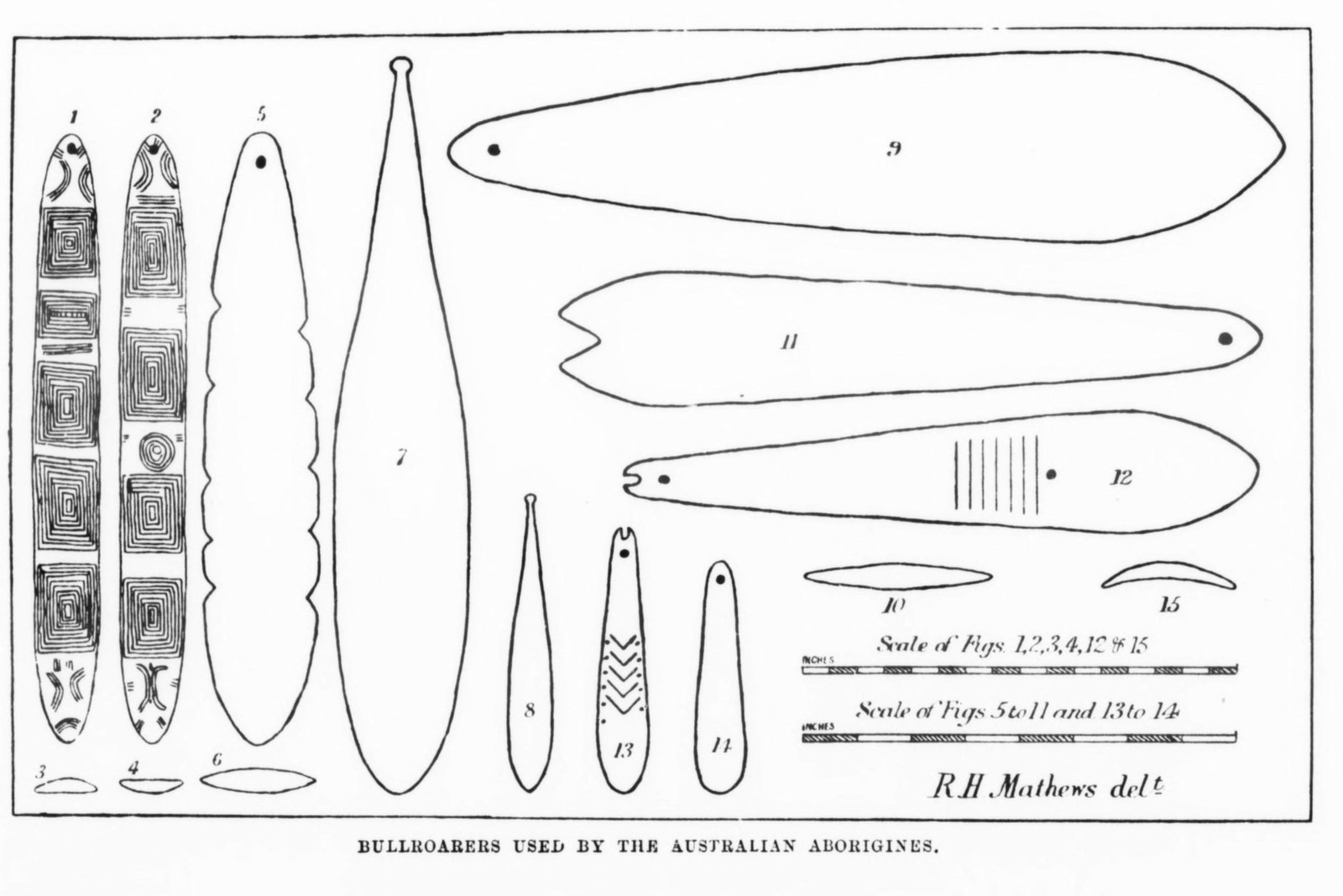
“When that kalk (wood) goes to a man he must come, he cannot stop away.” — A. W. Howitt, The Native Tribes of South-East Australia, 1904, p. 617 n.
A summons has two bodies
A summons needs a durable body and a broadcast body, and the Australian evidence supplies both. Wood and carving survive the journey, identify the commission, and pass from one custodian to the next. Sound leaves the hand, fills darkness, and reaches everyone in range at once. One blade holds the pair: addressable while it is carried, ambient the moment it is swung.
A Nukunu story sets the acoustic act in the landscape of the mid-north of South Australia. Malbunga divides those who will stay from those who will go, strikes the sandhill beside the salt lake with his wiithanha, sings of the blow, and musters the people with it. Luise Hercus recorded the story; the Nukunu community wordlist keeps the word on its own, wiithanha, bullroarer.
A collector’s card in the Smithsonian keeps the same act without the story around it. George R. Moule wrote of a Lardil bullroarer from Mornington Island, in the Gulf of Carpentaria, that it was “used to assemble the group and in some of their dances.” Assembly comes first on the card, and first in fact: the sound makes the social body that then performs.
The Tati Tati blade called Word
On the Murray below the Murrumbidgee, the Tati Tati called the blade Kalk — “that is to say, word,” A. L. P. Cameron noted in 1885. Among the Kulin, kalk, “wood,” was the name of the message stick, the object a messenger carried to prove the message was really sent. The Kurnai used the same word for the call that could not be declined.
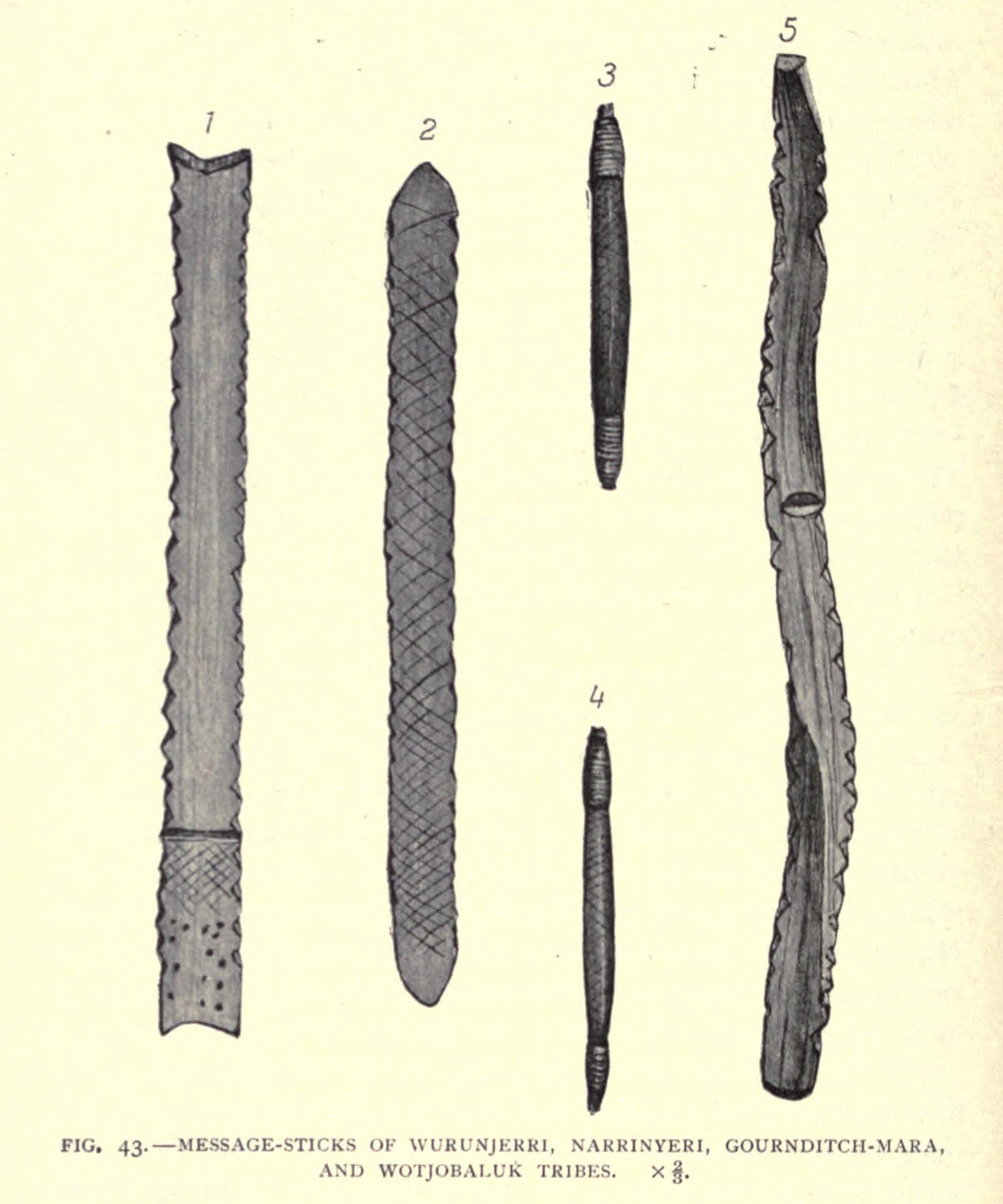
Wood, word and message make one small semantic field along the southeastern rivers, and the field is exact about what these societies took a word to be. A word need not be weightless. It can be cut, carried five days across country, and put into somebody’s hand.
Summons is the missing noun
“Initiation instrument” names the setting, “spirit voice” names what the sound was understood to be, and “restricted” names who was kept out. Summons names what the blade did to an addressee. The Mungarai messenger required safe passage and attendance. Barak’s Wurundjeri messenger convened the Talangun. The Kurnu buruki announced a ceremony and then voiced its thresholds. Malbunga mustered a dispersed people into one body. Moule’s Lardil informants assembled the group at the sound.
The noun is broader than invitation, because some of these calls compel, and narrower than communication, because the expected answer is a movement: come, gather, stop, hide, clear the path. It can rest in custody before it becomes sound — a messenger holding the recognized blade has already delivered the call, whether or not the blade ever turns above his head — and it can leave travel behind entirely and fill a camp at once.
The instrument is exceptionally good at the job: portable, hard to place by ear, loud in the open, usable in the dark, and unlike any human voice. The evidence for the function is always the prescribed response, and in Australia that response is recorded again and again as attendance.
Reading the roarer as a summons joins together things usually kept apart. The spirit voice and the public signal work as one: supernatural address is what makes a human instruction binding. Secrecy and assembly are one act, since the sound that gathers insiders is the sound that clears everyone else from the road. Credential and noise live in one object, which authenticates its bearer while still and publishes the ceremony while moving. Safe conduct brings the road under the same audible jurisdiction as the ceremonial ground it leads to.
The same summons where the object went
The bullroarer travelled, and the institution travelled with it. Beyond Australia the same act turns up in societies that share little else: a blade sounded to bring people, powers, or a fight into a new relation. A disc marks a summons carried between camps; a square, people assembled or ceremonial time begun; a lozenge, a road cleared or fighting stopped; a triangle, spirits, rain-makers or clouds called.

Southern California and the Southern Plains
In southern California the function was public enough for A. L. Kroeber to state it flatly: “To the Luiseño it was a summons.” He described the momlahpish as a crude board, whirled as a summons to religious assembly, and recorded it starting and stopping the Wauchanish mourning ceremony. Philip Sparkman heard it calling people to feasts. In Constance Goddard DuBois’s account of the ceremony for the dead, the chief stopped the singers by whirling the board three times rather than by speaking. Philip Drucker’s 1937 survey found the same signal among Cahuilla, Cupeño, Luiseño, Diegueño and Serrano communities, with the ceremonial assistants named as the people it assembled. Among the Mesa Grande Diegueño an old man swung the blade, called air, three times in the afternoon, and that was the signal for the people to assemble (Waterman 1910, p. 308).
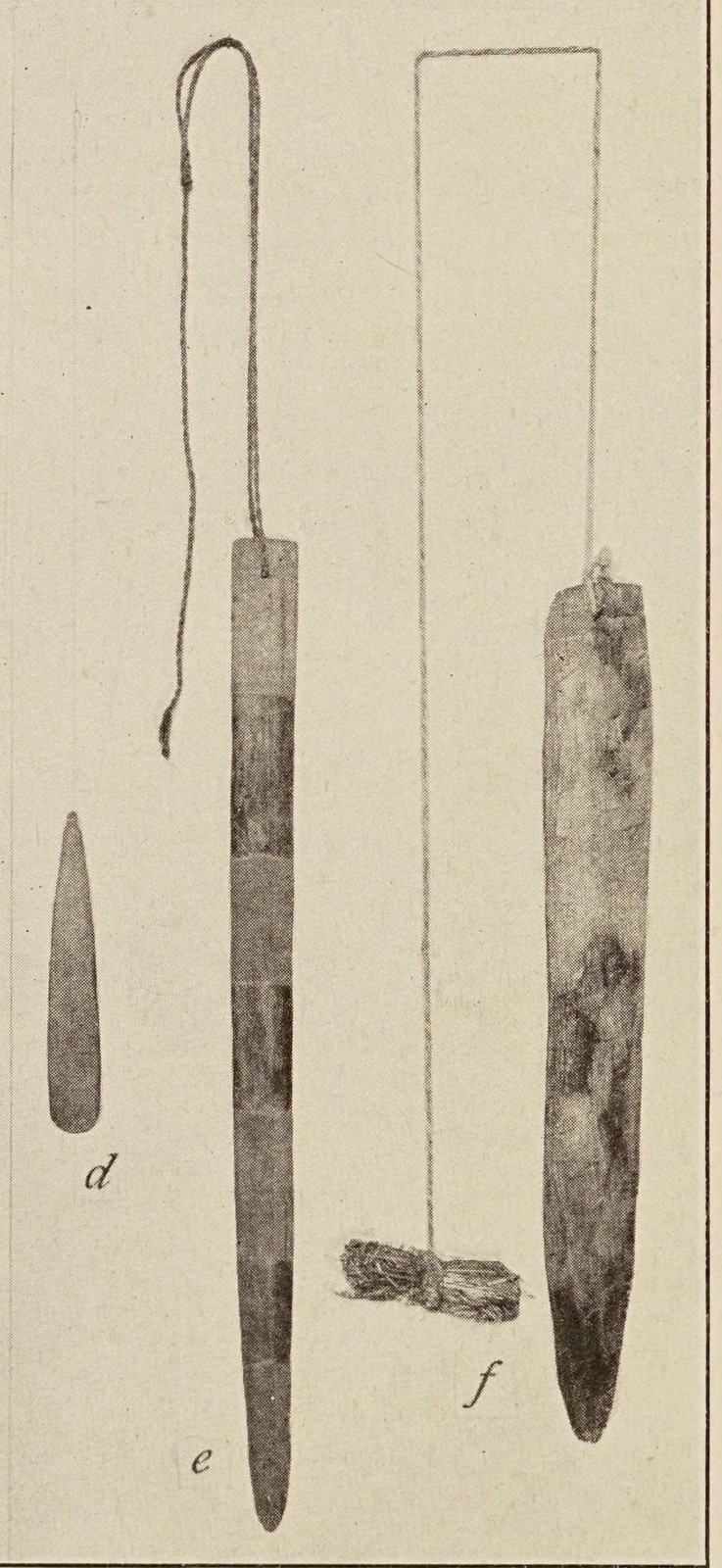
The Comanche joined the call to protection as tightly as the Mungarai did. The cedar slat was the “warm wind.” At the Beaver Ceremony a medicine man went to the east side of the tipi, swung the roarer and called to the people, who knew that he was inviting them in. In war the same medicine object travelled near the shield and was whirled in danger, so that a bullet would come straight and miss. Wallace and Hoebel published the complex in 1952 from field notes taken in 1933.
Zuni and the Upper Xingu
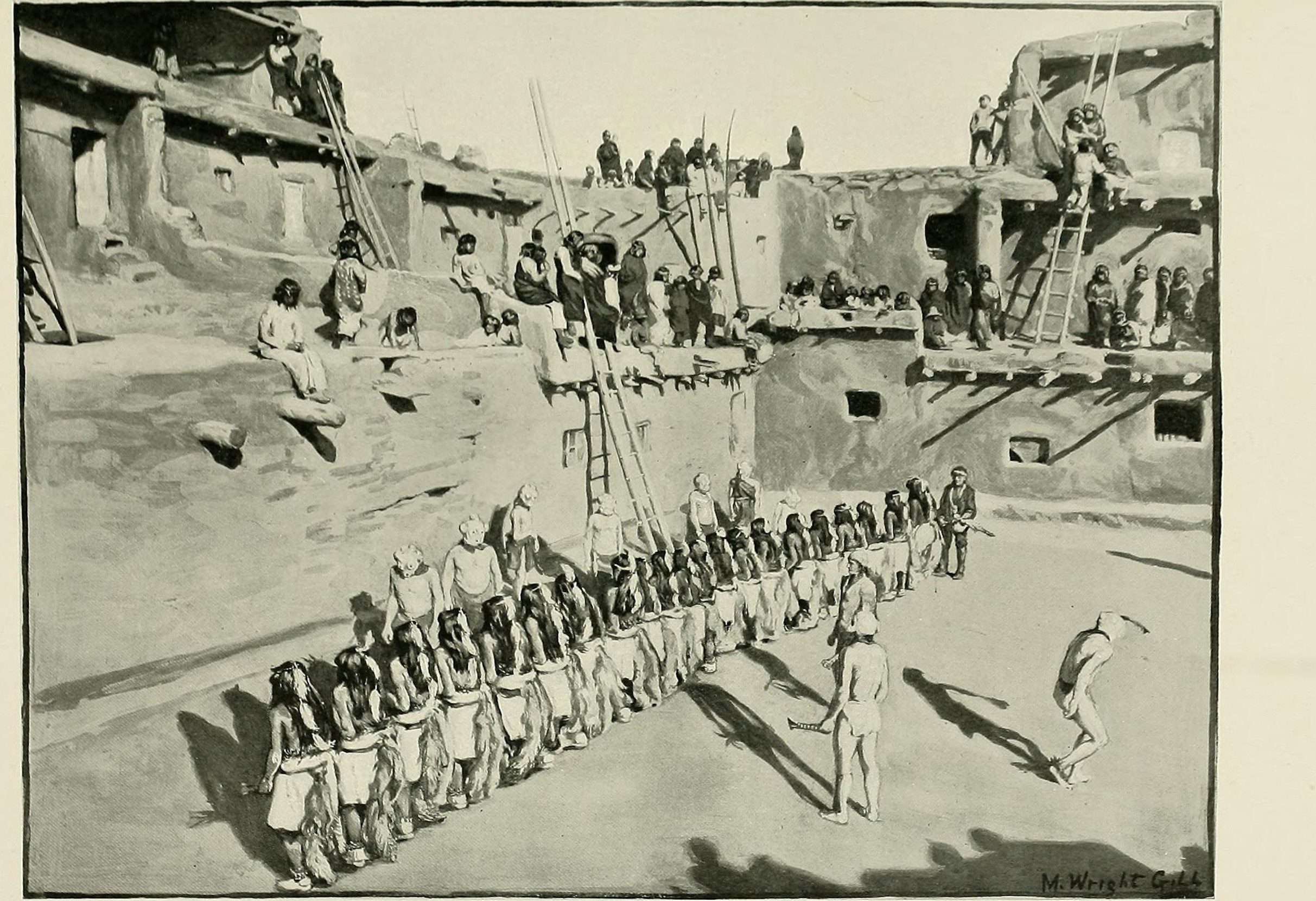
Some of the participants a summons calls cannot be assembled by human eyes. At Zuni, Matilda Coxe Stevenson recorded the rhombus whirled “to create enthusiasm among the u’wannami,” the rain-makers, and heard it in War-God processions, in fraternity rain retreats, and in calls for clouds. Women were never barred from the sound. The rooftops were full of human witnesses, and the imperative travelled upward past them.
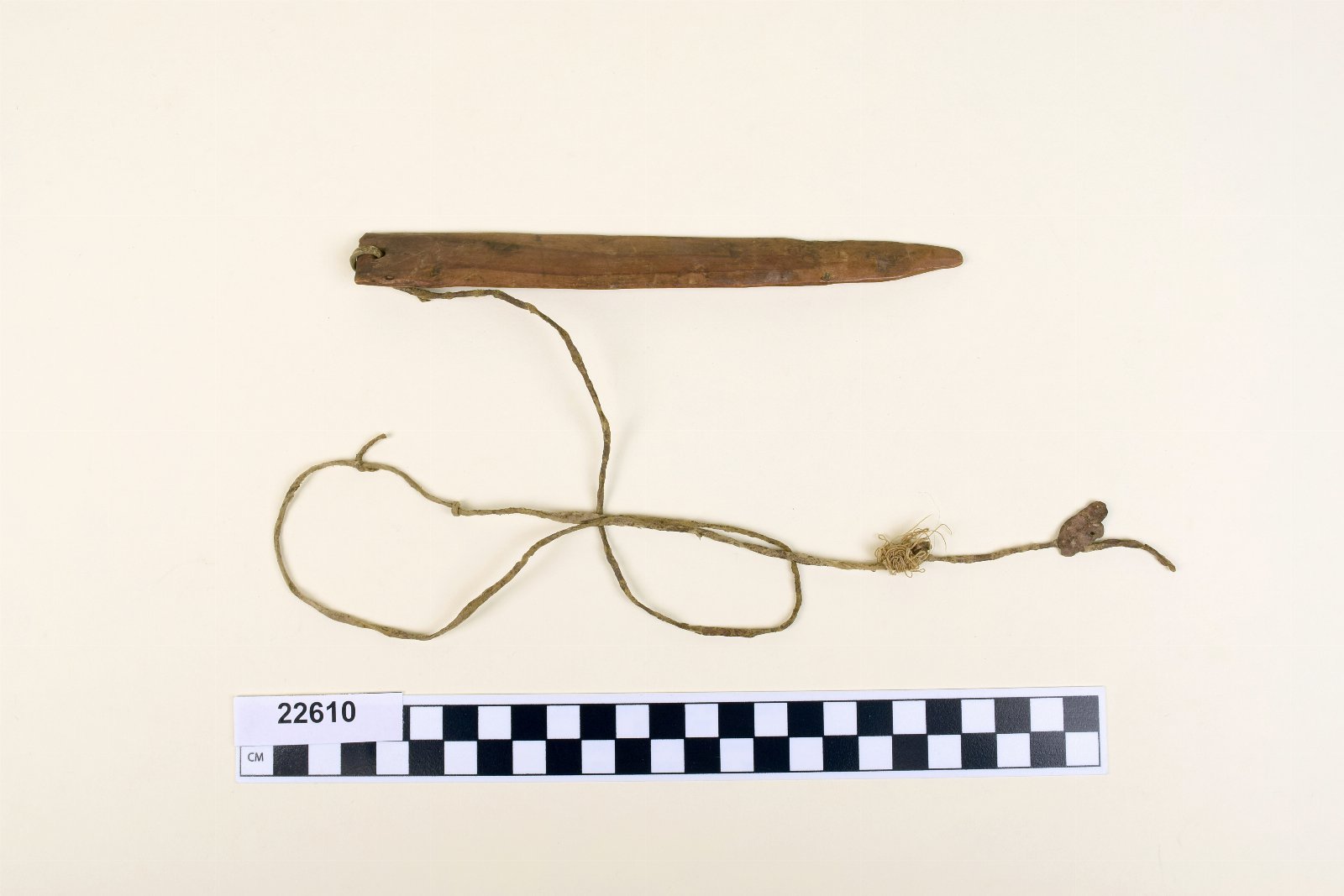
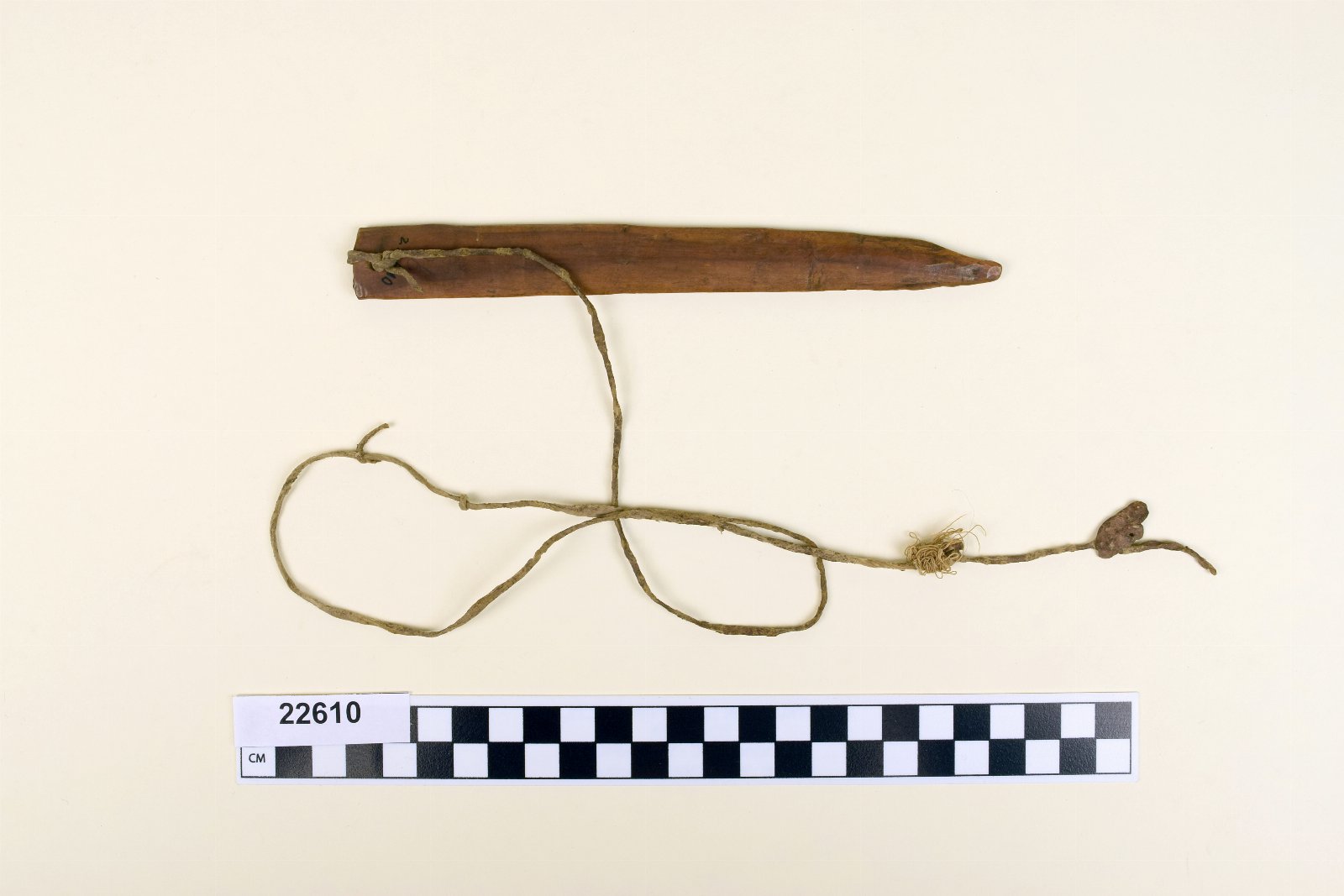
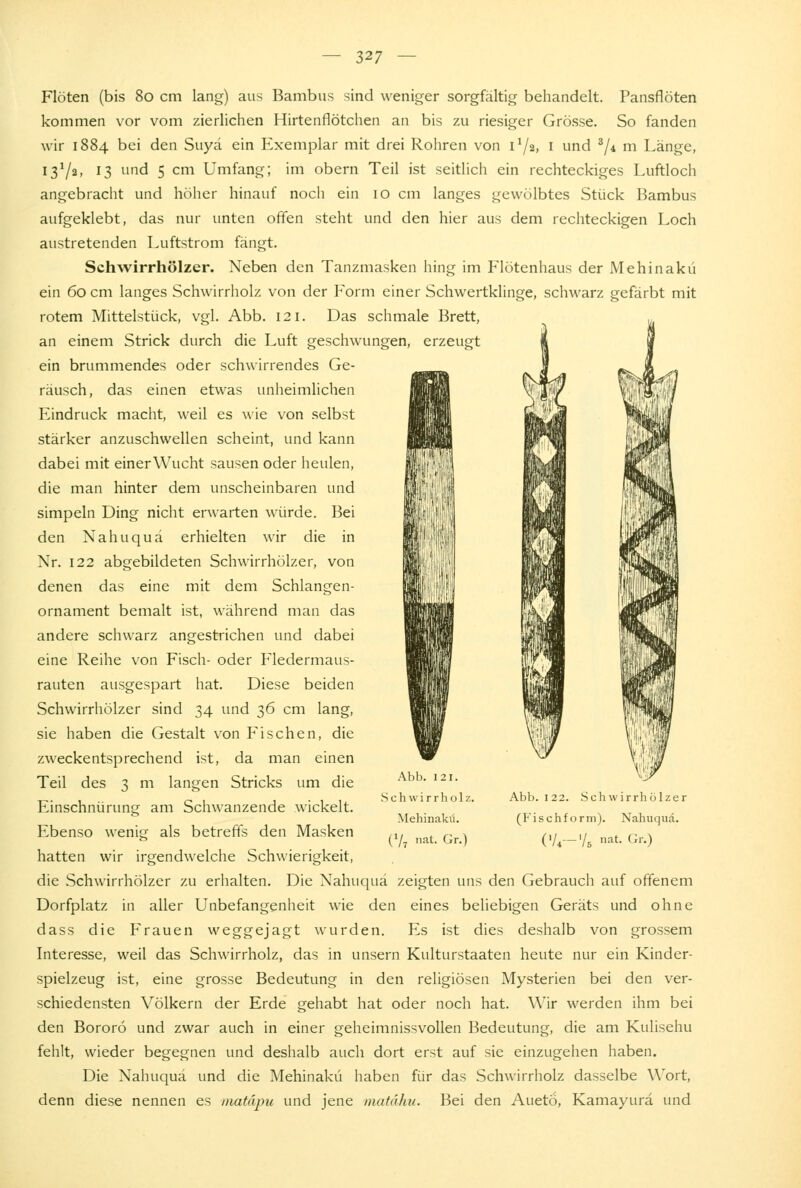
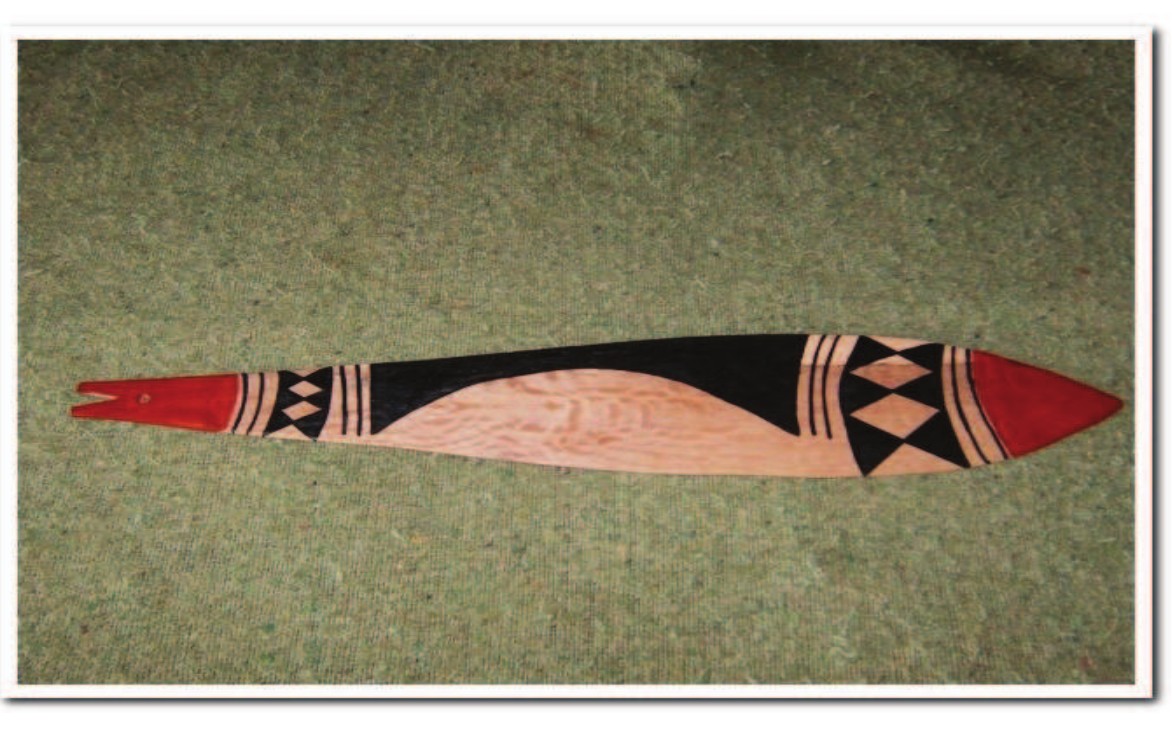
On the Upper Xingu, in central Brazil, the Mehinakú matapu is whirled in pairs at the pequi festival to summon the river-master whose voice the boards also are. The object calls the being that the object makes audible: a named sound goes out, a named power answers, and the rite proceeds through the meeting. Karl von den Steinen found the board itself hanging in the flute-house in 1887.
Nigeria and the northeast Congo
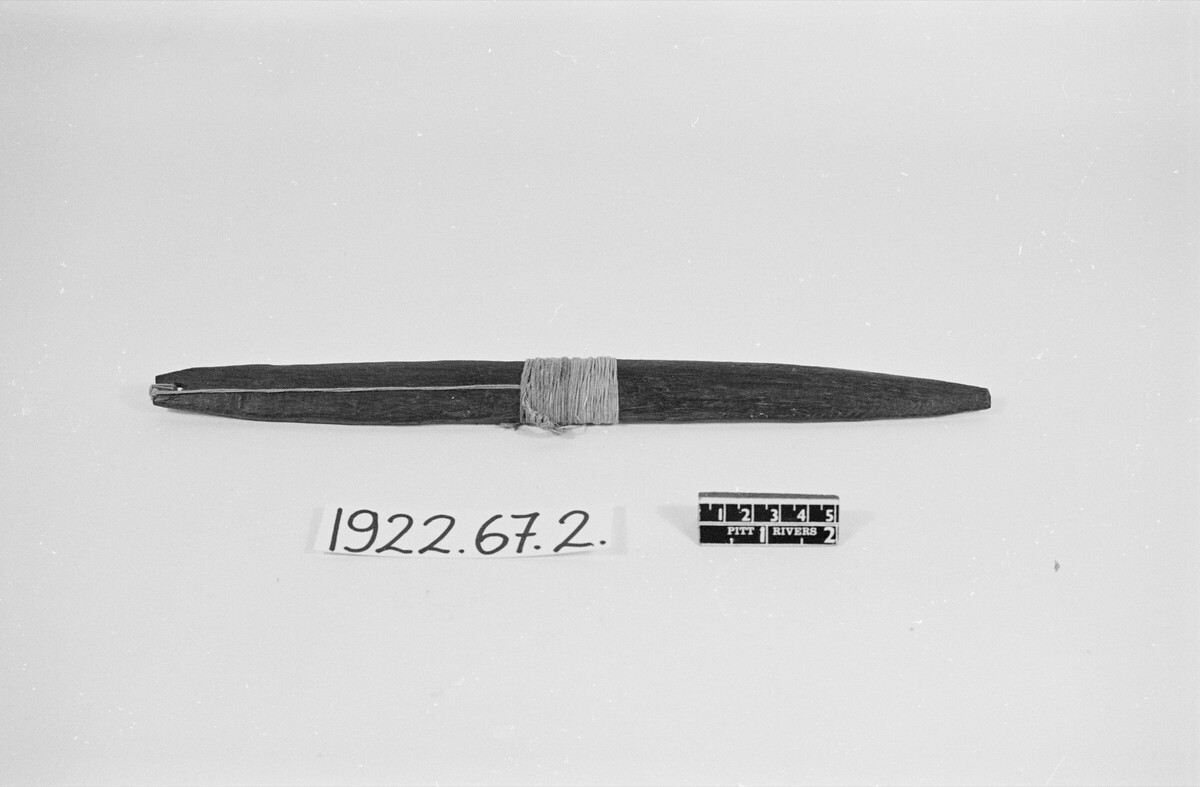
Toward midnight in the Igbo burning season, a clear call came out of the dark and was answered from the surrounding bush, and then the odegilligilli began.
Presently the blood-curdling moanings of the odegilligilli reverberate and these sounds fill the women and children with terror and they quickly hide themselves.
— G. T. Basden, Among the Ibos of Nigeria, 1921, pp. 238–239
The blade was plain: a thin strip of wood about a foot long, its edges notched, a cord through one end. Its social reach was exact. The sound gathered the scattered members of the Ayakka night-spirit society for their march on the town and emptied the road of everybody else in the same stroke.
Farther north, among the Morwa or Moro’a, the summons belonged to the calendar of the dead. C. K. Meek recorded in 1931 that the dead were heard crying in the sacred grove, a sign that the time had come for the rites to be performed, and that a bullroarer made the cry. The voice did not decorate a festival already under way; it announced that ritual time had opened.
In the northeast Congo the call reversed direction. Among the Aïméri, whom B. Costermans also called Walese, returning initiates were preceded on the path by a boy who set the kunzukunzu board droning, so that no woman would be met. Costermans’s earlier account gives the name anziko, a board of tende wood thirty centimetres long on a cord, and puts the man who whirled it at the head of the circumcision procession. The Mungarai emblem protects a messenger entering other people’s country; the Walese drone protects a procession by reorganizing the road in front of it. Both make a corridor in which ceremonial travellers move under a different rule.
The eastern Papuan Gulf
On the eastern Papuan Gulf the blade could make a crowd stop being a fight. Dawn Ryan’s 1978 account of Toaripi leadership begins with the pukari, whose office joined inherited knowledge to the settling of disputes. When fighting broke out he brought his badges of office, a string bag and a lime gourd, to the scene; if the fighting continued he smashed the gourd and tore the bag, and his associated mai karu, from a different men’s house, sounded the bullroarer. Then “all fighting had to stop on pain of undefined supernatural punishment.” Afterwards the disputants supplied a pig for a feast, the pukari received new badges, and friendly relations resumed.
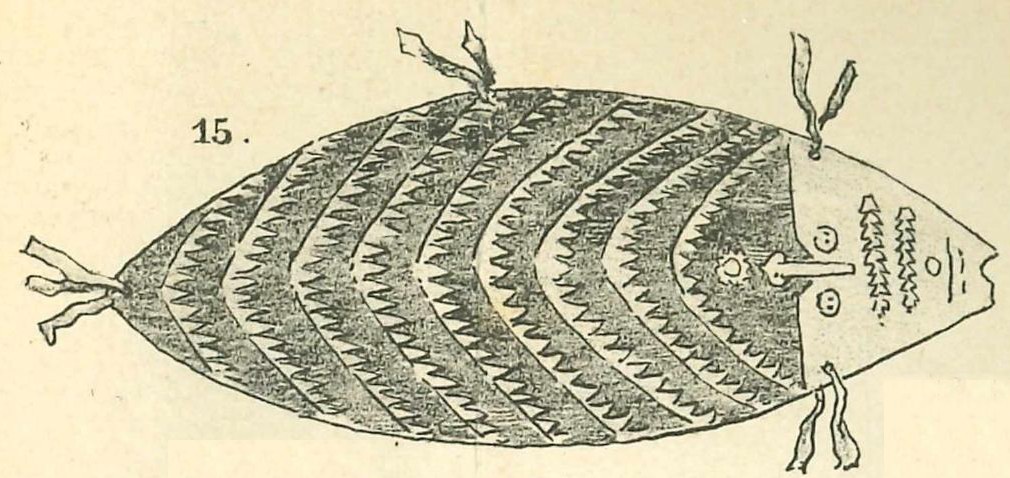
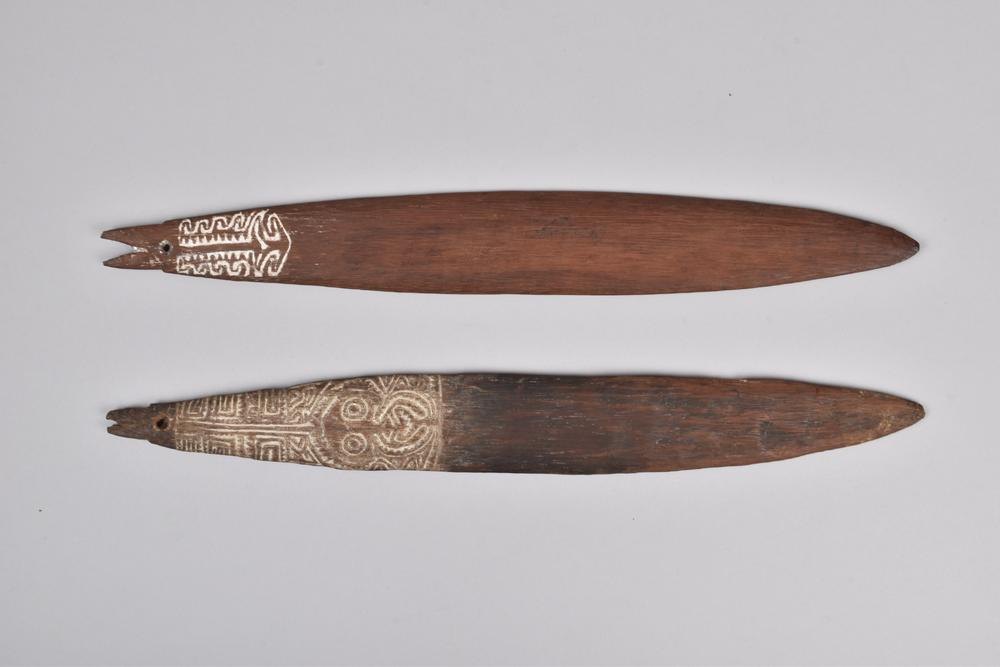
The offices repeat along the coast. At Karama, F. E. Williams found in 1936 that a bukari called up a named tiparu and a paired mai-karu swung it: offenders paid pigs, quarrels closed, and the same instrument mustered labour for houses and fences. That is village government conducted by sound. Ceremony supplied the force by which a command became publicly binding, which is exactly what a Mungarai messenger carried in his hands.
The gathering begins before anyone arrives
Before bodies can dance, mourn, initiate, feast or reconcile, someone has to bring them into the right relation with one another, and that work has to be done at a distance, in advance, across country that belongs to other people. Across Aboriginal Australia the bullroarer did it: a summons before it was a spirit voice, carried between camps or sounded over them, calling people to ceremony and making the road there safe. In Mungarai country a man walked into another group’s land carrying a blade two and a half feet long, and could not be touched. The ceremony began when he left.
Key sources
- Baldwin Spencer, Native Tribes of the Northern Territory of Australia (1914), pp. 164–165, 214, on Mungarai kunapippi messengers, invitation, and safe conduct.
- A. W. Howitt, The Native Tribes of South-East Australia (1904), pp. 617 n., 700–701, on the compulsory kalk summons and Barak’s account of the Wurundjeri initiation messenger; R. H. Mathews, “The Mŭltyerra Initiation Ceremony” (1904), pp. 199, 204–205, on the Kurnu buruki and yantamakaddya.
- Luise Hercus, A Nukunu Dictionary (1992), traditional stories, and the Nukunu community wordlist, entry wiithanha; Smithsonian NMNH accession 203876, George R. Moule’s Lardil collector’s card.
- South Australian Museum, Norman Tindale AA338/11/27, Gerard recordings, 25 July 1964, Reel 1 CD1 synopsis; A. L. P. Cameron, “Notes on Some Tribes of New South Wales” (1885), p. 359 n., for Tati Tati Kalk.
- A. L. Kroeber, Handbook of the Indians of California (1925), pp. 756, 765, 928; Constance Goddard DuBois, The Religion of the Luiseño Indians (1908), p. 101; Philip Drucker, “Culture Element Distributions: V, Southern California” (1937), items 924, 926, 1140; T. T. Waterman, The Religious Practices of the Diegueño Indians (1910), pp. 281–282, 308, for the three swings at Mesa Grande.
- Wallace and Hoebel, The Comanches: Lords of the South Plains (1952), pp. 175–176; the underlying 1933 account in Thomas W. Kavanagh, ed., Comanche Ethnography (2008), pp. 169–170.
- Matilda Coxe Stevenson, The Zuñi Indians (1904), p. 115 n. and related rain-fraternity passages; Karl von den Steinen, Unter den Naturvölkern Zentral-Brasiliens (1894), pp. 104, 327 (Abb. 121–122); R. G. A. Braida, Objetos Mehinako (2012), fig. 60.
- G. T. Basden, Among the Ibos of Nigeria (1921), ch. XXII, pp. 238–239; C. K. Meek, Tribal Studies in Northern Nigeria (1931), vol. II, p. 115.
- B. Costermans, “Muziek-instrumenten van Watsa-Gombari en omstreken” (1947), pp. 524–525, 528, 540–541, and “De Besnijdenis bij de Mamvu-Mangutu en omstreken” (1950), p. 18.
- Dawn Ryan, “Cliques, Factions, and Leadership among the Toaripi of Papua,” in Karen Ann Watson-Gegeo and S. Lee Seaton, eds., Adaptation and Symbolism (1978), pp. 33–48, at p. 35, for the Toaripi truce; F. E. Williams, Bull-Roarers in the Papuan Gulf (1936), pp. 39–46, for Karama.