Atlas Essay —
The Original Spin
Ice Age Europe · Siberia · the Americas · New Guinea and Australia · Africa
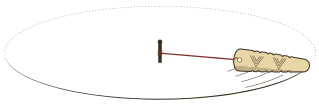
Swing a slat of wood on a cord and it roars. In Central Australia and central Brazil, in the forests of Nigeria and the men’s houses of New Guinea, men told their sons that the roar was the voice of a spirit, and told the women that to see the thing was death. Robert Lowie looked at that rule in 1920 and could find no reason in human nature for it. A rule with no reason behind it is a rule somebody taught. So it was carried, and it was carried from somewhere. The bone record says where.
Twenty scholars over a century said the bullroarer cult had one root, and several lines of evidence point to Ice Age Europe.
In brief
- Lowie (1920) and Loeb (1929) traced the bullroarer rite to “a common center” because its parts have no natural reason to travel together: women barred on pain of death, the roar as a spirit’s voice, death and rebirth, the initiate’s mark. Loeb thought the complex might reach back to the Old Stone Age.
- The modern folklorists Yuri Berezkin and Julien d’Huy reach the same verdict by a new road. d’Huy’s 2025 tree of bullroarer traits reconstructs a sacred instrument, taboo to women, at its root, and concludes that it may already have existed when Europe was first peopled.
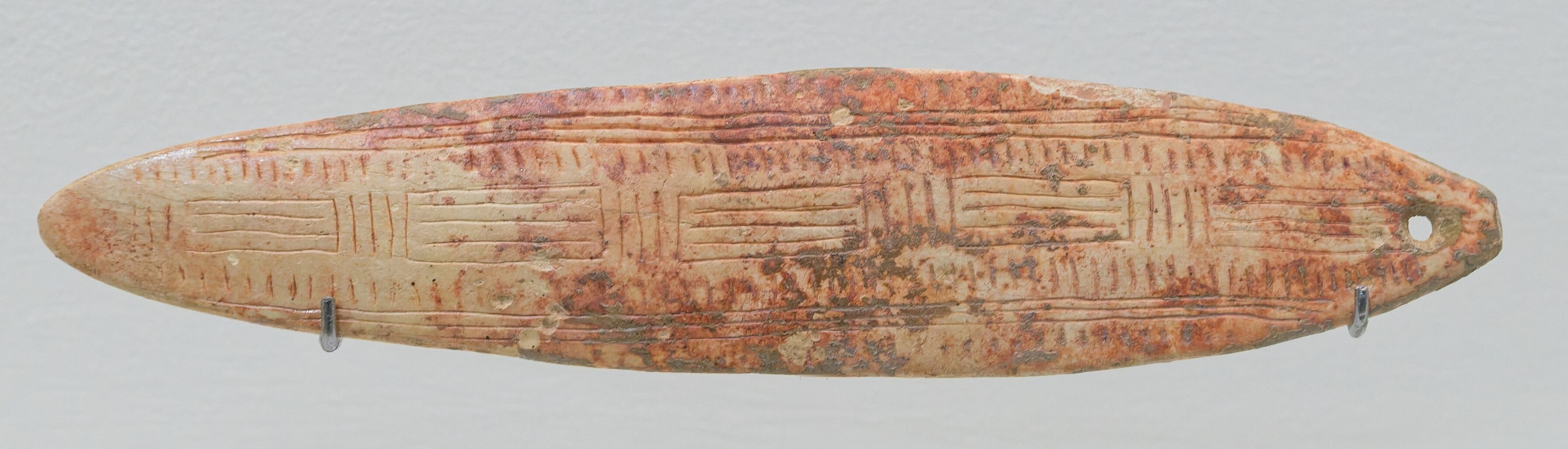
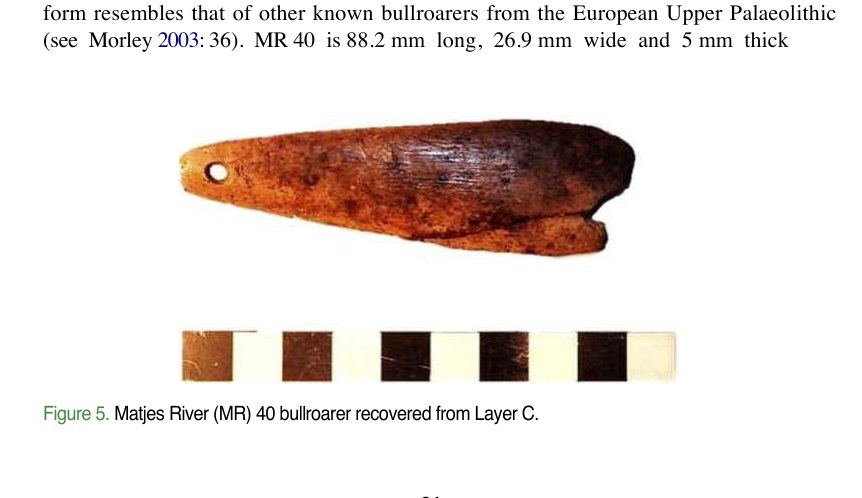
- About thirty-four Magdalenian bullroarers are catalogued from Cantabria in northern Spain to the Dordogne in southwestern France, with Solutrean blades at Lespugue and Badegoule behind them. A copy of the Lalinde blade roars when swung.
- Every Ice Age bullroarer is European. The first anywhere else, at Körtik Tepe in Turkey, comes as the ice ends. Africa’s first bullroarer is Matjes River in South Africa; America’s is Hogup Cave in Utah.
- Europe keeps the instrument’s whole career on record, from Magdalenian cave to Greek mystery to the Basque village toy whose engravings still look Palaeolithic.
Every record named below is on the atlas map — open the archaeology view to see the Ice Age finds together.
One Rule on Five Continents
The bullroarer itself proves nothing. A flat slat on a string is the kind of thing a bored child invents, and Andrew Lang, who put the instrument on the map of comparative religion in 1884, said as much. He had the Greek rhombos of the Dionysian mysteries, the Australian turndun, the roarers of New Mexico and Africa all in front of him, and he chose coincidence:
There are students who would found on this a hypothesis that the various races that use the bull-roarer all descend from the same stock. But the bull-roarer is introduced here for the very purpose of showing that similar minds, working with simple means towards similar ends, might evolve the bull-roarer and its mystic uses anywhere. There is no need for a hypothesis of common origin, or of borrowing, to account for this widely diffused sacred object.
Andrew Lang, “The Bull-Roarer,” Custom and Myth (1885 ed.), p. 31
Alfred Cort Haddon, the Cambridge zoologist turned ethnologist, gave the instrument its own chapter in 1898 and called it “perhaps the most ancient, widely-spread, and sacred religious symbol in the world.” He weighed the deeper idea too. It was “impossible to say,” he wrote, “whether it formed part of the religious equipment of man in his first wanderings over the earth.” Like Lang, he let the simplicity of the slat decide.
Robert Lowie saw what both of them had missed. The question was never the slat. It was the rule that came with it.
But this is to mistake the problem. The question is not whether the bull-roarer has been invented once or a dozen times, nor even whether this simple toy has once or frequently entered ceremonial associations. I have myself seen priests of the Hopi Flute fraternity whirl bull-roarers on extremely solemn occasions, but the thought of a connection with Australian or African mysteries never obtruded itself because there was no suggestion that women must be excluded from the range of the instrument. There lies the crux of the matter.
Why do Brazilians and Central Australians deem it death for a woman to see the bull-roarer? Why this punctilious insistence on keeping her in the dark on this subject in West and East Africa and Oceania? I know of no psychological principle that would urge the Ekoi and the Bororo mind to bar women from knowledge about bull-roarers and until such a principle is brought to light I do not hesitate to accept diffusion from a common center as the more probable assumption.
Robert H. Lowie, Primitive Society (1920), p. 313
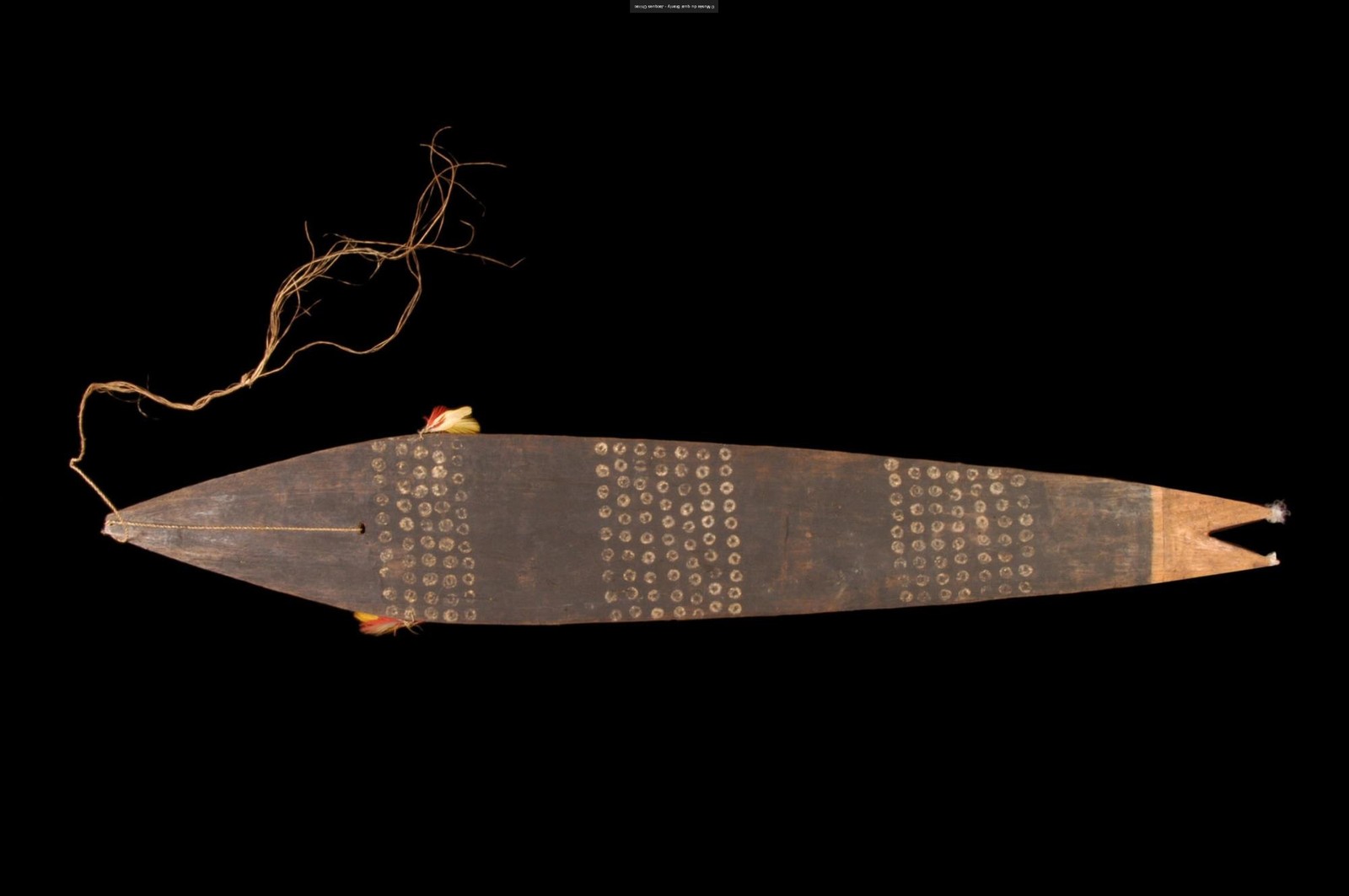
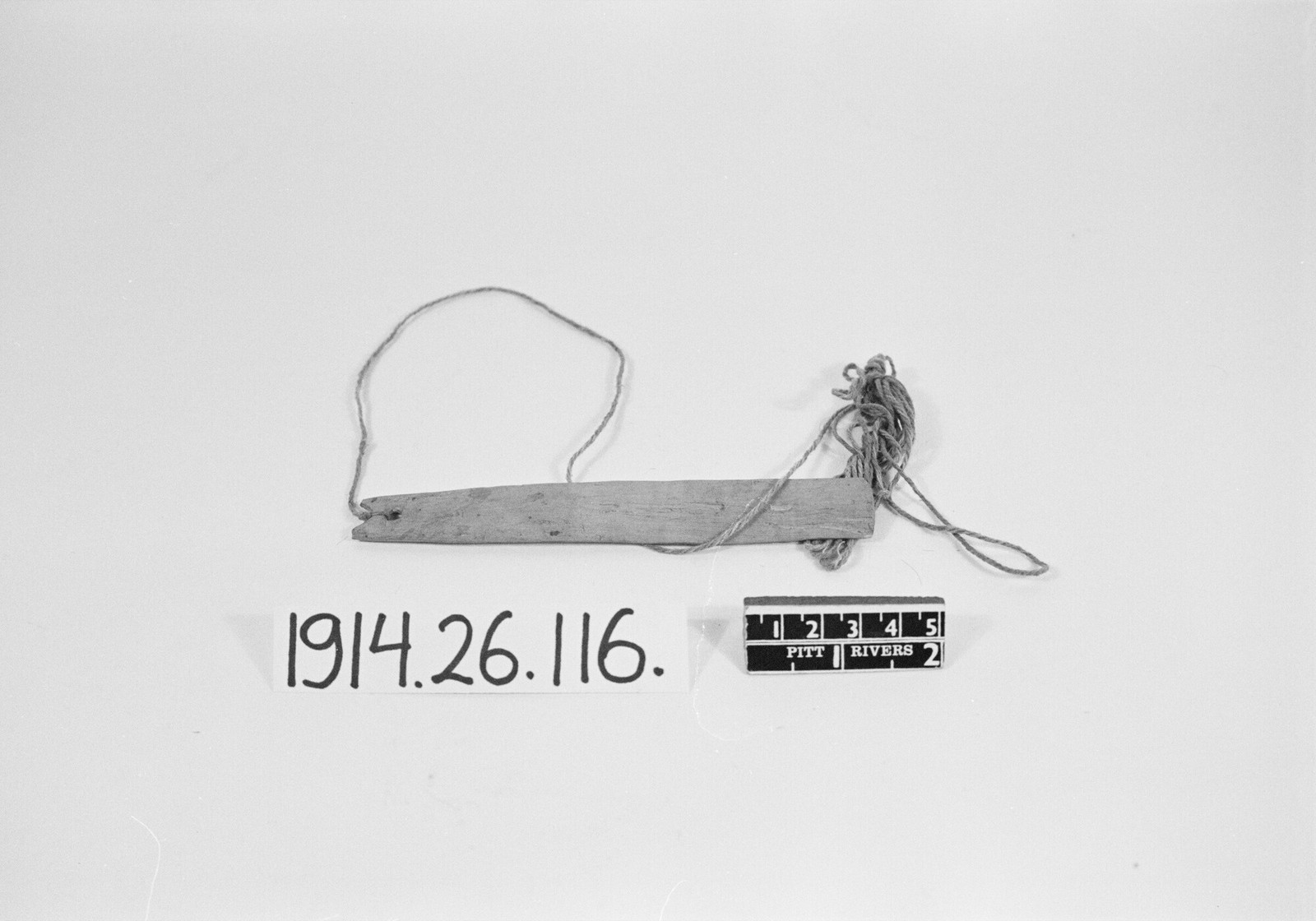
Edwin Loeb, Lowie’s colleague at Berkeley, spent the next decade testing the claim against every initiation rite in the literature, and came back saying Lowie had understated it. The roar was not only forbidden to women. It was “almost invariably represented as the voice of spirits,” and it travelled in company:
Nor does the bullroarer travel alone in connection with male initiation rites. This paper has demonstrated the fact that a form of tribal marking, a death and resurrection ceremony, and an impersonation of ghosts or spirits is found among male tribal initiation rites as the usual concomitants of the bullroarer. There is no psychological principle involved which would necessarily group these elements together, and they therefore must be regarded as having been fortuitously grouped in one locality of the world, and then disseminated as a complex.
Edwin M. Loeb, Tribal Initiations and Secret Societies (1929), p. 285
A mark cut into the boy, a pretended death, a monster that swallows and returns him, masked men playing the dead, and over all of it a roar that women must never trace to its source. Any one of these a people might invent. All of them together, from Arnhem Land in northern Australia to the Xingu in central Brazil and the Cross River forest of Nigeria, is a recipe, and recipes are passed down. Of the initiation rites that carry it Loeb went as far as the evidence of his day allowed: “these traits are of archaic, possibly paleolithic origin, and are not a matter of recent diffusion.”
The verdict hardened with every generation that looked. Joseph Campbell, setting the Greek mysteries of the infant Dionysos beside an Australian initiation, wrote in 1959 that “it surely is no mere accident, nor consequence of parallel development, that has brought the bull-roarers on the scene for both the Greek and the Australian occasions.” The Dutch ethnomusicologist Jaap Kunst put it flatly the next year:
No ethnomusicologist, I think, would stand for plurigenesis as regards the bull-roarers, which even in decorative detail are often alike and are used for the same purpose wherever and whenever found.
Jaap Kunst, “The Origin of the Kemanak,” Bijdragen tot de Taal-, Land- en Volkenkunde 116 (1960)
Otto Zerries, who wrote the standard monograph on the instrument, found the South American roarer “indigenous in an ancient cultural stratum of a certain uniformity,” and closed his survey by looking past the farmers who used it to an older possibility: that the instrument “functionally and spiritually has its roots in an early cultural stratum of hunting and gathering tribes.” Mircea Eliade, drawing on Zerries, called the roarer that speaks as a god one of the oldest religious ideas humanity has, the property of “the archaic hunter culture.” By the middle of the twentieth century the common root was the ordinary opinion of the people who knew the instrument best. What none of them could say was where.
“These traits are of archaic, possibly paleolithic origin, and are not a matter of recent diffusion.”
Edwin M. Loeb, 1929The Modern Tree Agrees
The diffusionists fell out of fashion after the war, and the bullroarer went with them into the footnotes. It came back by a road none of them could have built. Yuri Berezkin of the Kunstkamera in St Petersburg spent three decades coding the world’s folklore into a catalogue of motifs, and one of them, which he numbered F38, is the bullroarer’s charter: the sacred objects once belonged to women, and men took them. Berezkin found F38 across Melanesia, Australia, Amazonia and West Africa, told with the same instruments and the same ending, and he read the pattern as a single inheritance carried out of Africa by the first modern humans.
The French phylomythologist Julien d’Huy did what the diffusionists never could. In 2025 he took Haddon’s 1898 list of sixteen bullroarer traits, coded them across the world, and built trees of them the way a biologist builds a tree of species. The traits passed mostly from parent culture to daughter, not sideways between neighbours, and the root of the tree reconstructed the cult itself:
The bullroarer is a sacred instrument, used during mysteries and/or as a credential authorising a person to direct ceremonies. It may be used to produce wind or rain, and is taboo to women.
Julien d’Huy, “Le rhombe de la grotte de La Roche à Lalinde,” Bulletin de la Société historique et archéologique du Périgord 152 (2025), pp. 155–162
Writing of the Lalinde blade, d’Huy concluded that the instrument “may have existed at the time Europe was first peopled and then persisted there.” So the newest method in the field arrives where Lowie and Loeb stood: one rite, very old, carried out across the world with its rules intact.
Berezkin and d’Huy place the root in Africa, and there the tree has been asked to say more than it can. A tree of stories does not know where its own root sits. d’Huy set his 2017 tree of matriarchy myths in East Africa by borrowing the out-of-Africa model of human origins, and his 2025 bullroarer tree put Africa and Australia at its base by a rule of thumb that roots every tree at its middle. The place comes from a convention, not from a measurement. The trees establish one root. The bone establishes where it was.
The African date fails a second test. The anthropologists Thomas Gregor and Donald Tuzin, comparing the men’s cults of Amazonia and Melanesia in 2001, put the hardest question a single origin faces: if the regions have been apart for more than forty thousand years, why have the cults not drifted beyond recognition? Against a root sixty thousand years deep, carried by the first people to leave Africa, the question has no answer. Against a younger root, spread out of Ice Age Europe in the last twenty-odd thousand years, it answers itself: the cults are still recognisable because they have not been apart that long. Stories do not last sixty thousand years, and an African root asks them to.
Europe Has Them First
Put every bullroarer the atlas holds on one map and the picture is the world: thick in Australia and New Guinea, thick in West Africa and Amazonia, scattered through North America and the folk toys of Europe. Now turn the clock back and keep only the bullroarers that have been dug out of the ground with a date on them. The world goes dark, and one region stays lit.
The map
Today. The bullroarer is recorded on every inhabited continent: 1283 records in the atlas. The brick signs (462) mark it inside initiation or kept from women — the cult this essay follows back to its root.
The Ice Age. Every bullroarer from the Ice Age is European: pierced pieces from about 38,000 BC, Solutrean blades, and the Magdalenian blades of France and Spain, mostly 15,000 to 12,000 BC. At the glacial maximum, about 20,000 years ago, the sea stood some 120 metres lower and the stippled shelves were dry land.
After the ice. As the ice ends, the first bullroarer outside Europe appears at Körtik Tepe in southeastern Turkey, about 10,400 BC. Matjes River in South Africa, Hogup Cave in Utah and Xiaonanshan in northeast China follow, each thousands of years younger than the European blades.
The roads out of Europe. East over the mammoth steppe to Lake Baikal, then across Beringia into the Americas and south through East Asia to New Guinea and Australia — or along the southern coasts of Asia; and south through the Caucasus to Anatolia and the Levant, and on into Africa. The routes are inferred; the dated finds are not.
- a bullroarer record 1283
- with initiation or a ban on women 462
- Ice Age: bullroarer 9
- Ice Age: probable 16
- Ice Age: possible bullroarer 13
- after the ice, to 6000 BC: probable 11
- after the ice, to 6000 BC: possible bullroarer 21
- Unlabelled lozenges: Anatolia and the Levant (Göbekli Tepe, Çatalhöyük), Ladakh, north-east China and Japan
- today’s records, for reference
- exposed shelf: approximate, 200 m depth contour
- inferred route out of Europe
- or, the southern coasts of Asia
The Magdalenian hunters of southwestern France and Cantabrian Spain, between about seventeen and twelve thousand years ago, left a true corpus. Ignacio Barandiarán Maestu catalogued about thirty-four bone blades — bramaderas, in the name of the Spanish village toy — from Isturitz, Bourrouilla, which gave up ten on its own, La Vache, Lortet, Le Morin and El Pendo. Behind them stand the Solutrean blades of Lespugue in the Pyrenean foothills and Badegoule in the Dordogne, some twenty thousand years old, and deeper still the pierced pieces of the Gravettian and Aurignacian: the serpent blade from among the ivory women of Brassempouy, the pierced point of Potočka zijalka high in the Slovenian Alps at about 33,000 BC. Michel Dauvois, the acoustician of the Palaeolithic, placed the first sure roarers among the mammoth hunters of Moravia in the Czech Republic, about twenty-four thousand years ago. And the type-specimen works. Dauvois cut a copy of the Lalinde blade in reindeer antler and swung it in the Salon Noir, the great painted chamber of Niaux in the French Pyrenees: “the sound, forever rising and falling, filled the whole space” (le son perpétuellement ascendant et descendant, emplissait tout l’espace).
Nothing outside Europe comes near. The oldest bullroarers in the Near East are the engraved bone plaques of Körtik Tepe on the upper Tigris in southeastern Turkey, about 10,400 BC, as the ice was ending. Africa’s is Matjes River. The Americas begin at Hogup Cave in Utah, about seven thousand years ago, a wooden roarer that its excavator swung and heard speak. China begins with a pierced jade blade from Xiaonanshan on the Ussuri, the river that divides China from Russia, about 7000 BC. Australia, where the instrument is most sacred today, has no dated bullroarer from any excavation.
Bone survives where wood does not, and Europe has been dug harder than anywhere on earth; the Ice Age blades are, as Iain Morley put it, the tip of an iceberg of wooden ones. That is true of every continent, and it does not change the order. Wood rots in Australia and Brazil as fast as it rots in France. People who make a sacred thing in wood will sooner or later make one in bone or ivory, and outside Europe the first such piece dates from the end of the ice or after. The oldest witnesses crowd into one place, and the first people to see them recognised them at once.
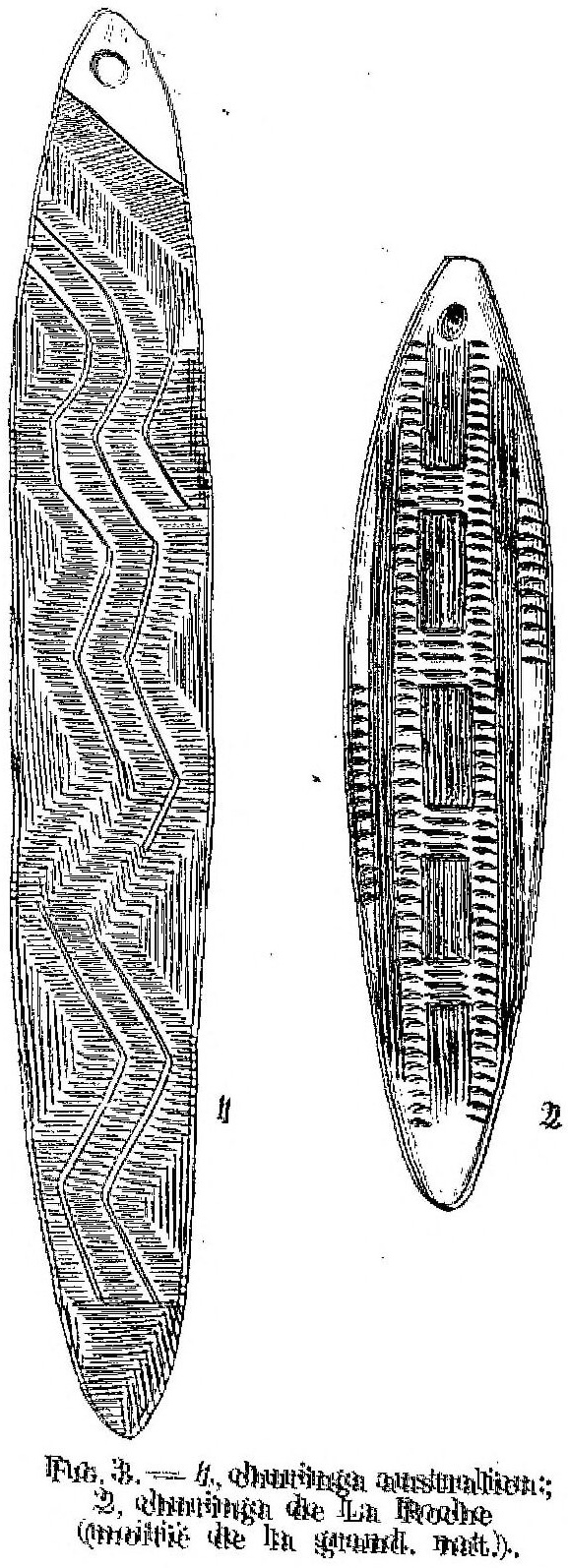
Lang himself changed his mind when the bone came in. In 1902, looking at the Abbé Breuil’s drawing of a Magdalenian pendant from Saint-Marcel in the Indre, in central France, he wrote to his friend A. B. Cook that it was “nettement un bull-roarer”, plainly a bullroarer. Two years later he told the readers of Man that it was “exactly akin to some Australian bullroarers,” and drew the conclusion his 1884 self had refused: “palaeolithic and neolithic men had bullroarers, and probably had such religious ideas as among savages are attached to bullroarers.” After Lang came Peyrony, and the Abbé Breuil hailing the Lalinde blade as the first complete Magdalenian churinga, and Gertrude Levy, who in 1948 set the whole series in one paragraph:
A special implement of the churinga type is the Bull-Roarer, which produced the voice of divinity to terrify the candidate and the distant women and children during the earlier ordeals of initiation. This was generally made of wood and pierced for whirling. Several similar objects appear among the Magdalenian finds … They are indistinguishable in general form and decoration from Australian specimens, but their purpose is of course unknown. The bull-roarer, however, was used in the mysteries of the succeeding civilisations of Europe, sometimes retaining its Magdalenian pattern.
G. Rachel Levy, The Gate of Horn (1948), p. 48
The recognition has been repeated so often that the paired blades fill a gallery of their own. Arnd Adje Both and Michael Praxmarer, writing in 2025 for the latest German survey of Stone Age music, said it again: “the forms are identical with bullroarers all over the world.”
The Women and the Blade
The charter of the cult is a story about women. Across New Guinea, Amazonia and Australia the men who swing the roarer say that women owned it first — that the women heard the voice before the men did, kept it in their own house, and lost it by theft or trickery. If the cult began somewhere, that somewhere should show women at the centre of the sacred, and an instrument beside them.
Ice Age Europe shows both. For twenty-five thousand years, from the ivory figure of Hohle Fels in southwestern Germany to the engraved silhouettes of the Magdalenian, its people carved and engraved women far more than men. At La Roche de Birol near Lalinde the two halves of the story came out of the same shelter: a limestone block engraved with a file of eleven women in profile, all hip and thigh — and the ochred blade of Plate I. At Brassempouy in the Landes the serpent-carved blade lay among the ivory heads and torsos that gave the site its fame.
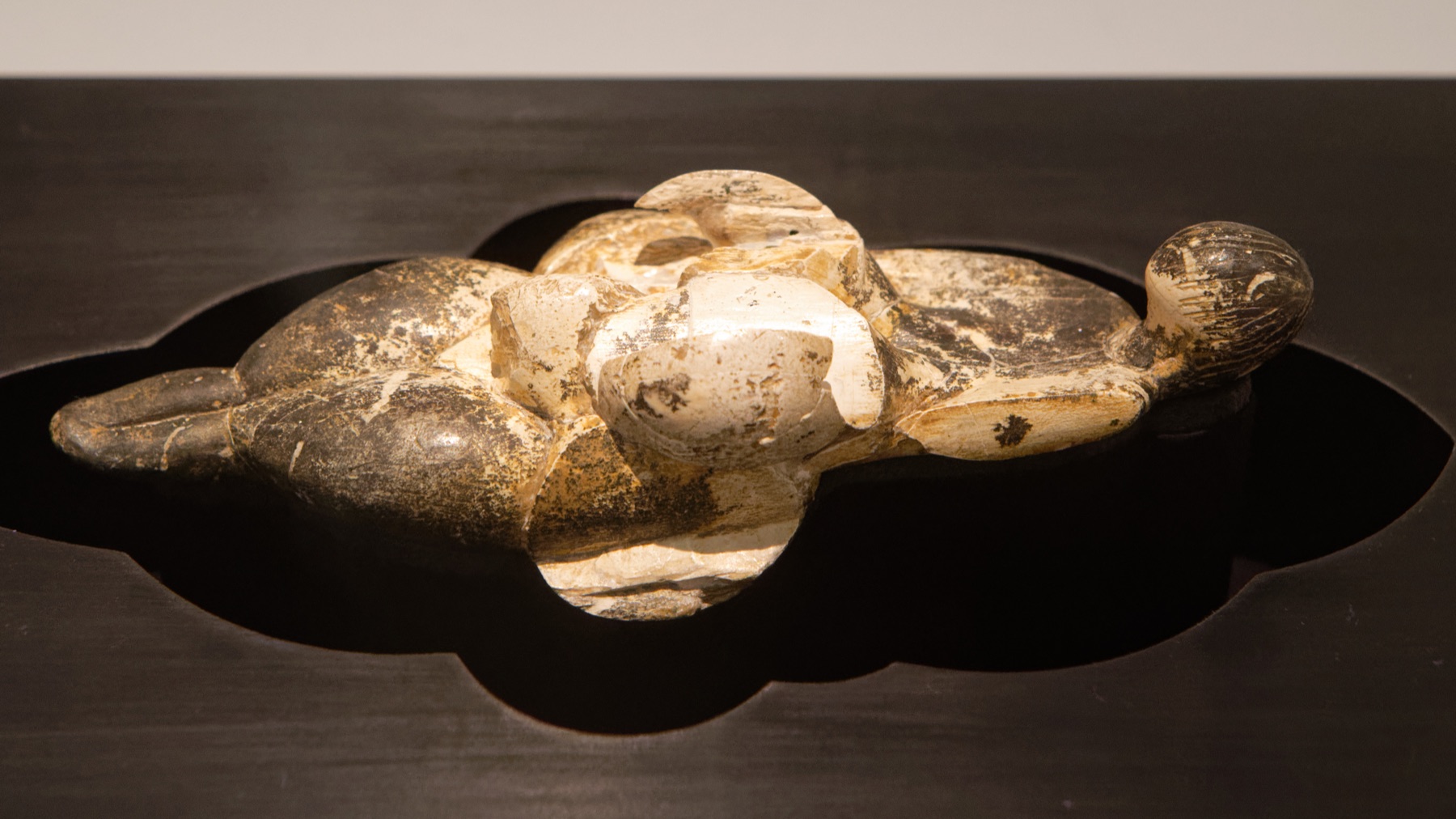
d’Huy’s own matriarchy tree points the same way. At the branch that leads into Europe his tree reconstructs the “European Palaeolithic myths about matriarchy,” and F38 — women as the first owners of the sacred things — is there at the Balkan node. Berezkin, mapping the motifs of the war between the sexes, found that their rare appearances outside Africa, the Pacific and the Americas are mostly in Europe, a belt running from the Balkans through the Caucasus to the Baltic. A relic belt is what an old layer looks like after newer ones have been laid over it. The women and the roarer, the myth and the instrument, meet in one landscape before they meet anywhere else.
From God to Toy
Europe today is where the bullroarer is least sacred. The atlas holds more than a hundred and fifty European roarers, and nearly all of them are toys, scarers and Holy Week noisemakers. The living cult, with its secret house and its death sentence, is in Australia, New Guinea, West Africa and Amazonia. Loeb noticed the same thing and stated it bluntly: the initiations are “lacking among the Caucasians with the peculiar exception of the sophisticated mysteries of ancient Greece.”
That exception is the clue. The bullroarer’s students saw it fall from god to plaything wherever the old order broke. Haddon wrote that it “has in various places degenerated into a child’s plaything.” Loeb found it among the Arapaho of the Great Plains, where “the instrument has deteriorated into a child’s toy.” Zerries watched it happen in northeastern Peru: “It has been degraded to a toy. This kind of employment is evidently the last phase in the continuing change of the bull-roarer’s meaning.” The toy is not where the bullroarer begins. It is where it ends.
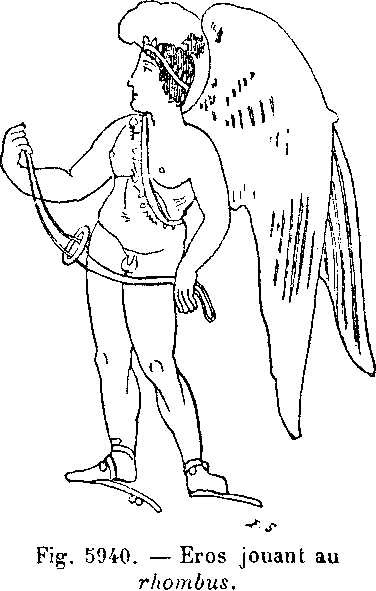
Europe is the one region where that whole descent is on record. The Magdalenian blade, ochred and engraved, belongs to the cave. The rhombos belongs to the mysteries of Dionysos, where Clement of Alexandria listed it among the toys with which the Titans lured the god-child to his death, and where the Titans who killed the child came smeared in white clay, like the white-downed dancers of the Australian rite Campbell set beside them. Then the farmers came, and the speakers of Indo-European languages after them, and then the Church, and each new order pressed the old rite further down, until it survived as the thing a child swings at Easter. In the Basque Country, where Europe’s last language older than Indo-European and its densest cluster of Magdalenian bullroarers share a corner of the map, a village burruna recorded at Sare in the French Basque hills in 1947 carried engraved animals that a French ethnomusicologist found “astonishingly close to the Palaeolithic engravings.”
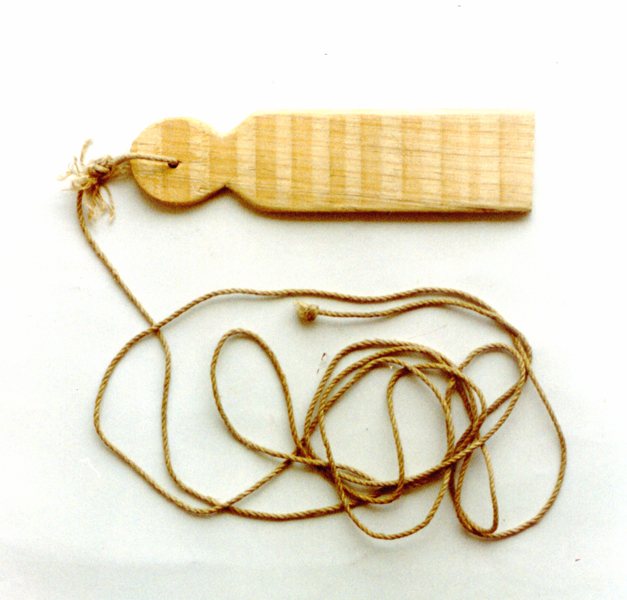
The living heartlands are not the place of origin. They are the places the later waves never reached: the far side of Sahul, the Ice Age continent of Australia and New Guinea; the deep Amazon; the forest of West Africa. A cult survives longest at the end of its road, and dies first at home under everything that comes after it.
East with the Mammoth Hunters
The road out of Europe ran east across the mammoth steppe. At Mal’ta, near Lake Baikal in Siberia, about twenty-four thousand years ago, people living in houses roofed with mammoth bone carved ivory women in the European manner, and a rectangular ivory plaque engraved with three serpents. They are the Ancient North Eurasians of the geneticists, and their blood runs in every Native American: the genome of a boy buried at Mal’ta showed that a large share of Native American ancestry comes from people like him. Siberia is the bridge that carried the Venus figures east, and it is the road the roarer took.
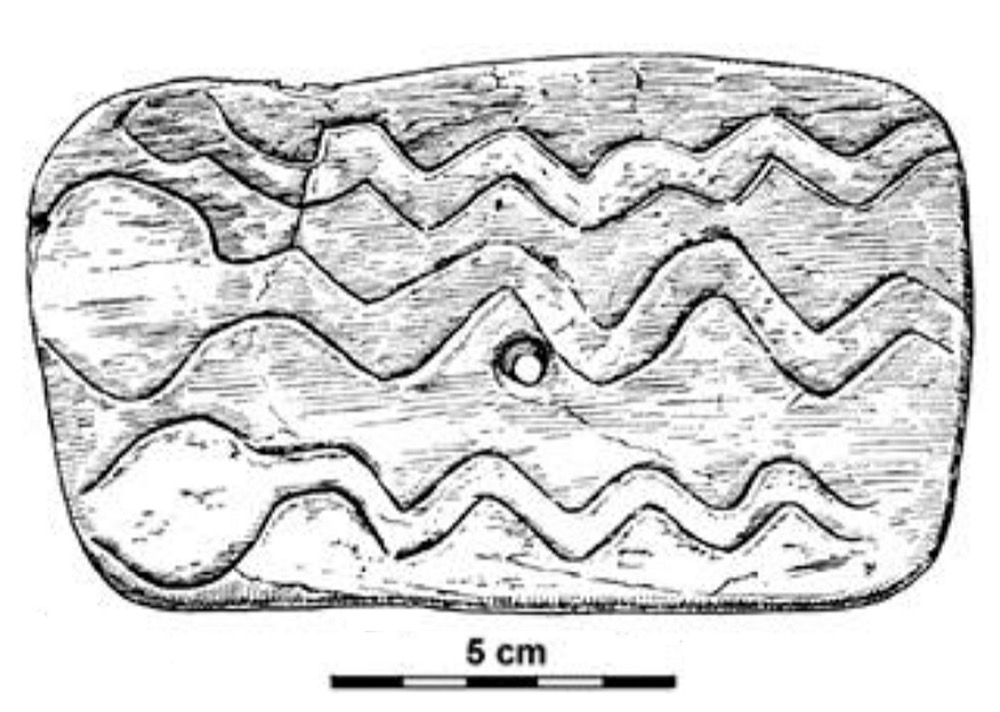
Joseph Campbell drew this road on his maps of the hunters’ world, and named what travelled it:
Passing eastward across Siberia into America, as well as southeasterly to Australia, shamanism traveled as but one element of a living compound that included — besides the x-ray style of animal painting and engraving, the atlatl, and the bull roarer — an elaborate complex of social regulations, ceremonials, and associated mythological ideas.
Joseph Campbell, The Way of the Animal Powers (1983), p. 133
The Americas bear him out in a detail no one planned. The North American bullroarer is above all a weather instrument — thunder’s voice for the Pomo of California, rain’s summons for the Hopi of Arizona. Even where farmers swing it, it calls the rain and the wind, the business of the sky before it was the business of the field. That is what a roarer carried by hunters across Beringia, the land bridge between Siberia and Alaska, before farming existed would look like: thunder before the plow. Its first American witness, at Hogup, is a hunter-gatherer’s roarer from the Great Basin.
In the Amazon the cult arrived whole. The Mehinaku and the Wauja of the upper Xingu keep the sacred flutes in the men’s house, tell how the women once owned them, and threaten any woman who sees them with gang rape. Their roarer is a fish spirit, spun in the village while the women stay shut indoors on pain of death — a fish, like the Lalinde blade that Peyrony saw as “a fish without a tail.” Izikowitz, mapping the Amazonian instrument in 1935, judged that it “belongs to one of the oldest cultural strata in Amazonas.”
Into Sahul from the North
The other road ran southeast, and its first stretch is the least certain part of the map. It may have left the steppe from Siberia and come down through East Asia, or followed the southern coasts of Asia; the bridge that took the cult to America could as easily have fed the road to Sahul. What is certain is how it ended. People reached Australia fifty thousand years ago or more, long before the first European blade, so the cult cannot have come with the first settlers. It came later, and it came the way the corroborees came: from the north. Spencer and Gillen, who watched Central Australian ceremony at first hand, recorded that the corroborees handed from tribe to tribe “always pass from north to south and never vice versa.” New Guinea is bullroarer country from coast to coast, and there the instrument carries the fuller theology — one word for the blade, the swallowing monster and the ghost. Its Australian forms are the downstream version. The founders of the cult carry the same name on both sides of the water between New Guinea and Australia: the Nggwal of the Sepik, and the Djanggawul, who brought the sacred law to Arnhem Land by canoe from an island to the north.
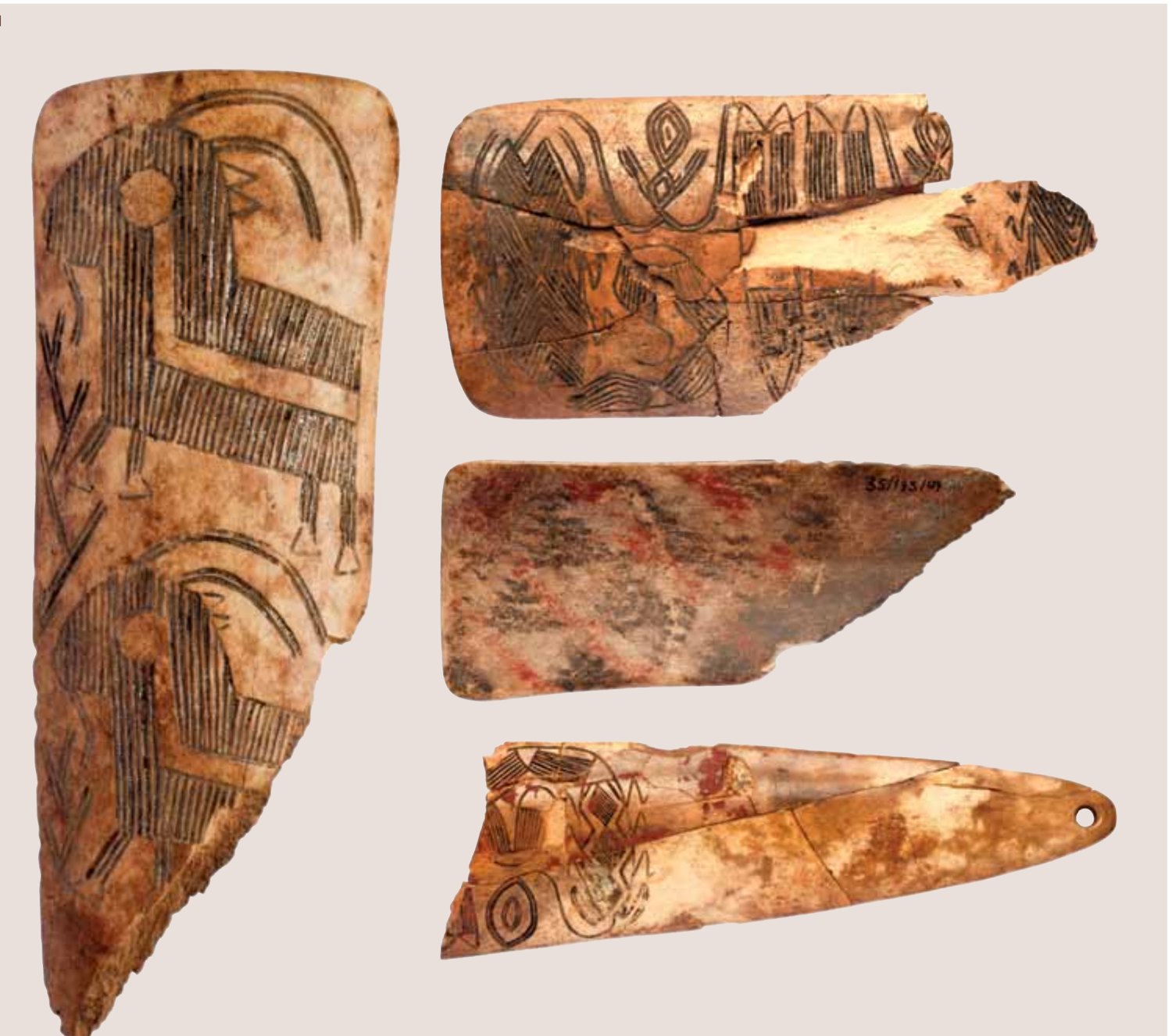
Whichever way it came, the last stretch of the road ran along coasts that are now under the sea. At the glacial maximum Sundaland joined Borneo, Java and Sumatra to the mainland and Sahul joined New Guinea to Australia, and the roads between them are now the floors of the Java Sea and the Arafura. On the dry land that remains, the way stations still stand: the grave plaques of Körtik Tepe at the end of the ice, the roarers of the Indian hill peoples and of Borneo on the coastal road, the jade blades of the Chinese Neolithic on the inland one. The sea took the coastal road, and the plow and the temple overwrote the inland one, as they did in Europe.
The third road ran south from the Levant, and Africa received the cult late. Its first blade, at Matjes River, belonged to Cape foragers; its great roarer societies — the Dogon Awa of Mali, the Ekoi, the Mano and Dan of the Liberian forest — belong to farming peoples, and the harvest rite they share with Eleusis and the Sepik is the subject of The Bullroarer and the Harvest.
The Original Spin
Lowie asked for a psychological principle that would make the Ekoi and the Bororo bar women from the bullroarer, and held to diffusion “until such a principle is brought to light.” In the century since, none has turned up that explains the whole bundle. What has turned up instead is the evidence he lacked. A tree built from the traits themselves reconstructs his cult at its root. A motif catalogue of the world’s folklore finds the women’s charter myth told the same way on three continents. And the trowel has given us a bullroarer fifteen thousand years old, ochred and engraved, that a man can still swing and hear roar.
Every bullroarer of the Ice Age proper is European. The continent where the instrument is now a toy is the continent where it is oldest, where it lay beside the engraved women, where its first scholars knew it on sight for the churinga of the Arrernte of Central Australia. From there the roads lead east over the mammoth steppe to Lake Baikal, across Beringia and down the Americas, and south through Asia over drowned shelves into New Guinea and on into Australia. Along those roads went a slat on a cord, a voice that was a god’s, a secret kept from women, a boy swallowed and given back, and a story that the women had it first. The rite that Lang thought anyone might invent was invented once. It was invented in Ice Age Europe.
The first whirl of the blade is a fitting place to begin the story of the sacred. The original spin is the first turn of the mind back on itself, the moment a creature first thought “I am.” The bullroarer carried that turn, spinning on its own axis as it circles the head of the man who swings it, from one Ice Age valley to the ends of the earth.
Key sources
- Lang, Andrew. 1885. “The Bull-Roarer,” in Custom and Myth, new ed. (London: Longmans), pp. 29–44 — the parallelist case, p. 31; the Greek rhombos as a survival of savage mysteries, p. 34.
- Lang, Andrew. 1904. Note on Cook’s painted pebbles, Man 4, no. 22, pp. 37–38 — “exactly akin,” p. 37; “palaeolithic and neolithic men had bullroarers,” p. 38. Lang’s 1902 letter on Saint-Marcel is printed by A. B. Cook, L’Anthropologie 14 (1903), p. 658.
- Haddon, Alfred C. 1898. The Study of Man (London: Bliss, Sands), ch. “The Bull-Roarer,” pp. 277–327 — “first wanderings over the earth,” p. 318; “degenerated into a child’s plaything,” p. 325; “perhaps the most ancient,” p. 327.
- Lowie, Robert H. 1920. Primitive Society (New York: Boni and Liveright), pp. 311–313; the passage quoted is on p. 313.
- Loeb, Edwin M. 1929. Tribal Initiations and Secret Societies. University of California Publications in American Archaeology and Ethnology 25(3): 249–288 — the Arapaho toy, p. 271; the complex, p. 285; “archaic, possibly paleolithic,” p. 285.
- Peyrony, Denis. 1930. “Sur quelques pièces intéressantes de la grotte de La Roche, près de Lalinde (Dordogne),” L’Anthropologie 40: 19–29 — fig. 3, p. 22; the identification, p. 24.
- Izikowitz, Karl Gustav. 1935. Musical and Other Sound Instruments of the South American Indians (Göteborg), p. 211.
- Levy, G. Rachel. 1948. The Gate of Horn (London: Faber), p. 48.
- Zerries, Otto. 1953. “The Bull-roarer among South American Indians,” Revista do Museu Paulista, n.s., 7 — “degraded to a toy,” p. 304; “an early cultural stratum of hunting and gathering tribes,” pp. 304–305. His book is Das Schwirrholz (Stuttgart, 1942).
- Eliade, Mircea. 1958. Rites and Symbols of Initiation (New York: Harper), pp. 22–24 and nn. 13–15, after Zerries 1942.
- Campbell, Joseph. 1959. The Masks of God: Primitive Mythology (New York: Viking), p. 101. Campbell, Joseph. 1983. Historical Atlas of World Mythology, vol. I, The Way of the Animal Powers (New York: A. van der Marck), p. 133.
- Kunst, Jaap. 1960. “The Origin of the Kemanak,” Bijdragen tot de Taal-, Land- en Volkenkunde 116: 263–269.
- Gregor, Thomas A. & Donald Tuzin (eds). 2001. Gender in Amazonia and Melanesia (Berkeley: University of California Press), p. 310.
- Morley, Iain. 2003. The Evolutionary Origins and Archaeology of Music (PhD thesis, Cambridge), pp. 33–37; see also his The Prehistory of Music (Oxford, 2013).
- Dauvois, Michel. 1994. “Les témoins sonores paléolithiques extérieur & souterrain,” in La pluridisciplinarité en archéologie musicale (Paris) — the Lalinde replica in the Salon Noir at Niaux and the Pavlovian date (−24,000). And 2018, “Néandertal et Cro-Magnon, le renne et le son,” Revue de Paléobiologie 37(2): 457–468, §7 “Rhombes,” p. 460.
- Barandiarán Maestu, Ignacio. 2015. Catalogue of Palaeolithic bramaderas, Kobie BAI 6: 152–154.
- Kumbani, Joyce, Neil Rusch et al. 2019. “Aerophones in the Holocene archaeological record of South Africa,” Azania; and Journal of Archaeological Science: Reports 24: 693–694, on Matjes River MR 40.
- Aikens, C. Melvin. 1970. Hogup Cave. University of Utah Anthropological Papers 93, p. 173.
- d’Huy, Julien. 2017. “Matriarchy and Prehistory: A Statistical Method for Testing an Old Theory,” Les Cahiers de l’AARS 19: 159–170 — the East African rooting, and the Balkan node, p. 167 n. 7.
- Berezkin, Yuri. 2021. “Африканское наследие в мифологии” (“The African heritage in mythology”), Антропологический форум 48, pp. 105–106; motif F38 in his online catalogue, ruthenia.ru/folklore/berezkin/f38.html.
- d’Huy, Julien. 2025. “Le rhombe de la grotte de La Roche à Lalinde. L’apport de l’approche phylomythologique,” Bulletin de la Société historique et archéologique du Périgord 152: 155–162.
- Both, Arnd Adje & Michael Praxmarer. 2025. “Musik in der Steinzeit,” in Fontaine et al. (eds), Interdisziplinarität in der Disziplin, pp. 119–153, at p. 138.
- Raghavan, Maanasa et al. 2014. “Upper Palaeolithic Siberian genome reveals dual ancestry of Native Americans,” Nature 505: 87–91.
- Further reading on Vectors of Mind: The Biggest Coincidence in Human Evolution and Nggwal: The Cult That Crossed Sahul.