No. PEUR2026-007
El Valle cave zumbadera
Spain · Cantabria · Rasines; Upper Magdalenian level · Europe · Iberia
Function not recorded Candidate only
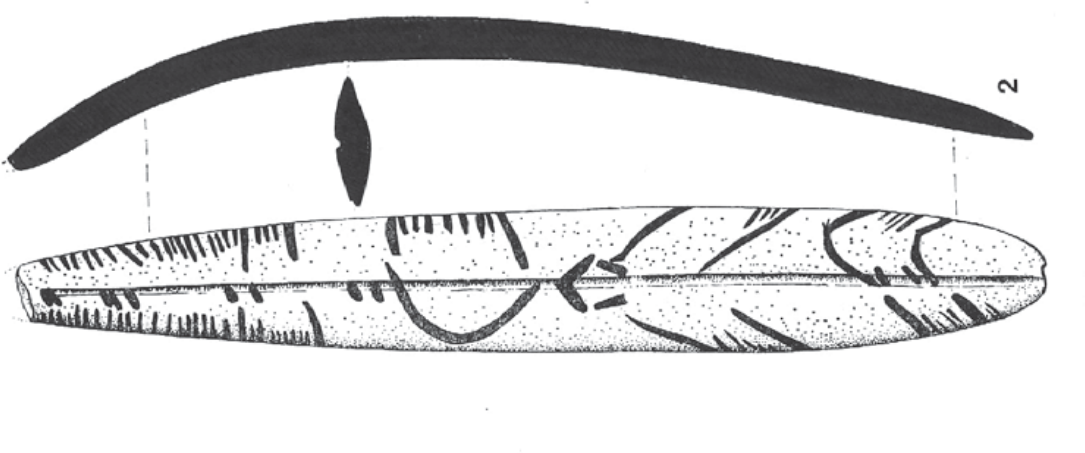
zumbadera
zumbadera: Spanish for a whirled sound-maker, used alongside bramadera and rombo in the Iberian Palaeolithic literature.
Breuil and Obermaier, looking at it in 1912, called it a kind of shuttle ornamented with geometric designs, and left it at that. It is a strip of red-deer antler out of an Upper Magdalenian level at El Valle, near Rasines in Cantabria: 156 millimetres long, 22 wide, 5 thick, practically whole, with a groove running the length of its back and non-figurative engraving across that face alone. Sixty years later Ignacio Barandiarán inventoried it, could not decide what it was, and filed it among doubtful spatulas. It was Soledad Corchón who proposed that it made sound, and a decade later she called it an engraved rhombus — the old Greek name for a bullroarer. The doubt against her is precise, and worth stating plainly: the one piece missing from the object is the small proximal fragment, which is exactly where a hole or a constriction for the cord would have been. Barandiarán, returning to it in 2012, still would not choose, and asked whether these Cantabrian antler strips simply lack the suspension a bullroarer cannot do without. Everything else fits. It is thin enough to spin and long enough to sound deep, and the single thing that would settle it is the part that did not survive.
excepcional objeto, probablemente una espátula o una zumbadera
an exceptional object, probably a spatula or a bullroarer
Corchón 1986:450, quoted in Barandiarán Maestu 2012, Veleia 29:326
Particulars
- Object
- Practically complete strip of red-deer antler, missing only a small proximal piece: 156 x 22 x 5 mm, with a longitudinal groove down the dorsal face and non-figurative engraving on that face alone. No suspension hole or constriction survives — the proximal end, where one would sit, is the part that is missing.
- Function
- Whirled on a cord to sound.
Source
Ignacio Barandiarán Maestu 2012, 'Forma vs. función en tipología prehistórica: el caso de las bramaderas óseas magdalenienses', Veleia 29:307-334, at p. 326, quoting Corchón 1986:450 and 1996:321