No. SMILCICI2026-001Europe
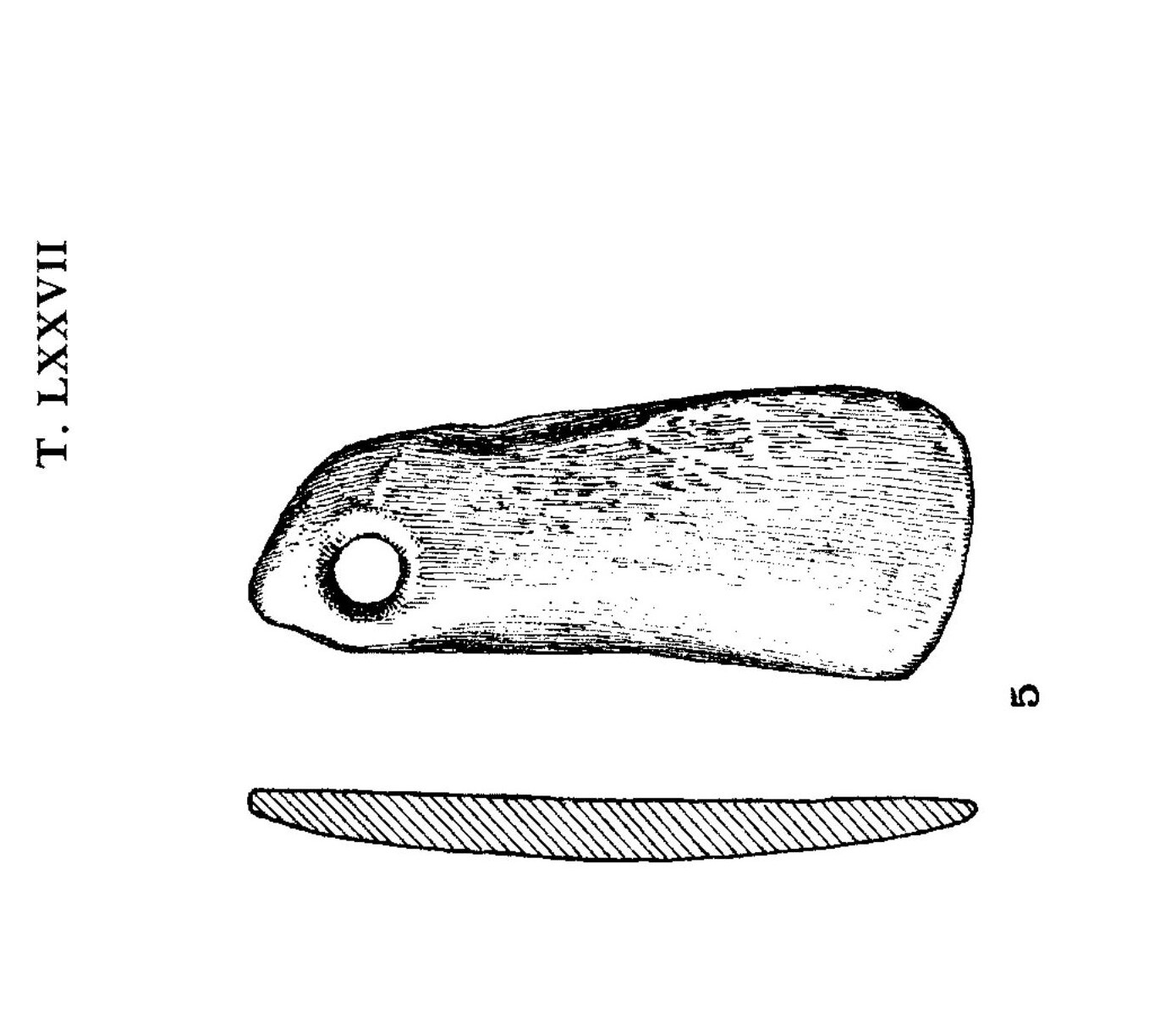
Smilčići bone plate
Croatia · Smilčići · northern Dalmatia · Europe
Function not recorded Candidate only
Source term: bull roarer / pendant / pottery smoother
No local term is recorded
A small bone blade from Smilčići, thin and tongue-shaped, carries a single biconical hole at one end. Batović, who published it, thought it an ornament or a tool for smoothing pottery; Galin later sent it into the literature as a bullroarer. The plate that finally settles its shape shows a form a cord could indeed swing - barely a palm long, from the Early Neolithic impresso world of the eastern Adriatic, and still untested for wear or sound.
the oldest archeological finding of an artifact that we interpret as a bull roarer is made of bone, from Smilčići
Galin 1988:135-136
Particulars
- Object
- Small bone plate with a thin lenticular section and one biconical perforation at one end; about 68 x 29 x 6 mm at the plate's 1:1 scale. Batović reads it as probably a pottery smoother; Galin reinterprets it as a bullroarer.
- Function
- Not recorded.
Source
Krešimir Galin, Archeological Findings of Musical Instruments in Yugoslavia (Narodna umjetnost, special issue 2, 1988), pp. 135-136, fig. 36; Šime Batović, in Praistorija jugoslavenskih zemalja II: Neolit (1979), p. 503, pl. LXXVII