ZOTZ1964-001 - archaeological find
Tischofer perforated bone needle
Austria - Tyrol - Kaisergebirge - Kaisertal above Kufstein - Central Europe
Function not recorded Candidate only
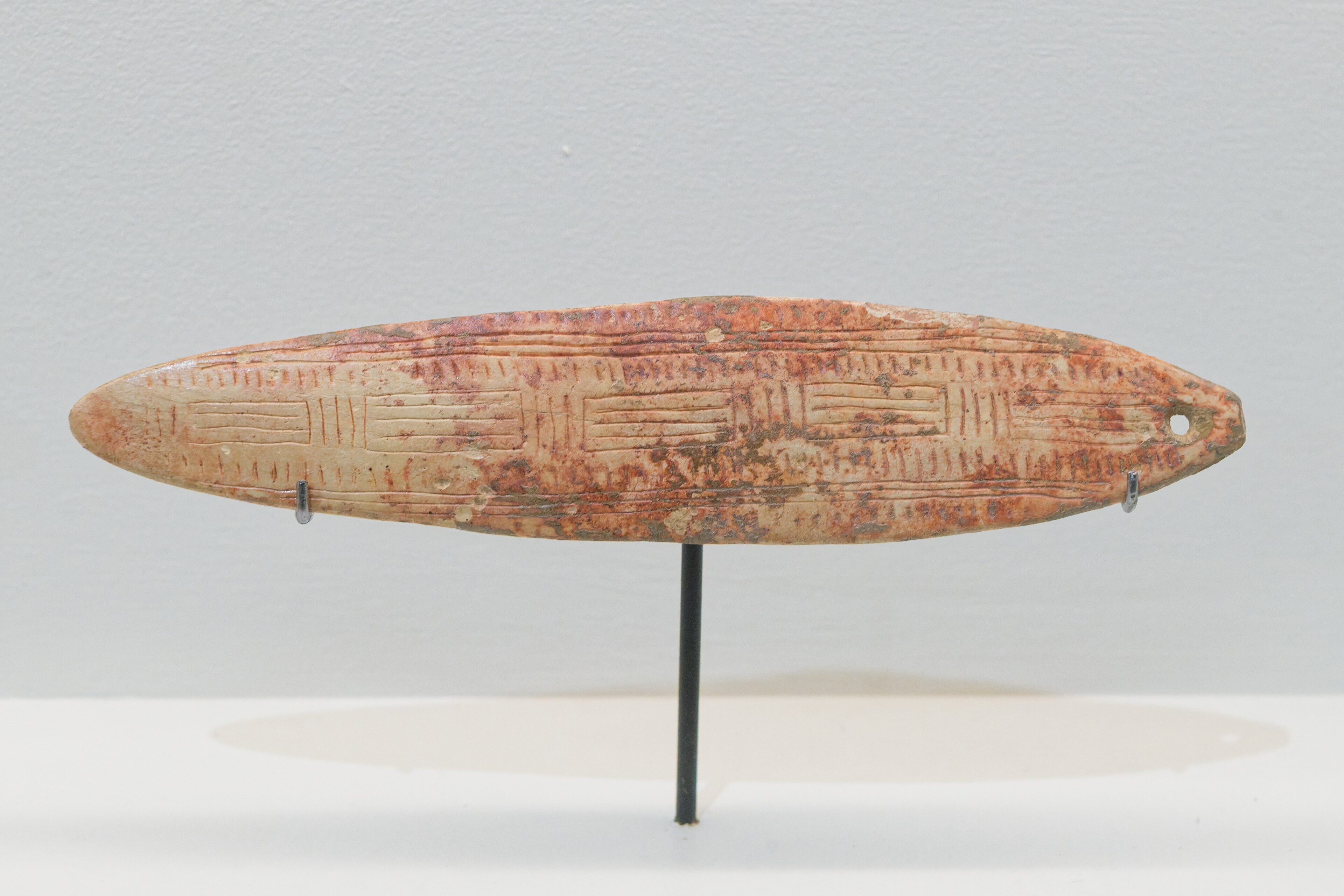
Source term: Schwirrgerät
Schwirrgerät: German 'whirring device', the archaeological cover term for a bullroarer or related whirled sound-maker.
In 1909 a cave above Kufstein in the Kaisertal gave up a handful of worked bone pins, drawn at natural size on a single plate: one with a ring head, one with a flat, spade-shaped head pierced by a small drilled hole, one broken. For most of a century they were filed as needles and awls, probably Bronze Age. Lothar Zotz, who examined them in the 1960s, thought the spade-headed pin might be far older. A recent survey of Stone Age music later named this cave, alongside Vogelherd, as the source of one of the earliest whirled sound-makers known: flat, long, tapered, drilled for a cord, and roughly forty thousand years old. It did not say which pin. The plate is all there is to look at, and the spade-headed one remains the strongest guess.
Die frühesten Funde dieser Art aus der Vogelherdhöhle auf der Schwäbischen Alb in Südwestdeutschland und der Tischoferhöhle im österreichischen Kaisergebirge datieren um 38.000 bis 32.000 v. Chr.
The earliest finds of this type, from Vogelherd Cave in the Swabian Jura of south-western Germany and Tischofer Cave in the Austrian Kaiser Mountains, date to around 38,000 to 32,000 BC.
Both and Praxmarer, "Musik in der Steinzeit" (2024/25), p. 137
- Object
- Perforated osseous object from the 1909 Tischoferhöhle excavation, identified only at the level of a candidate family. The 1909 Fig. 3A plate shows five bone pins or needles j-n at natural size, of which l (tapering shaft with a ring-shaped head) and m (long shaft with a rectangular, spade-like widened head carrying a small drilled hole) match the flat, elongated, terminally perforated description used in the modern bullroarer literature. Zotz's re-examination of the Kufstein collection makes m the stronger match. No thickness measurement is published for either piece, and the specific artefact behind the modern bullroarer claim has never been named in print.
- Function
- Not recorded.
- Source
- Bullroarer identification: Arnd Adje Both and Michael Praxmarer, "Musik in der Steinzeit" (2024/25), pp. 136-138, DOI 10.25366/2024.12; their footnote 65 cites Holdermann and Praxmarer's withdrawn dissertation Music(s) in the European Upper Palaeolithic, which Gill 2023 reports as the source of the Tischofer reidentification
- Source location
Page references
Zotz 1964/65, Quartär 15/16, p. 149 n. 18; Schlosser, Birkner and Obermaier 1909, p. 488 Fig. 3A, objects l-n; Both and Praxmarer 2024/25, pp. 136-138 and n. 65
- Source confidence
- low Published anchor for the Tischoferhöhle in the Kaisertal above Kufstein; a cave-mouth anchor, not a findspot or layer coordinate, and the object's own excavation position is not recoverable from the 1909 report.